














Integrating Anaerobic Digestion in Recirculating Aquaculture Systems

Recirculating Aquaculture Systems (RAS) have become popular due to their compact and manageable size. Compared to traditional net pens in open waters, RAS allow operators to rear fish at high densities in indoor tanks in a more biosecure manner.
One of the biggest benefits of RAS is lower water consumption, as it can recirculate and recycle 90-99% of the water, making it a sustainable aquaculture option. Though they offer several benefits compared to traditional aquaculture systems, they are not without their flaws.
According to Dr. Abhinav Choudhury, Environmental Research Engineer with The Conservation Fund (TCF) Freshwater Institute, one of the biggest challenges to RAS is waste management. While the collection and removal in itself is not necessarily difficult, the challenge lies in what RAS farmers do with that waste.
40,000-gallon Growout tank (left) and radial flow settler (right) for waste solids removal at the Freshwater Institute. (Credit: Sam Levitan / The Conservation Fund)
Waste Removal in Recirculating Aquaculture Systems
Culture tank design is an important consideration to prevent the build-up of solids. Once removed from the tanks, mechanical filtration systems, such as drum filters, can separate most of the solid waste particulates.
Regardless of how the waste is removed, the process results in a backwash rich in organic matter and nutrients. Massive volumes of this discharge can be generated on a daily basis.
“Many RAS producers consider this a concentrated stream, but from an engineer’s perspective, it is actually quite dilute, with a high moisture content,” shares Choudhury.
The next step to treatment is dewatering—or reducing the volume of waste that needs to be treated and/or disposed of.

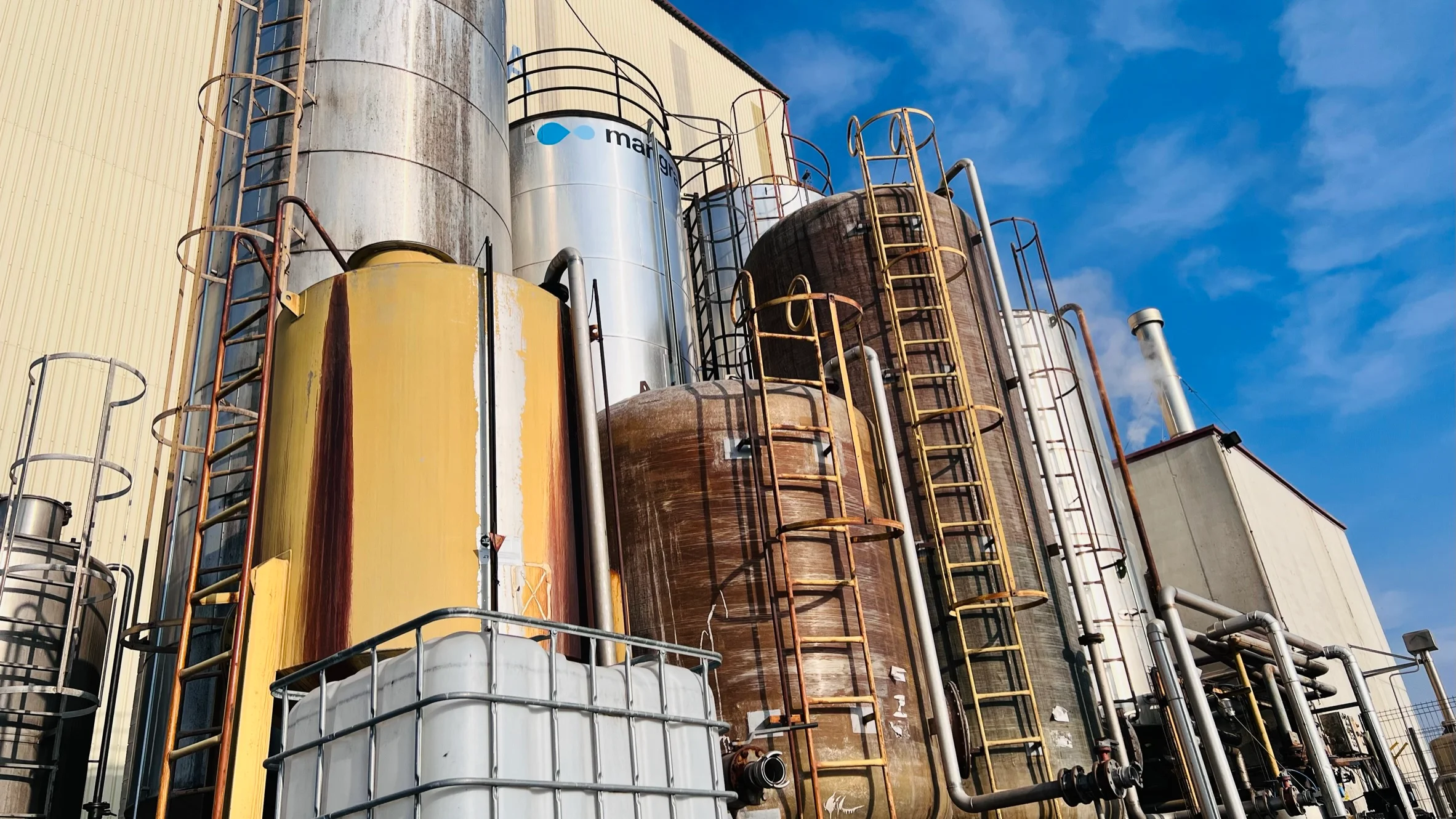
Anaerobic digester setup at the Freshwater Institute. (Credit: Abhinav Choudhury / The Conservation Fund)
The Freshwater Institute relies on gravity thickening settlers, which raise the dry matter content of the wastewater from roughly 0.1–0.5% up to about 10%.
“To put those numbers into perspective, a 1,000-metric-ton fish farm could produce 800 metric tons of backwash every single day. After dewatering, that drops to 8 metric tons of sludge at 10% solids. That still sounds like a lot, but it is 99% less than what the farm started with,” explains Abhinav.
Even with the reduced volume, the waste still needs to be dealt with daily. After dewatering, farmers are ultimately left with a highly concentrated waste stream that needs to be treated or disposed of, as it can lead to the eutrophication of local water bodies if it’s discharged untreated.
“This is exactly where my work comes in: investigating technologies that allow RAS farmers to generate revenue from this waste, instead of paying someone else to dispose of it,” Choudhury introduces.
He’s explored composting of aquaculture waste to produce a sellable fertilizer and is currently investigating energy generation through anaerobic digestion.

Abhinav Choudhury collecting data on the composting of aquaculture sludge. (Credit: Kata Sharrer / The Conservation Fund)
Anaerobic Digestion: Creating Energy out of Waste
Choudhury has been trialing a pilot-scale anaerobic digestion system at the institute since 2025. The digester tank, constructed from fiberglass, is partially underground and sealed with a geomembrane liner to maintain anaerobic conditions.
The system is designed to keep the digester’s waste level constant, releasing the digested effluent whenever raw waste is added.
“We expect to maintain a hydraulic retention time of 20-25 days during regular operation. The digester temperature is maintained using a shell-and-tube heat exchanger.
The recirculation system pumps wastewater through the heat exchanger at regular intervals to keep the solids mixed and the temperature within the optimal range of 35-38 ℃, to keep the microorganisms happy,” explains Choudhury.
Inside the digester, microorganisms break down organic matter in the absence of oxygen, producing a mixture of gases (biogas)—including methane, carbon dioxide, traces of hydrogen sulfide, ammonia, and water vapor.
The biogas is continuously measured and stored in inflatable bladders, which can be used as needed for energy production. “The methane content in the biogas can vary between 50–75%, making this product highly energy-dense,” adds Choudhury.

Inflatable bladders containing biogas generated from the anaerobic digestion of aquaculture waste. (Credit: Abhinav Choudhury / The Conservation Fund)
Additional Benefits and Possible Drawbacks
In addition to energy generation, the anaerobic process also creates a stabilized digestate byproduct rich in dissolved nutrients that can be used as fertilizer on land. There is also a substantial reduction in the pathogen load in raw wastewater after digestion.
Another benefit is the reduction of offensive odors. The closed anaerobic system prevents the release of toxic gases and odors.
While seemingly a minor issue, offensive odors and toxic gases generated in open waste treatment systems can prevent the acceptance and implementation of aquaculture at a broader scale.
There is also the possibility of the anaerobic digester being used for other waste removal and processing, including food/organic waste from other sources. “This prevents the food waste from going to a landfill and increases the digester’s energy production potential,” notes Choudhury.

Abhinav Choudhury analyzing aquaculture sludge characteristics data. (Credit: Kata Sharrer / The Conservation Fund)
Even with these benefits, Choudhury notes that there are potential drawbacks as well. One of which is that, even though there is a substantial reduction in solids, the actual volume of the digested effluent and its nutrient content remain roughly the same.
Another possible drawback stems from having nowhere to dispose of the digestate. While land application is the most common management form, without access to land, disposal may be challenging and may require more expensive treatment methods to reduce its nutrient load and eutrophication potential.
Third, the microorganisms in the tank are most effective at 35 ℃, making it a less accessible and efficient option for colder climates, as “a substantial fraction of the generated energy may need to be returned to the digester to maintain optimal process performance,” explains Choudhury.
According to Choudhury, the biggest challenge, however, tends to be the capital cost of highly engineered large-scale anaerobic digestion systems, which limits their economic feasibility for smaller farms.
“However, addressing these issues is part of ongoing research in this area,” he adds.

Boiler setup for supplying heat to maintain the digester temperature at optimal levels. (Credit: Abhinav Choudhury / The Conservation Fund)
Initial Testing of the Anaerobic Digester
As of April 2026, the digester was equipped with a control panel that automates the process. Since then, the team has been testing the system’s capabilities and troubleshooting operational challenges.
“Our goal is to optimize all the components of the anaerobic digestion system by 2027, so that we can start running our planned experiments at that time,” explains Choudhury.
He continues, “Our goal for this research cycle is to optimize digester operating conditions for aquaculture waste, identify and address inhibitory conditions (if they arise), and investigate changes in the microbial community over long-term operation.”
Sourced from a digester that processes protein- and fat-containing food waste and dairy manure as feedstocks, the inoculum (microbial source) appears to be handling the aquaculture waste well.
“As aquaculture waste, specifically salmonid waste, contains high levels of fat and protein, it was likely that the microorganisms could easily adapt to this new feedstock, and they did,” explains Choudhury.
The suited inoculum enabled the digester to achieve the highest methane concentration obtainable (75%) in the biogas from aquaculture waste.
High methane concentrations indicate the presence of fats in the feedstock and suggest that the inoculum is acclimated to these conditions; however, high fat concentrations can also lead to inhibitory conditions, according to Choudhury.
He continues, “It will be interesting to see how more concentrated aquaculture waste affects process efficiency and biogas production.”

Semi-commercial scale recirculating aquaculture system (RAS) at the Freshwater Institute. (Credit: Kata Sharrer and Scott Tsukuda / The Conservation Fund)
Scaling up Operations
Dr. Choudhury has been working on this project for 6 years, progressing from lab scale to pilot scale. Seeing the system work at a large scale at the institute has been particularly rewarding, he shares.
“Coming from a lab-scale research background, the project was quite overwhelming at the beginning, as it has so many moving parts and safety considerations. But thanks to my supervisors, colleagues, and support staff, we were able to get the system up and running, while also doing our best to ensure operator safety,” explains Choudhury.
He continues, “There are always new challenges that come up, but having a supportive team at the Freshwater Institute who are as invested as I am in making sure this project succeeds has been the real highlight.”
The post Integrating Anaerobic Digestion in Recirculating Aquaculture Systems appeared first on FishSens Magazine.
Apa Reaksi Anda?
 Suka
0
Suka
0
 Kurang Suka
0
Kurang Suka
0
 Setuju
0
Setuju
0
 Tidak Setuju
0
Tidak Setuju
0
 Bagus
0
Bagus
0
 Berguna
0
Berguna
0
 Hebat
0
Hebat
0