

































The Mealtime Secrets Your Cat Wants You to Know

Chances are, you’ve spent time researching which cat food—whether commercial dry or wet, a boutique brand or a fresh or raw diet—is best for your cat. But substantially less time is devoted to how we feed our cats. How we feed our cats can have a significant impact on their natural feeding behaviour and overall well-being. By considering cats’ natural feeding behaviours and drawing from current feline research, we can use food to support our cats’ behavioural well-being, not just physical health. Here’s what your cat wishes you’d do come dinnertime!
How to Feed Your Cat: Supporting Natural Feeding Behaviours
 How Much to Feed a Cat?
It can be challenging to figure out the right amount of food to feed your cat. The first person to ask is your veterinarian. They can give you guidance on how many calories your cat should be fed per day. A rough estimate is that a healthy, spayed or neutered adult cat will need approximately 20 to 30 calories per pound of weight each day. An indoor, less active cat needs fewer calories than an active cat or a growing kitten. Be sure to check packaging carefully to calculate how much food to feed your cat each day. Often, it’s more or less than you think! We are cautioned about the perils of extra pounds, but many people are actually underfeeding their cats.
How Many Times a Day Should You Feed a Cat?
Cats are solitary hunters who primarily capture and kill small prey animals, such as mice and birds. As a result, they are used to hunting and eating small meals throughout the day. When allowed to control their feeding frequency, cats eat approximately 8 to 16 meals a day!
Studies have also shown that most cats prefer to eat food when it is fresh. We can help our cats follow a more natural feeding pattern by splitting their daily caloric allotment into several small meals throughout the day.
*There’s no one right answer for every cat, but I suggest a minimum of five meals a day.

Denis Val/Shutterstock
How to Fit in Five Meals a Day
The Five-a-Day Felix Feeding plan was developed by the International Society of Feline Medicine to help cat caregivers support healthy feeding behaviours. It may seem like a lot, but it doesn’t have to increase your workload significantly. Here’s a suggested feeding schedule that accommodates your cat’s natural feeding behaviours.
- Feed your cat in the morning, shortly after you wake up
- Leave your cat with a puzzle feeder while you are away at work
- Feed your cat when you return home from work
- Feed your cat just before you go to bed
- Leave your cat with a puzzle feeder to work from overnight
Automatic feeders can also help you fill in gaps overnight or while you are at work.
What About Free-Feeding?
Free-feeding may work for some cats, but this lifestyle tends to be associated with overweight cats. The other reasons I don’t generally recommend free-feeding are:
- Cats prefer food when it is fresh. The longer food sits out, the less appealing it is to your cat.
- Free-feeding makes it harder to track how much and when your cat is eating. You may not notice as quickly that your cat is eating less, or not at all, which can be a key sign of a health problem.
- Caregivers who free-feed are less likely to keep the feeding area clean or wash feeding bowls daily.
*If you free-feed: wash and refresh bowls daily. Weigh your cat at least monthly to ensure they are maintaining and not gaining or losing weight.
The Feeding Dish
Vera Verano/Bigstock
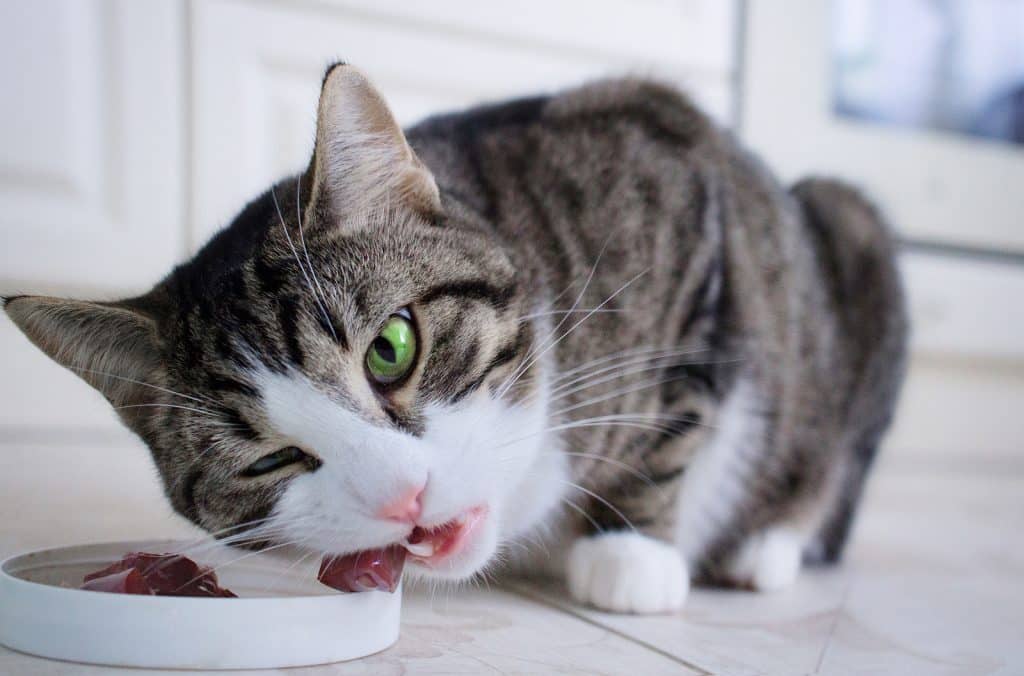
Take a careful look at your cat’s feeding set-up. Cats are clean animals who don’t leave a lot of food to return to later. Similarly, cats appreciate a clean feeding area and fresh food. Do you wash your cat’s plates or bowls daily? If not, the bowl may be full of saliva and crumbs! The National Science Foundation has identified pet bowls as one of the most bacteria-laden kitchen surfaces. Don’t let your cat’s bowls be one of them!
*Wash your cat’s food dishes after every meal or at least once daily. An easy solution: use dishwasher-friendly dishes and have multiples so you always have a clean option readily available.
Does your cat need a whisker friendly dish? There’s only one study to date on this issue, and it was inconclusive. Some cats preferred a flatter feeding surface, while other cats did not seem to mind a higher sided bowl. You can give your cat choices and let them tell you if they have strong feelings!
Multiple Cats Means Multiple Feeding Areas
As previously mentioned, cats are solitary hunters—and that means they are also solitary eaters. They do not naturally share food or eat close to other cats—not even ones they are friendly with! Feeding your cats separately can reduce conflict and stress and allows each cat to eat in peace. Eating while stressed has been associated with increased storage of adipose tissue (fat), another reason for each cat to have a separate, safe place to eat.
*Food dishes in a multi-cat household should be spaced several feet apart, or even better yet, in separate rooms.
High-Tech to the Rescue
Multiple cats can also mean juggling different diets or feeding styles. Some cats are chronic food-stealers, which can lead to conflict between cats and challenges to feline weight loss programs. Other cats would prefer to graze but are forced to wolf down food before their housemates eat it all. Thankfully, there are several products on the market that can help you manage your multi-cat household’s feeding needs. Microchip feeders, such as the SureFeed, the PortionPro Rx, Pet Libro One RFID, and the Wireless Whiskers can all control which cats have access to what food. Each feeder has different features. The SureFeed controls which cat can access a bowl, but does not deposit food, making it a great option for wet or dry food. The PortionPro Rx, Pet Libro, and Wireless Whiskers are designed to be used with dry food, and they can deliver portions in addition to controlling which cats have access.
Food Puzzles: Giving Cats Their Jobs Back
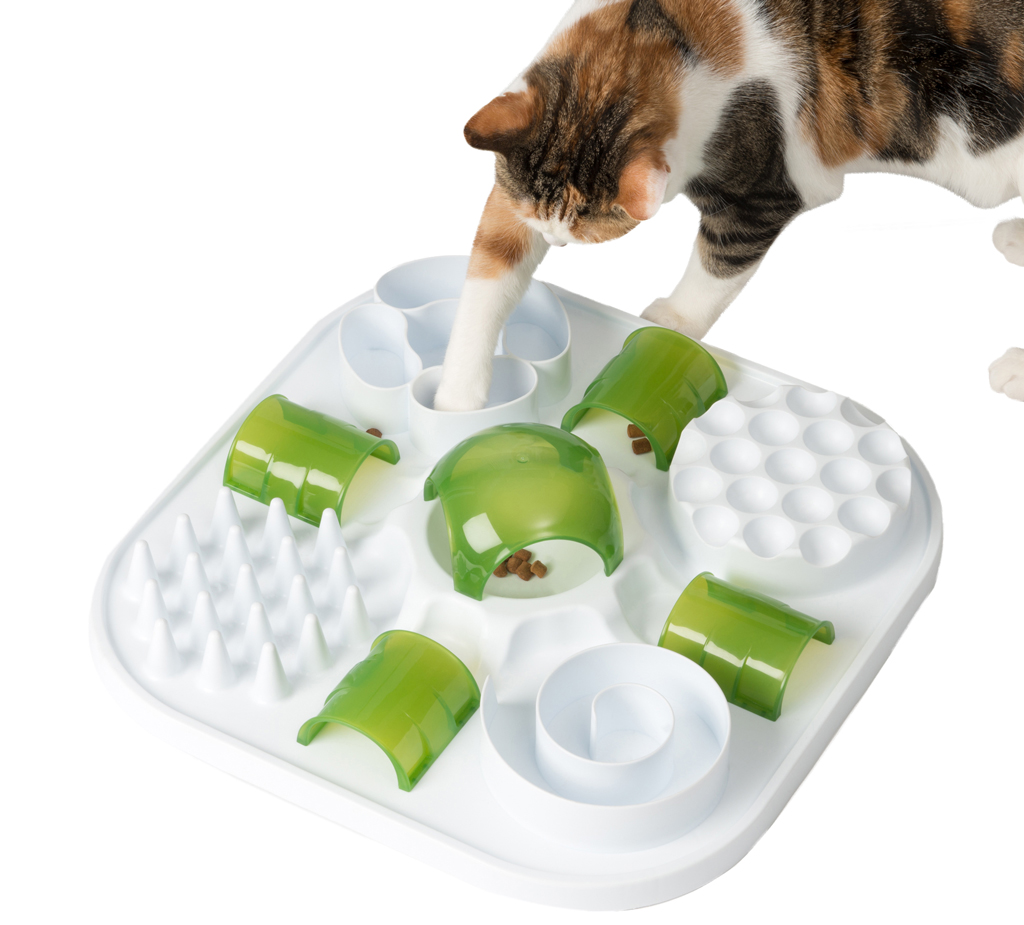
Catit Senses Treat Puzzle
Because cats naturally work for food, we can restore that work ethic by providing some of their food in puzzle feeders. Puzzle feeders are objects that your cat can interact with to extract food. These can be small toys that your cat bats around with a paw. Holes in the puzzle allow food to fall through, which your cat can then retrieve. These puzzles usually work best with a dry diet.
Other puzzles are a stationary board or tray with compartments that your cat can interact with to get food. They are often compatible with dry or moist diets. Although food puzzles aren’t exactly equivalent to hunting, they can provide your cat with problem solving opportunities and mental stimulation.
Tips for Introducing Food Puzzles
- Offer food puzzles as a choice initially; continue to offer food to your cat in their regular dish.
- Using treats (as opposed to kibble) in the puzzle may make your cat more excited to try food puzzles!
- Food puzzles can be used for meal feeding for healthy, enthusiastic eaters.
How we feed our cats may be just as important as what we feed them—and with a few simple adjustments, we can help our cats eat in ways that are more natural to them and that support their physical and behavioural health!
This article originally appeared in the award-winning Modern Cat magazine.
Subscribe today!
The post The Mealtime Secrets Your Cat Wants You to Know appeared first on Modern Cat.
Apa Reaksi Anda?
 Suka
0
Suka
0
 Kurang Suka
0
Kurang Suka
0
 Setuju
0
Setuju
0
 Tidak Setuju
0
Tidak Setuju
0
 Bagus
0
Bagus
0
 Berguna
0
Berguna
0
 Hebat
0
Hebat
0