





















































Diagnosing Why Enhancements Lift in Prep, Product and Technique


There is no complaint that ruins a working week faster than a returning client whose enhancements are peeling away at the cuticle. Lifting is one of the industry's most stubborn problems, and one of its most misunderstood. It is rarely caused by a single failure. Far more often, it is the cumulative effect of small oversights that compound across prep, application, and aftercare.
To solve a lifting problem, treat it like a crime scene. The location of the lift, the timing of its appearance, and the pattern across your clients all hold clues. Once you know what to look for, you can almost always trace lifting back to a specific point of failure, and fix it.
The crime scene: where the lift is tells you why
Before changing anything in your routine, look closely at where lifting is happening on the nail. The location is often the most useful diagnostic clue you have.
Lifting at the cuticle area almost always points to a problem with prep or application near the proximal nail fold. Either dead skin and oil were not fully removed before product was laid down, or product was flooded too close to the eponychium, or onto it.
Lifting from the sidewalls typically indicates a problem with product placement or, in liquid and powder work, an incorrect mix ratio. Product that has been laid too dry leaves micro-gaps along the lateral nail folds. Product that has run into the sidewall skin will release the moment client oils return.
Lifting from the free edge suggests insufficient capping, an over-filed natural nail edge, or a client whose nails curl inward as they grow. It can also signal that prior lifting was not properly removed at the previous infill.
Pocket lifting, where a bubble forms in the centre of the enhancement with sealed edges, is a different beast. With L&P, it most often traces back to an incorrect mix ratio or insufficient infill procedures. With gel systems, it is frequently linked to improper or incomplete cure, especially when a knock or impact has caused under-cured product to delaminate from the nail plate.
Once you have identified where the lift is occurring, the four-suspect framework below will help you pinpoint why.
Suspect one: the prep
Prep is the single biggest contributor to enhancement breakdown. Some experienced technicians and educators put the figure at well over 80 per cent of cases.
The natural nail plate is not a passive surface. It produces oil from below. It holds an invisible layer of moisture on its top surface. It sits at a slightly acidic pH that does not naturally invite adhesion to the alkaline systems we apply over it. Good prep does three jobs in sequence. It cleanses. It dehydrates. It balances.
Cleansing removes contaminants such as filing dust, hand cream residue, environmental oils, and dead cuticle tissue stuck to the plate. That last point matters more than many techs realise. The translucent layer of pterygium that grows out from the eponychium and onto the nail plate is largely invisible to the naked eye, but it is absolutely there, and gel cured over it will lift within days. A cuticle bit on a low-speed e-file, used with a feather-light touch, is the most reliable way to remove it. No amount of scrubbing will save a bond that has been laid over dead skin.
Dehydration deals with the moisture layer that re-forms on the plate within seconds of washing. A nail dehydrator, applied to a properly cleansed plate, evaporates this surface moisture and gives a window of roughly thirty minutes during which the plate is dry enough to bond. After that, the nail rehydrates from below, which is why prep should be the last thing you do before product application, not the first.
pH balancing is where bonders earn their keep. The natural nail plate is acidic. Most enhancement systems are alkaline. A pH bonder temporarily shifts the plate's surface chemistry to make it more receptive to what comes next. This is also where hormones can change a client's behaviour overnight. pH levels in the nail can shift across menstrual cycles, pregnancy, or hormone therapy, which is why a previously reliable client can suddenly start lifting for no obvious reason.
Skip any of these three steps and you are asking your primer or base coat to compensate for a contaminated surface. It cannot.
Suspect two: the product
Once prep is correct, your products themselves can still let you down, usually in ways that are entirely preventable.
Primer chemistry matters, and more is not better. Acid-based primers chemically etch the plate to create mechanical grip. Non-acid and acid-free primers work more like double-sided tape, creating a tacky dispersion layer that bonds the natural nail to the enhancement. Both work well when used correctly. Both fail when over-applied. Flooding primer onto the plate does not increase adhesion. In many systems, it actively reduces it. A thin, controlled application that stops short of the cuticle and sidewalls is what manufacturers test for.
System compatibility cannot be ignored. Mixing a base coat from one brand with a builder gel from another is one of the most common, and least diagnosed, causes of lifting in modern salons. Manufacturers formulate their products to bond to each other, not to a competitor's chemistry. If a client's enhancements are lifting and you have recently swapped one product in your routine for a cheaper or trendier alternative, that is where to start your investigation.
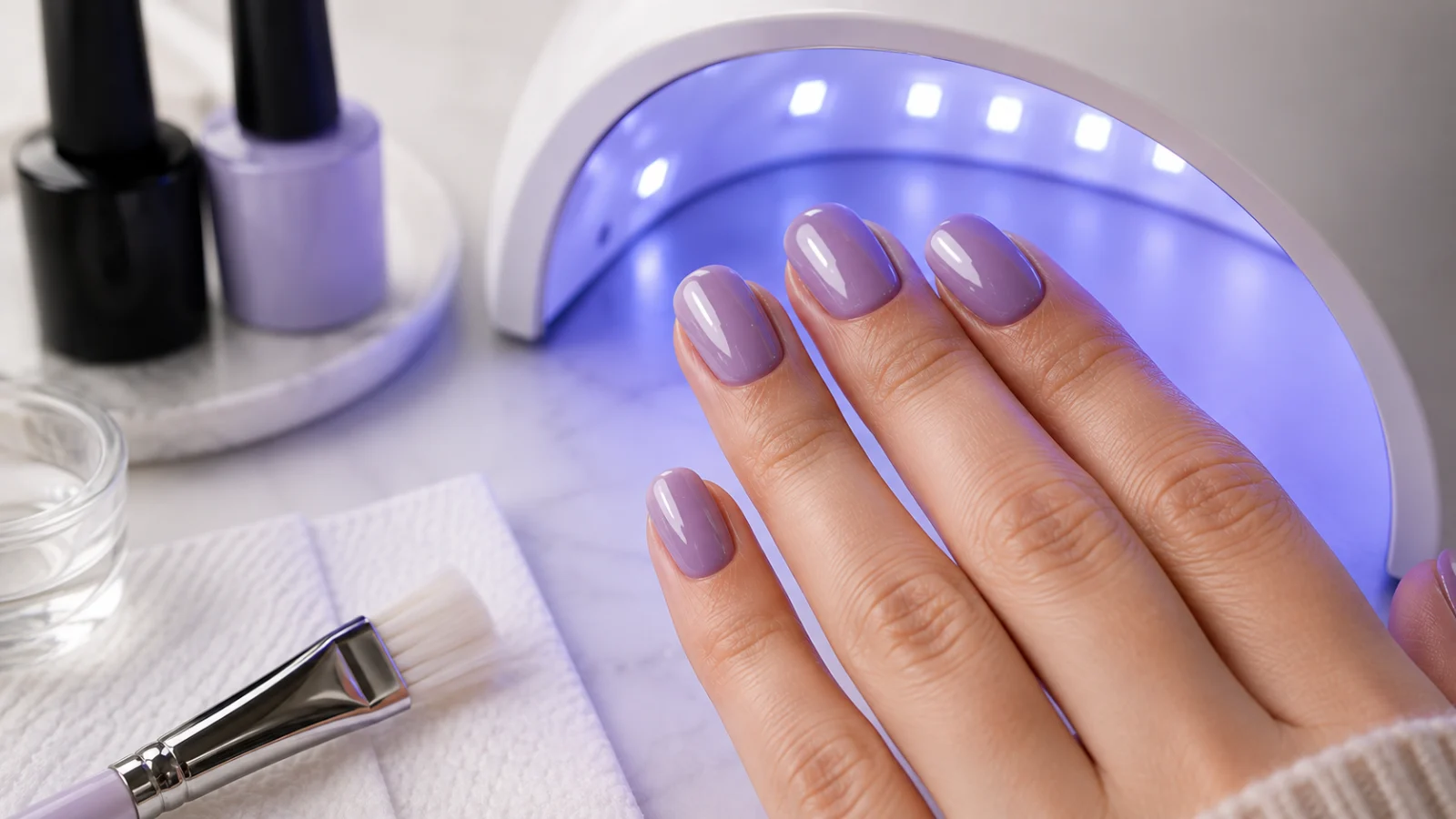
Lamps are the silent saboteurs. An under-cured gel looks and feels cured because it can be filed and topped with colour, but the polymerisation is not complete. The chemist Doug Schoon, who has done more than most to make sense of nail product science, has shown that under-cured product continues to cure only marginally after the client leaves the salon. The result is an enhancement that is structurally weaker than intended, more prone to lifting, and more likely to provoke an allergic response in both client and technician over time.
Wattage is not the metric to fixate on. What matters is wavelength (most modern gels need light in the 365 to 405 nm range), irradiance (the actual UV power reaching the nail in milliwatts per square centimetre), and compatibility between your specific lamp and the gel system you are using. If you have changed gel brands without checking lamp compatibility, lifting is one of the first symptoms you will see. So is a sudden uptick in clients reporting itchy, red skin around the nail. Bulbs in older fluorescent-style lamps degrade long before they stop lighting up. LED units lose intensity with age too. If your lamp is more than a couple of years old and seeing daily use, it has earned a spec check.
Suspect three: the technique
Even with faultless prep and a perfectly compatible product system, technique can undo everything.
Cuticle flooding is the cardinal sin. Any product cured over skin, even a sliver, even invisibly, is a guaranteed lifting point. Skin oils return. The bond fails. The entire seal at the proximal nail fold is compromised. Leave a 1 to 2 mm gap between cuticle and product to give yourself room to lay clean lines without tracking onto skin.
Apex placement and product structure matter for enhancement work. An enhancement that is too thick at the cuticle, or has a "doorstep" where product meets the nail plate, is creating its own stress point. Filing it down afterwards weakens the bond further by pushing pressure straight into the seal. An enhancement that is too thin where the natural nail meets the free edge is asking to be flexed off. The apex should sit over the natural nail's stress point, with thickness tapering at both ends.
Capping the free edge is what stops water and lifestyle from getting underneath. Whether you are working with L&P, hard gel, builder in a bottle, or gel polish, the free edge needs to be sealed with the same product that covers the top of the nail. Skipping this step in the interest of speed is one of the most common causes of lifting in fast-paced salons.
Layer thickness in gel systems affects cure quality directly. UV light only penetrates so far through pigmented gel. Layers that are too thick will be cured at the surface and under-cured at the base, which is exactly where the bond to the nail plate needs to be strongest. Thin coats, fully cured, are stronger than thick coats partially cured. Every time.
Suspect four: the client
Sometimes the technician has done everything right, and the lifting is genuinely not their fault.
Lifestyle is the most common culprit. Clients whose hands live in water, including nurses, hairdressers, parents of small children, and hospitality workers, are working against you between every appointment. Frequent exposure to acetone in cleaning products, jewellery cleaners, and even some window or screen sprays will degrade the bond. Hot baths, saunas, and prolonged soaking soften the enhancement edge. Hand sanitisers and lotions containing lanolin can interfere with adhesion long after they have been applied.
Biology shifts. Hormonal changes around pregnancy, perimenopause, or thyroid medication can alter oil production, plate hydration, and even nail growth rate. A client who has been a perfect retention story for years can become a problem overnight, and through no fault of yours or theirs.
Medications are commonly blamed, but the science is murkier than salon folklore suggests. Short courses of medication rarely affect adhesion directly. Long-term medications such as retinoids, certain antidepressants, hormone therapy, and chemotherapy drugs can change the structure or growth of the plate enough to cause retention issues, but the mechanism is usually indirect. The drug dries the skin, oils up the plate, slows growth, or thins the keratin.
Habits matter more than people admit. Picking, peeling, biting, using nails as tools, tapping out anxiety on a desk: these behaviours destroy enhancements faster than any chemistry problem. A frank, kind conversation about home care is part of the job.
Working the case
When a lifting problem appears, resist the urge to change everything at once. The technicians who solve retention problems consistently are the ones who isolate variables.
Start with the location of the lift. Examine your last three steps before the product cured. Ask whether this is one client or many. If it is many, the problem is on your side of the desk. If it is one, investigate together. Replace one variable at a time and write down what changed. Keep client cards detailed enough that you can spot patterns. A previously reliable client who has started lifting consistently is telling you something has shifted, even if neither of you has noticed yet.
Lifting is not a mystery. It is a chain of cause and effect, and almost every link in that chain is something you can control. The technicians whose clients walk out with three, four, or five weeks of retention are not using better products than yours. They are simply working a tighter case.
Sign up with your email address to receive news and updates.
Subscribe
We respect your privacy. Thank you!
What's Your Reaction?
 Like
0
Like
0
 Dislike
0
Dislike
0
 Agree
0
Agree
0
 Disagree
0
Disagree
0
 Excellent
0
Excellent
0
 Useful
0
Useful
0
 Great
0
Great
0