














































%20and%20Batch%20Production%20Records%20(BPR).png)
















AI Reimagines Caffeine as a Molecular Off‑Switch for Engineered Cells

A cup of coffee can mean many things: a daily part of our routine, a moment of calm, a midday boost. But zoom in past the steam, past the roasted aromatics, down to the caffeine molecule itself, and a different story emerges. At the Texas A&M Health Institute of Biosciences and Technology, researchers have turned this everyday stimulant into something far more unexpected: a molecular “pause button” for engineered cells.
In a study published in the Journal of the American Chemical Society (JACS), the team unveiled CODS, a caffeine‑operated dissociation system built using AI‑guided de novo protein design. The paper, “AI‑Guided De Novo Design of a Caffeine‑Induced Protein Dissociation System,” describes how the group reprogrammed “an existing caffeine-responsive chemically induced proximity (CIP) module into a ligand-dependent dissociation system.”
“AI is changing how we design biology,” said senior author Yubin Zhou, MD, PhD. “Instead of relying only on protein parts that already exist in nature, we can now design new mini proteins with specific behaviors. Here, we used AI to help turn caffeine into a precise trigger for controlling engineered cells.”
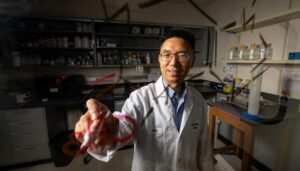
The team demonstrated CODS across several biological contexts. In engineered gene circuits, caffeine addition sharply reduced transcriptional activity. In a rewired pyroptosis pathway, caffeine triggered inflammatory cell death by freeing the active domain of gasdermin D. And in perhaps the most translational example, CODS served as a conditional deactivator for CAR T cells, temporarily dampening their activity without destroying the therapeutic cells.
“Powerful therapies need powerful control,” Zhou said. “By combining AI‑designed proteins, high‑performance computing, and familiar small molecules, we are building a new language for communicating with engineered cells.”
The design process itself leaned heavily on computation. Graduate student Brendan McKee led the AI‑guided binder design and molecular modeling, while Tatsuki Nonomura spearheaded the molecular engineering and live‑cell validation. The Texas A&M High Performance Research Computing service provided the infrastructure needed to run large‑scale simulations. “High‑performance computing was essential for this project,” Zhou noted. “It helped us move from a conceptual idea to a functional molecular switch much faster.”
Although caffeine is not a therapeutic molecule, its safety and familiarity make it an appealing control signal. As Zhou emphasized, “Coffee will not replace medicine. But caffeine can help us imagine medicines that are more controllable, more responsive, and safer for patients.” The researchers’ next steps include further testing in therapeutic cells, animal models, and disease-relevant settings before moving toward clinical use.
CODS now joins a growing toolkit of AI‑designed molecular switches, offering a blueprint for future systems responsive to other safe, accessible molecules. As programmable cell therapies advance, the ability to modulate them with something as simple as caffeine may prove unexpectedly powerful.
The authors report that a patent application covering the CODS platform has been filed by Texas A&M University, with Y.Z., T.N., B.M., and T.W. listed as inventors (U.S. Provisional Patent Application No. 64/022,078).
The post AI Reimagines Caffeine as a Molecular Off‑Switch for Engineered Cells appeared first on GEN - Genetic Engineering and Biotechnology News.
Apa Reaksi Anda?
 Suka
0
Suka
0
 Kurang Suka
0
Kurang Suka
0
 Setuju
0
Setuju
0
 Tidak Setuju
0
Tidak Setuju
0
 Bagus
0
Bagus
0
 Berguna
0
Berguna
0
 Hebat
0
Hebat
0