





















































%20and%20Batch%20Production%20Records%20(BPR).png)














Biological Order Emerges from Tissue Boundaries, Drives Embryo Development
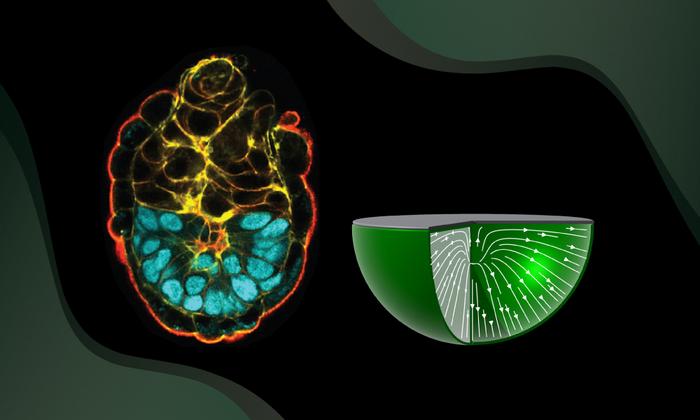
In a new study in Nature Materials titled, “Boundary geometry controls a topological defect transition that determines lumen nucleation in embryonic development,” researchers from European Molecular Biology Laboratory (EMBL) describe how interactions between tissue geometry impact development.
In an early-stage mouse embryo, cells of the epiblast are polarized and give rise to all major tissues. The team investigated the fundamental principles governing the behavior of polarized cells that are present in bulk and the impact of physical constraints at tissue borders. By focusing on how cellular orientations influence each other and their environment, the researchers built a minimal model that predicts how organization changes when interactions are altered.
“For me, as a physicist, I may know why something works, but it’s still kind of magic to see that it’s all true in messy biological systems,” said Pamela Guruciaga, PhD, postdoctoral researcher at EMBL and co-first author of the study. “It was also super interesting coming from a pure physics perspective to come up with a common language to work with biologists.”
In the cup-shaped epiblast, results showed different boundaries led to varying orientations for epiblast cells. When the boundary was lined with the extracellular matrix, the cells oriented perpendicularly. In contrast, when the epiblast was in direct contact with a neighboring tissue without a matrix, the cells aligned parallel to the boundary. The researchers found that the combination of these two orientations result in the appearance of structures, known as “topological defects.”
“These are points in space where it is undefined in which direction an object should point,” explained Guruciaga. “For example, if a set of arrows is arranged in a starburst pattern, the center is a point where all directions are equivalent. These points are super relevant because they are very robust; you cannot easily destroy them.”
To directly test whether the boundary shape controls the number of defects, the authors altered the geometry of the epiblast. Perturbing embryo shape induced the formation of additional lumina at the predicted positions.
“What I find most exciting is that these results identify a very general physical principle,” said Anna Erzberger, PhD, group leader at EMBL and co-corresponding author of the study. “We show that geometry alone can determine orientation patterns in three dimensions, independent of the microscopic details of the system. That means shape itself can act as a robust control parameter—not just in embryos, but across a wide range of biological and physical systems.”
The post Biological Order Emerges from Tissue Boundaries, Drives Embryo Development appeared first on GEN - Genetic Engineering and Biotechnology News.
Apa Reaksi Anda?
 Suka
0
Suka
0
 Kurang Suka
0
Kurang Suka
0
 Setuju
0
Setuju
0
 Tidak Setuju
0
Tidak Setuju
0
 Bagus
0
Bagus
0
 Berguna
0
Berguna
0
 Hebat
0
Hebat
0