






































































The Ultra-Processed Sports Food Dilemma

This week in the world of sports science, here’s what happened…
- The ultra-processed sports food dilemma
- Was Usain Bolt really a poor starter?
- Sprinters should never jog!
The ultra-processed sports food dilemma
Ultra-processed foods have received considerable negative attention in recent years, but a new review highlights an interesting dilemma for athletes: many commonly used sports nutrition products are technically classified as ultra-processed.
Sports drinks, carbohydrate gels, protein bars and recovery drinks can all fall into this category. However, unlike many ultra-processed foods, these products are often consumed for a specific purpose, such as providing carbohydrate during prolonged exercise, replacing fluids and electrolytes, or supporting post-training recovery.
For example, endurance athletes may require large amounts of carbohydrate during prolonged exercise. Meeting these demands entirely through minimally processed foods may be impractical, whereas sports drinks and gels provide a convenient source of carbohydrate that can be easily consumed during exercise.
Interestingly, the researchers note that relatively little research has examined ultra-processed food consumption specifically among athletes. Therefore, although athletes should still prioritise a high-quality, nutrient-dense diet, classifying a sports food as “ultra-processed” does not necessarily mean it is unhealthy or inappropriate.
This raises an interesting question: when it comes to sports nutrition, should we judge a food by how processed it is or by how effectively it supports an athlete’s training and performance?
Was Usain Bolt really a poor starter?

Leading sports scientist Lance Brooks offers an alternative perspective on sprint acceleration, using Usain Bolt as an example (see here). While many believe Bolt was a poor starter out of the blocks, Brooks strongly disagrees.
His argument is that acceleration should not be viewed in isolation. For example, positioning the starting blocks closer together may allow an athlete to accelerate out of the blocks more quickly. However, sprinting is not simply about maximising initial acceleration, but rather about building velocity effectively and maintaining it for as long as possible.
Brooks highlights the importance of the impulse–momentum relationship, explaining that athletes may benefit from staying in the blocks slightly longer to apply force, particularly through the front leg, and generate greater impulse.
Therefore, rather than judging Bolt’s start by how quickly he exited the blocks, Brooks suggests we should consider how effectively he used the block phase to begin building velocity, continuing to increase that velocity throughout the sprint before maintaining it for as long as possible.
Sprinters should never jog!
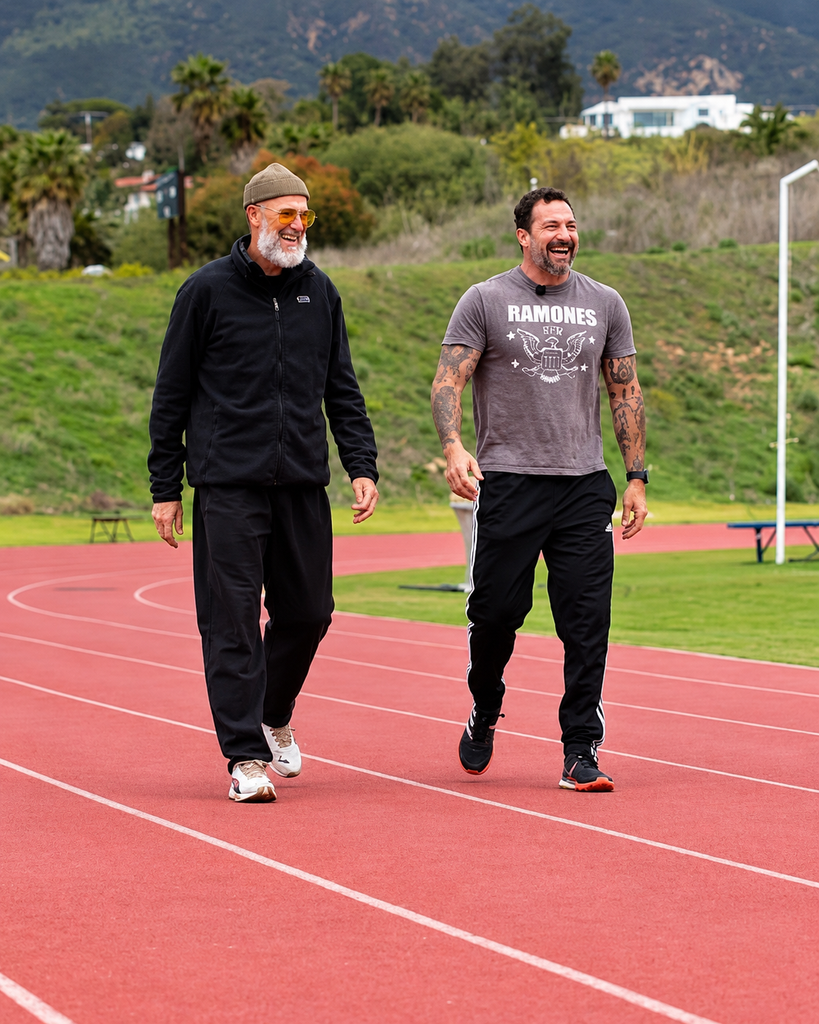
A recent clip circulating on social media from Dr. Andrew Huberman’s visit to renowned sprint coach and speed mechanics expert Stu McMillan has generated considerable engagement. The clip provides a fascinating insight into McMillan’s warm-up philosophy for sprinters.
While jogging is commonly utilised at the beginning of warm-ups, McMillan explains why he never gets his sprinters to jog. His reasoning is simple: sprinters are sprinters, not joggers. McMillan argues that jogging and sprinting involve very different gait patterns. Instead, he favours skips and strides, which encourage stiffness through the ankle, knee and hip, helping athletes develop the coordination and elastic qualities associated with sprinting. He also highlights how jogging tends to involve more pushing behind the centre of mass, whereas sprinting, particularly at maximal velocity, requires different limb positioning and coordination.
While this doesn’t necessarily mean jogging has no place in field sport warm-ups, it highlights McMillan’s belief in making the warm-up as specific as possible to the athlete and the activity that follows. If you work with speed athletes and regularly begin your warm-ups with jogging, this clip is certainly worth watching!
From us this week:
>> New course: Observation Before Intervention: Building Better Coaching Environments
>> New podcast: Preventing Non-Contact Injuries in Professional Football
>> New infographic: Performance Analysis
>> New article: ESSA and Science for Sport Announce Strategic Professional Development Partnership
Access to a growing library of sports science courses
SFS Academy is an all-access membership to premium sports science education.
With SFS Academy, you’ll learn from some of the best coaches around the world as they teach you how to apply the latest research and practice with your athletes.
The post The Ultra-Processed Sports Food Dilemma appeared first on Science for Sport.
Apa Reaksi Anda?
 Suka
0
 Kurang Suka
0
 Setuju
0
 Tidak Setuju
0
 Bagus
0
 Berguna
0
 Hebat
0