





































































Lost and Found: Neural Pathway for Forgetting Found in C. elegans

For as long as human inquiry has existed, people have tried to understand how and why we remember and forget. As we have begun to understand how the brain works, researchers have slowly uncovered the biological mechanisms underlying memory. Researchers from Kyushu University have now found the key molecular and neural pathways that cause the nematode worm Caenorhabditis elegans to actively forget a specific odor it previously remembered.
Through extensive studies of the C. elegans nervous system, the team discovered that a peptide called NLP-47 triggers this process of active forgetting. NLP-47 is received by a different neuron further along the circuit, which in turn sends a signal to the neuron storing the memory of the odor, leading to its erasure. Most strikingly, when C. elegans memorized two different odors simultaneously, this circuit erased the memory of only one odor while leaving the other intact.
“There are many diseases that involve memory loss,” said research lead Professor Takeshi Ishihara, PhD, at Kyushu University Faculty of Science. “But before we can understand what goes wrong, we need to understand how forgetting works in the brain, and I hope this research will lead to a better understanding of such brain functions.”
Ishihara is senior and corresponding author of the researchers’ published paper in Current Biology, titled “Neuropeptidergic-glutamatergic circuit regulates selective forgetting of olfactory learning.” In their paper the authors concluded that their findings may “… offer insights into disorders associated with dysregulated forgetting, including dementia and PTSD.”
Forgetting specific memories is “… as essential as forming them,” the authors wrote. “… animals must selectively discard irrelevant experiences while preserving others to adapt to constantly changing environments.” But as they further noted, “Despite proposals of selective forgetting in psychological frameworks, the molecular and neuronal mechanisms underlying this selectivity remain largely unexplored.”
Ishihara commented, “Research on memory has focused on how it is formed and maintained. How memories are lost has received less attention. We usually think of forgetting as a failure of memory. But forgetting is just as essential for adaptation and survival. This raises a question: How does the brain decide which memories to erase?”
To uncover the mechanism of active forgetting, the team has been studying the model organism C. elegans, a nematode with only 302 neurons. Because each neuron has been identified, it is possible to trace a memory and its erasure to specific neurons. C. elegans are blind but have an exceptional sense of smell. In 2013, Ishihara’s team used C. elegans to identify the neurons that cause the active forgetting of a specific odor memory housed in another neuron.
However, at that time, the team could not identify the molecules that activate this pathway. For their newly reported study first author and PhD candidate Yuuki Onishi, and colleagues set out to identify the responsible molecules. The researchers trained C. elegans to learn a specific smell, diacetyl. “C. elegans exhibits chemoattraction to various odorants, including diacetyl …” they explained. After about four hours—the time it usually takes for the organism to forget a smell—diacetyl was administered again. If the C. elegans moved toward the diacetyl smell, it meant that it had forgotten the memory, if not, the memory had been retained.
The C. elegans olfactory system comprises two pairs of sensory neurons, AWA and AWC, which receive volatile attractive odorants. In a previous study, Ishihara’s team identified that AWA neurons store the memory of the odor, and that memory was erased by signals from AWC neurons. Experiments aiming to identify the “forgetting” signal released by AWC identified the neuropeptide NLP-47 and its receptor GNRR-1. When the team then investigated which neural circuits these two factors affected, they discovered that AIZ neurons, which are located between AWC and AWA, were involved. “Neuropeptide NLP-47, secreted from AWC neurons, regulates forgetting of the olfactory memory through its receptor GNRR-1, an orthologue of the human GnRH receptor, in AIZ interneurons,” the scientists wrote.
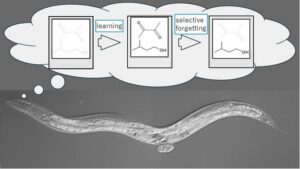
Ishihara further explained, “First, AWC releases NLP-47 and activates the GNRR-1 receptor on the AIZ neurons. The AIZ neurons would then release glutamate, another neurotransmitter. The glutamate then acts on the GLR-4 receptor on the AWA neurons that house the memory of the scent, leading to active forgetting. When we used optogenetics to suppress the activity of the AWC and AIZ neurons, we found that the nematodes were more resilient to forgetting.”
Follow-up experiments revealed that this active forgetting was highly specific. When nematodes were trained to remember two odors—diacetyl and isoamyl alcohol—simultaneously, the NLP-47/GNRR-1 pathway only forgot the diacetyl smell. “Simultaneous conditioning with two odorants revealed that neuropeptidergic-glutamatergic signaling selectively promotes forgetting of diacetyl memory without affecting isoamyl alcohol memory … indicating that forgetting can be regulated in a memory-specific manner,” the investigators stated.
C. elegans in which NLP-47/GNRR-1 or glutamate did not function were more resistant to forgetting the smells. “Discovering that this forgetting system is not indiscriminate and can target a specific memory is fascinating,” Onishi said. “At first, I was not expecting to find such a concrete mechanism of active forgetting with a remarkable specificity. I hope this research will lead to a deeper understanding of forgetting and eventually to more insights on conditions and pathologies involving memory.”
Commented Ishihara, “Interestingly, receptors like GNRR-1 are found in other organisms, including humans. In rodents, these receptors are found in the hippocampus, the brain’s center for memory, although their role there is not yet known. Our findings may also lead to an understanding of the mechanisms by which mammals forget specific memories.”
In their paper the authors concluded, “Our findings provide a framework for understanding how specific memories are differentially eliminated and suggest that such mechanisms extend to other species.”
The post Lost and Found: Neural Pathway for Forgetting Found in C. elegans appeared first on GEN - Genetic Engineering and Biotechnology News.
Apa Reaksi Anda?
 Suka
0
 Kurang Suka
0
 Setuju
0
 Tidak Setuju
0
 Bagus
0
 Berguna
0
 Hebat
0