



















































%20and%20Batch%20Production%20Records%20(BPR).png)















Multi-Controller System: Major Boost to Continuous CHO Perfusion

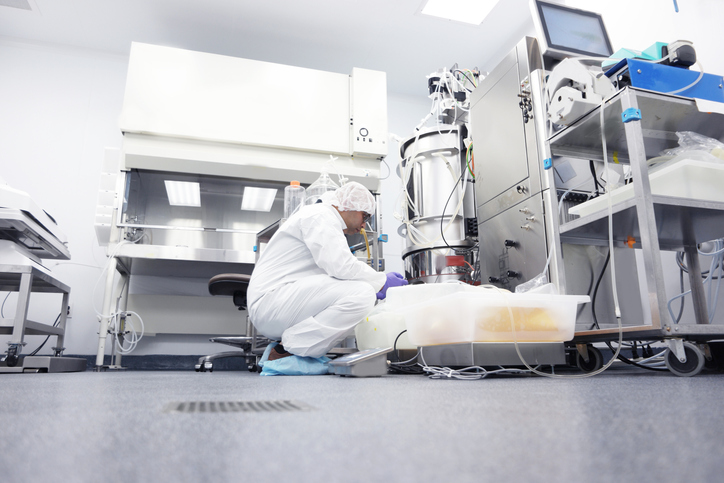
A nonlinear model predictive control system developed by researchers at Sartorius is making fully-continuous biomanufacturing for Chinese hamster ovary (CHO) cells more productive. By simultaneously controlling feed, bleed, and harvest flows, they increased production by 68% and maintained viable cell density at or above 95%.
This multi-strategy nonlinear model predictive control (NMPC) system allows biomanufacturers to switch seamlessly between such objectives as stable operation and economic optimization, according to Mahshad Valipour, PhD, senior research scientist, and Christopher McCready, head of product innovation, both of Sartorius, writing in a recent paper. The control system also accounts for unknown states—many of which are rarely, if ever, measured—through a moving horizontal estimate that considers the process and its constraints.
After the process is stabilized, an economic NMPC (ENMPC) mode further maximizes performance objectives. It does this, Valipour and McCready explain, “by determining optimal operating conditions in real-time… while explicitly enforcing dynamic process feasibility and biological constraints throughout the perfusion run. [It] improves numerical conditioning and avoids instability issues [commonly encountered in standard ENMPC formulations,] eliminating the need for ad hoc damping/terminal functions or frequent weight retuning.”
Combining a multifunction NMPC and an economic mode within one framework enables “seamless transition between operating modes without controller switching or reformulation,” they add. The primary benefit of this approach may be that biomanufacturers can determine maximum feasible operating conditions safely in real time, while accounting for the accumulation of biomaterials that inhibit cell productivity.
The most important step in making this approach work, they indicate, is “capturing the impact of accumulated inhibitory biomaterials on growth and death dynamics.” Conventional models, they point out, do not account for trade-offs among perfusion rate, inhibitor removal, and cell growth. Therefore, conventional models cannot be used to maximize viable cell density.
Experiments using digital twins showed the NMPC transitioned smoothly among process controller strategies while maintaining a healthy cell culture and increasing upstream productivity. Evaluations under realistic real-world conditions showed online and inline measurements of viable cell density and viability matched predictions, as did dead cell density.
Notably, rather than merely maintaining a stable cell culture and viability rate for a prolonged period, this multi-strategy lets biomanufacturers change objectives as the process is running. Even when tested against what they call “a significant plant-model mismatch,” operations, they said, remained stable.
For bioprocessors, this study suggests that advanced automation strategies can resolve the hurdles associated with continuous CHO perfusion, making it more predictable and more efficient.
The post Multi-Controller System: Major Boost to Continuous CHO Perfusion appeared first on GEN - Genetic Engineering and Biotechnology News.
Apa Reaksi Anda?
 Suka
0
Suka
0
 Kurang Suka
0
Kurang Suka
0
 Setuju
0
Setuju
0
 Tidak Setuju
0
Tidak Setuju
0
 Bagus
0
Bagus
0
 Berguna
0
Berguna
0
 Hebat
0
Hebat
0