





































































Poxvirus Machinery Mapped with Electron Microscopy Shows “Paired Engines”

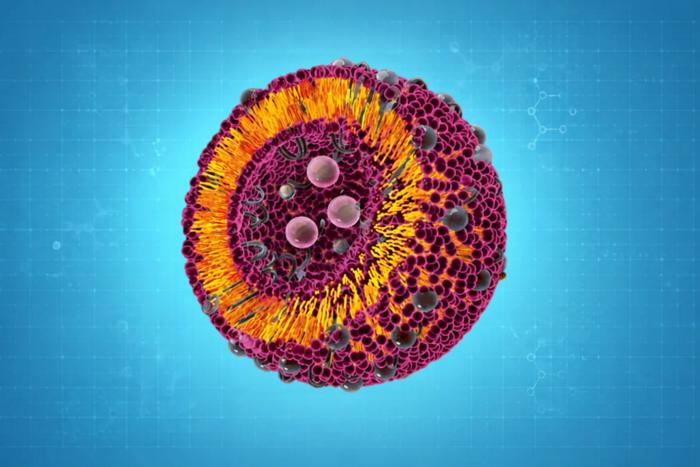
Mpox outbreaks have kept poxviruses in the public-health spotlight, but some of their most important biology has remained hidden inside a structure that has proved exceptionally difficult to visualize. The viral core is a multilayered capsule that carries both the genome and the molecular machinery needed to launch an infection. Now, researchers have captured that machinery in place, revealing how poxviruses keep their gene-copying engines on standby and how newly made messages may leave the core.
The work has been difficult because researchers previously examined isolated components outside the virus. Those studies provided detailed views of individual proteins, but not their native arrangement, interactions, or location inside an intact core.
Published in Nature, the study, “Architecture of the poxvirus early-transcription machinery and portal complex,” was led by scientists at the Institute of Science and Technology Austria (ISTA). The team included first and co-corresponding author Benoît Arragain, PhD, and ISTA professor Florian Schur, PhD, working with Lukas Bauer and Victor-Valentin Hodirnau of ISTA’s Electron Microscopy Facility.
“At the center of the brick-shaped poxvirus sits a sturdy, protective capsule called the viral core. Poxviruses use this core as a self-contained ‘starter kit’ for infection,” Schur said in a press release.
The researchers purified cores from vaccinia virus, a laboratory model used to study the wider poxvirus family. They flash-froze the cores to preserve them in a near-native state and imaged them from many angles using cryo-electron tomography. Computational reconstruction and sub-tomogram averaging then produced three-dimensional structures at sub-nanometer resolution. This approach allowed the team to examine two key systems directly inside the core: the viral RNA polymerase that transcribes early genes and a portal complex thought to export messenger RNA.

Instead of finding single polymerases, the researchers saw 1.8-megadalton resting-state dimers: pairs of polymerases bridged by a fully ordered viral early transcription factor. Nearly half of the pairs also carried proteins that tethered the machinery to viral DNA near the inner core wall. Additionally, the team wrote, “Furthermore, we determine a sub-nanometer structure of the putative poxvirus mRNA extrusion portal complex, revealing a rigid assembly integrated into the core wall comprising an E8 hexameric crown, an E6 hexameric central hub, and a basal L3 dodecameric channel suited for nucleic acid export.”
Together, the structures suggest a coordinated “production-and-dispatch” system. The virus packages transcription machinery close to its genome, holds it in a dormant paired state, and positions possible exit routes nearby so early viral messages can be made and released soon after infection. The resulting architectural blueprint identifies interactions that could be investigated as antiviral targets and may inform efforts to engineer poxviruses for biomedical uses, including cancer therapy. Future work will need to test how the polymerase pairs separate and activate, confirm how messenger RNA passes through the proposed portal, and determine whether disrupting either process can block infection.
The post Poxvirus Machinery Mapped with Electron Microscopy Shows “Paired Engines” appeared first on GEN - Genetic Engineering and Biotechnology News.
Apa Reaksi Anda?
 Suka
0
 Kurang Suka
0
 Setuju
0
 Tidak Setuju
0
 Bagus
0
 Berguna
0
 Hebat
0