














First operational welfare indicator protocol for seawater rainbow trout sets 33 measurable indicators
Editorial Staff | Aquaculture Magazine
Source: Centre for Aquaculture Progress · Operational Welfare Indicator Protocol for ongrowing rainbow trout in seawater, version 1.0, 2026 · Available on the CAP OWI Protocol Hub as an interactive version and as a PDF download
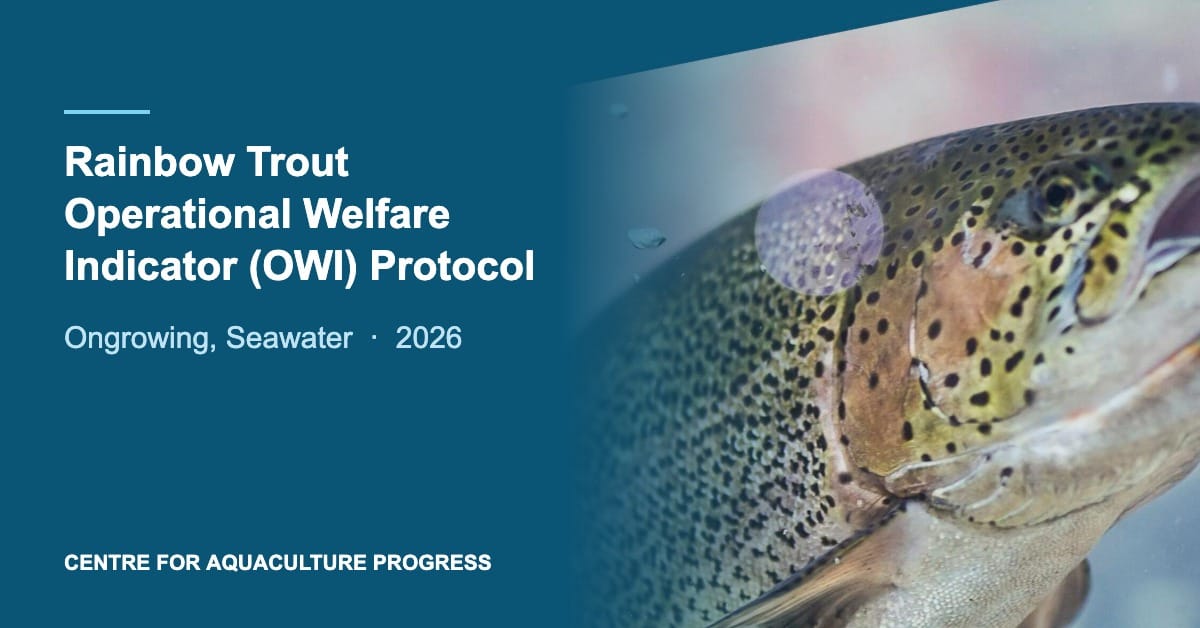
The Centre for Aquaculture Progress has published what it describes as the first assessment tool of its kind for farmed rainbow trout in seawater systems, defining 33 indicators with a common four-tier scoring scale so that auditors and farm managers assess the same thing in the same way.
CAP Protocol v1.0, 2026
Common scale across the protocol
RSPCA Assured and ASC
The protocol addresses a gap in how trout welfare is assessed on seawater farms
The Centre for Aquaculture Progress has launched an Operational Welfare Indicator (OWI) Protocol for ongrowing rainbow trout raised in seawater. According to the organisation, it is the first assessment tool of its kind for farmed rainbow trout in seawater systems, and the first in a series of OWI protocols the Centre plans to release.
The protocol is aimed at three groups with different needs: farm personnel carrying out routine welfare monitoring, and certification bodies, auditors and buyers verifying it. It is designed to align with the welfare monitoring and assessment requirements of key certification schemes, specifically RSPCA Assured and the Aquaculture Stewardship Council.
“Standards for farmed trout already exist, but the welfare requirements in them vary a lot in depth and in how well they can be assessed on a farm. What we tried to do here was to be more specific: state what should be measured, how, and what counts as acceptable, so that either an auditor or a farm manager are looking at the same thing.” — Marco Cerqueira, CCMAR, University of Algarve
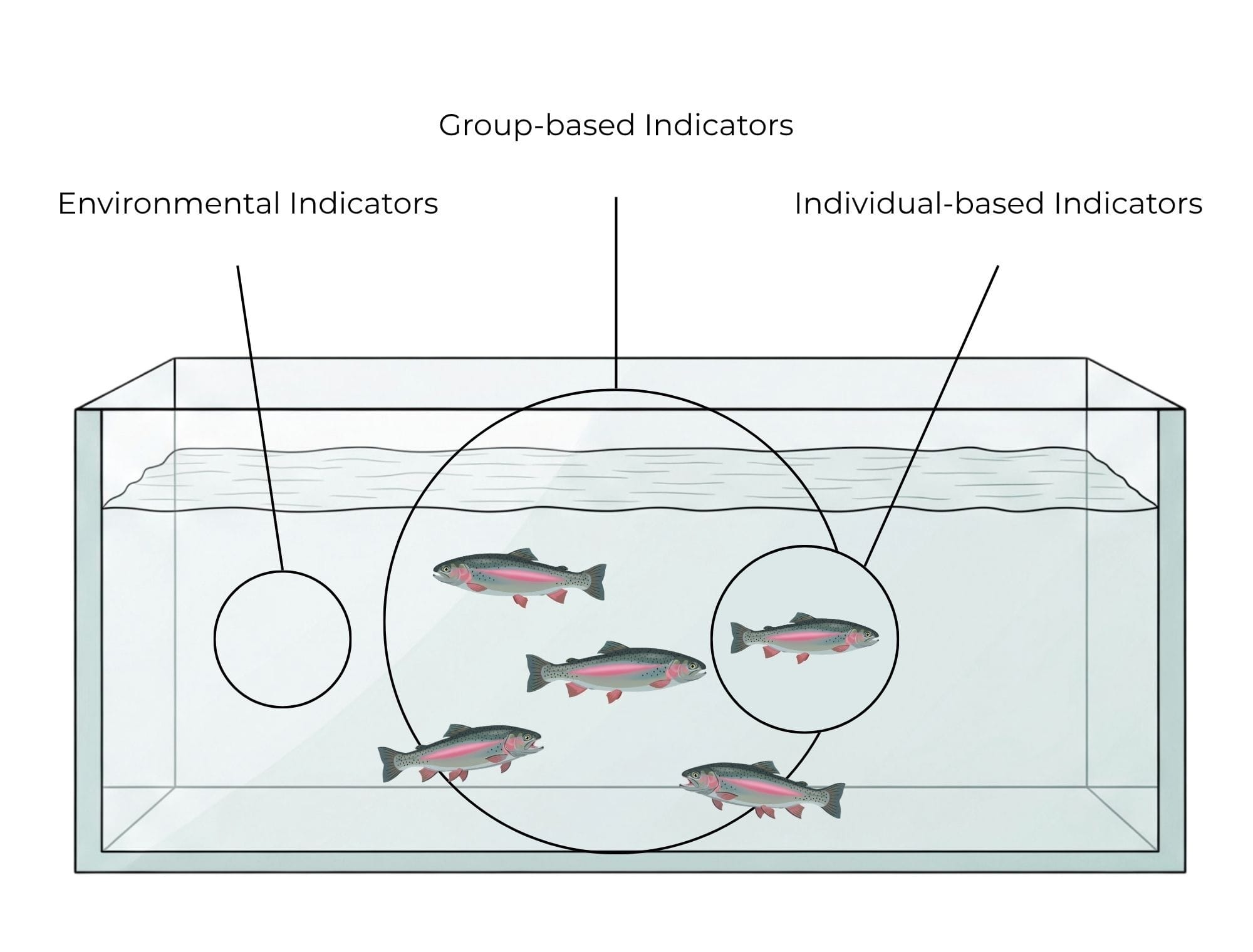
The 33 indicators are split between individual, group and environmental measures
The protocol organises its indicators into three categories, each capturing a different level of observation on the farm.
Table 1. Structure of the OWI protocol
| Category | Indicators | Level of observation |
|---|---|---|
| Individual-based | 14 | The individual fish |
| Group-based | 5 | The population in the unit |
| Environmental | 14 | The rearing environment |
| Total | 33 | — |
Source: CAP Operational Welfare Indicator Protocol for ongrowing rainbow trout in seawater, version 1.0. Swipe horizontally on small screens.
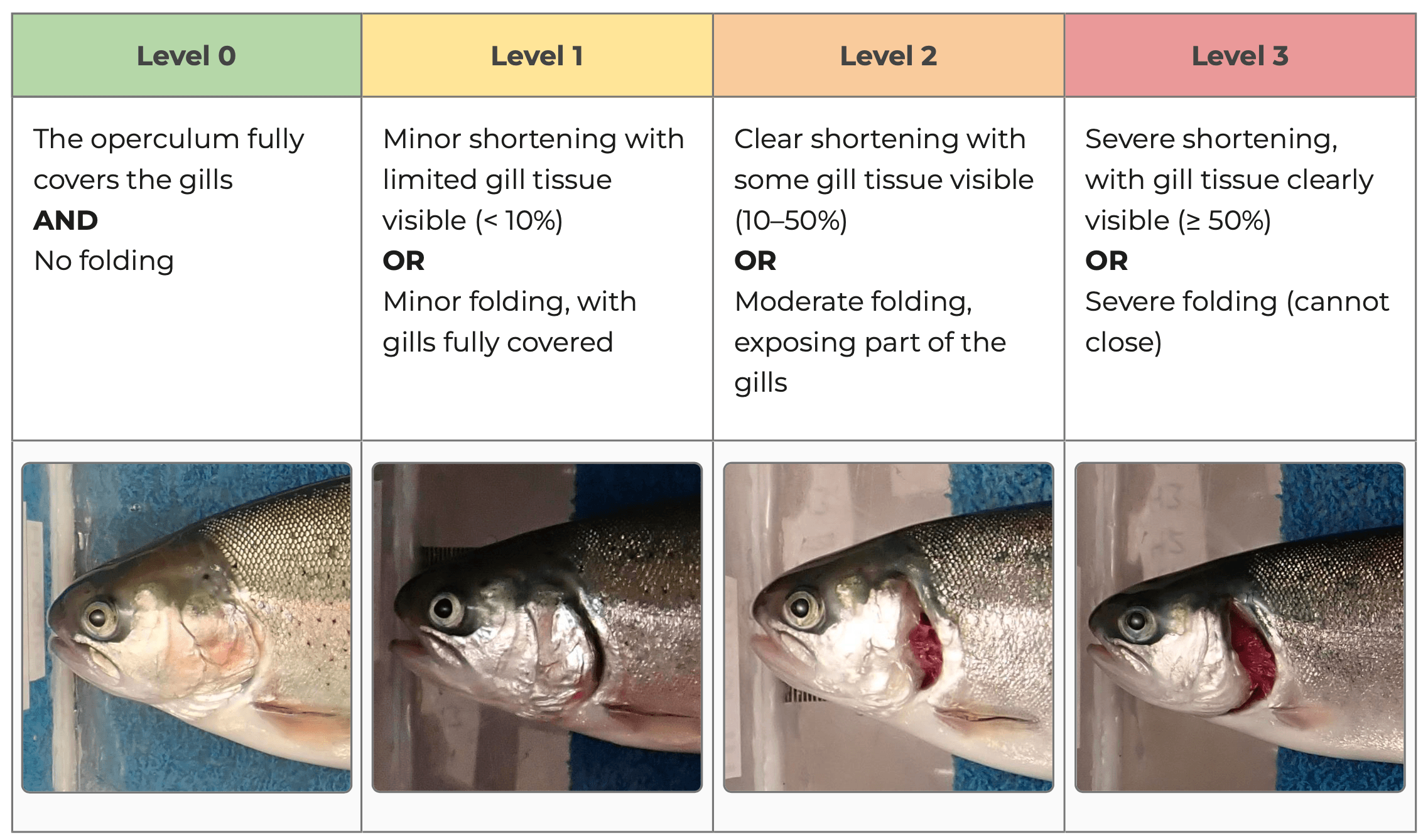
Every indicator carries a four-tier scoring system with reference images
Each of the 33 indicators is accompanied by its own scoring system, split into four tiers comprising levels 0 to 3. The protocol also includes reference images and scoring guidance intended for practical application in the field.
That combination is what distinguishes an operational protocol from a written standard. A requirement stated in words leaves the threshold to the judgement of whoever is holding the clipboard; a scored indicator with a reference image narrows that margin.
The stated purpose is convergence: that an auditor and a farm manager assessing the same fish arrive at the same score.
Development involved research institutes, certifiers, academia, NGOs and producers
The protocol was developed in close collaboration with Marco Cerqueira of CCMAR at the University of Algarve. Jonatan Nilsson and Angelico Madaro at the Institute of Marine Research provided detailed review and extensive contribution to the document.
The Centre also reports feedback from a number of other industry stakeholders, including individuals from certification bodies, academia, NGOs and producers. That breadth matters for a tool whose value depends on being accepted by both the party being audited and the party auditing.
The protocol is available in interactive and PDF formats
The document is published on the CAP OWI Protocol Hub as an interactive online version and as a PDF download. It is identified as version 1.0, dated 2026, and is described as the first in a planned series covering additional species and production systems.
Questions this article answers
What does the CAP protocol cover?
Operational welfare assessment of ongrowing rainbow trout raised in seawater. It defines 33 operational welfare indicators: 14 individual-based, 5 group-based and 14 environmental, each with its own scoring system.
How are the indicators scored?
Each indicator uses a scoring system split into four tiers comprising levels 0 to 3. The protocol supplies reference images and scoring guidance so that the same observation produces the same score in the field.
Who is the protocol intended for?
Farm personnel carrying out routine welfare monitoring, and certification bodies, auditors and buyers. It is designed to align with the welfare monitoring and assessment requirements of RSPCA Assured and the Aquaculture Stewardship Council.
How does it differ from existing trout standards?
According to Marco Cerqueira of CCMAR, existing standards vary considerably in the depth of their welfare requirements and in how well those requirements can be assessed on a farm. The protocol specifies what should be measured, how, and what counts as acceptable.
Where can the protocol be obtained?
On the CAP OWI Protocol Hub, as an interactive online version and as a PDF download. It is version 1.0, published in 2026, and the first in a planned series of OWI protocols.
Sources and method
Primary source. Centre for Aquaculture Progress, Operational Welfare Indicator (OWI) Protocol for ongrowing rainbow trout raised in seawater, version 1.0, 2026. Published on the CAP OWI Protocol Hub. Organisation website: centreforaquacultureprogress.org.
Contributors named by the Centre. Marco Cerqueira (CCMAR, University of Algarve), developed in close collaboration; Jonatan Nilsson and Angelico Madaro (Institute of Marine Research), detailed review and contribution; additional feedback from individuals at certification bodies, academia, NGOs and producers.
Editorial note. This article reports the launch of a protocol published by the Centre for Aquaculture Progress. The figures, categories and scoring structure are those stated by the organisation. Aquaculture Magazine has not independently evaluated the protocol in field conditions, and no performance or validation data accompanying its use has been published at the time of writing.
About the Centre for Aquaculture Progress
The Centre for Aquaculture Progress accelerates the adoption of science-based and sustainable fish welfare improvements in European aquaculture. The Centre focuses on solutions that work better for everyone: practical for farmers, affordable for consumers, and better for fish.
Aquaculture Magazine is a leading specialised publication for the global aquaculture industry. Published by DP International, Inc., it covers science, technology, markets and trends across the sector. Contact: info@dpinternationalinc.com
Apa Reaksi Anda?
 Suka
0
Suka
0
 Kurang Suka
0
Kurang Suka
0
 Setuju
0
Setuju
0
 Tidak Setuju
0
Tidak Setuju
0
 Bagus
0
Bagus
0
 Berguna
0
Berguna
0
 Hebat
0
Hebat
0