



















Why do broilers hug the walls? Understanding how broilers use space
By Shawna Weimer, PhD, University of Arkansas
Broilers do not spread evenly across their environment. Some may cluster near a wall, equipment line, or other boundary, while other areas appear relatively unoccupied. This pattern is not necessarily a sign that something is wrong. Broilers do not use space randomly and tend to congregate along the sidewalls of broiler houses1. This behavior, referred to as thigmotaxis, is the tendency to remain near walls (Figure 1) or other vertical surfaces.
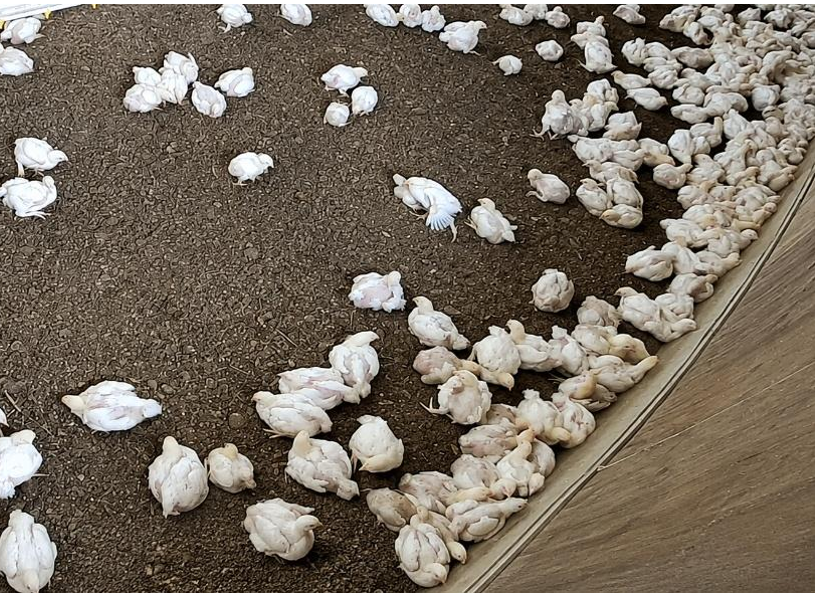
Figure 1. Broilers clustered along the side wall of a commercial house. Photo credit: Shawna Weimer.
What is wall-hugging behavior?
Where broilers choose to spend time is influenced by more than space allowance. Broilers make use of peripheral areas more than would be expected by the amount of floor space available alone2-4. This pattern originates from their natural history. Red Junglefowl, the wild ancestor of domestic chickens, inhabit forests with dense vegetation that provides natural cover5.
Useful observations
When you ask yourself, “How much space do my birds have?” also ask, “How are my birds using the space they have?”
Why do broilers choose the wall?
Where broilers spend time can vary by environmental conditions, resource location, stocking density, age, time of day, and social interactions.
Temperature and litter condition
Temperature and litter condition vary within a broiler house. Heating, cooling, and ventilation systems create a temperature gradient within the house, with differences increasing as broilers grow6. For example, solar radiation can warm house sidewalls, while cool air from inlets can create cooler areas near sidewalls. Litter moisture varies with equipment and tends to be greater around waterlines7. Broilers may avoid areas with wet litter (Figure 2), making bird distribution a useful observation of litter condition.
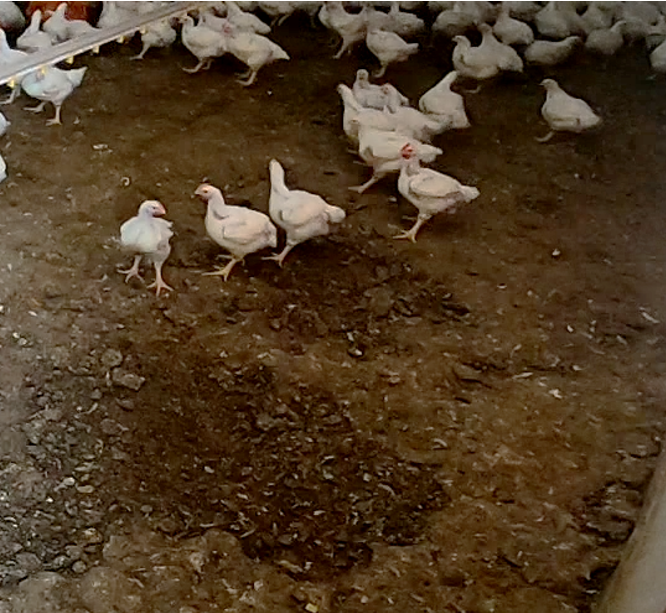
Figure 2. Broilers avoiding a wet spot in a commercial house. Photo credit: Shawna Weimer.
Resource location
Birds stay near areas where feed, water, enrichments, or other resources are available. Stocking density and locations of feeders and drinkers affect how birds use space. At low stocking densities, birds tend to remain near feeders and drinkers, but at higher densities they move farther from these resources, likely because competition and disturbance increase around resource areas4. Environmental enrichments can further influence space use. Visual cover, vertical panels, and platforms encourage broilers to use areas that might otherwise be less frequently occupied3,9,11. Domestic fowl use visual cover more than uncovered areas and rest and preen more in covered locations6. Depending on facility design, the location of resources may help explain why birds cluster in areas of the house, including near sidewalls.
Age and time of day
Broiler space use follows a diurnal pattern and changes as birds grow. Broilers in pens with sidewall-mounted platforms showed increased side occupancy compared to unenriched controls, especially during the dark period at younger ages (Figure 3). The highest platform occupancy was 80% at younger ages during the dark period, compared with less than 40% in controls12. This pattern may be the result of a greater tendency for younger birds to seek protection.
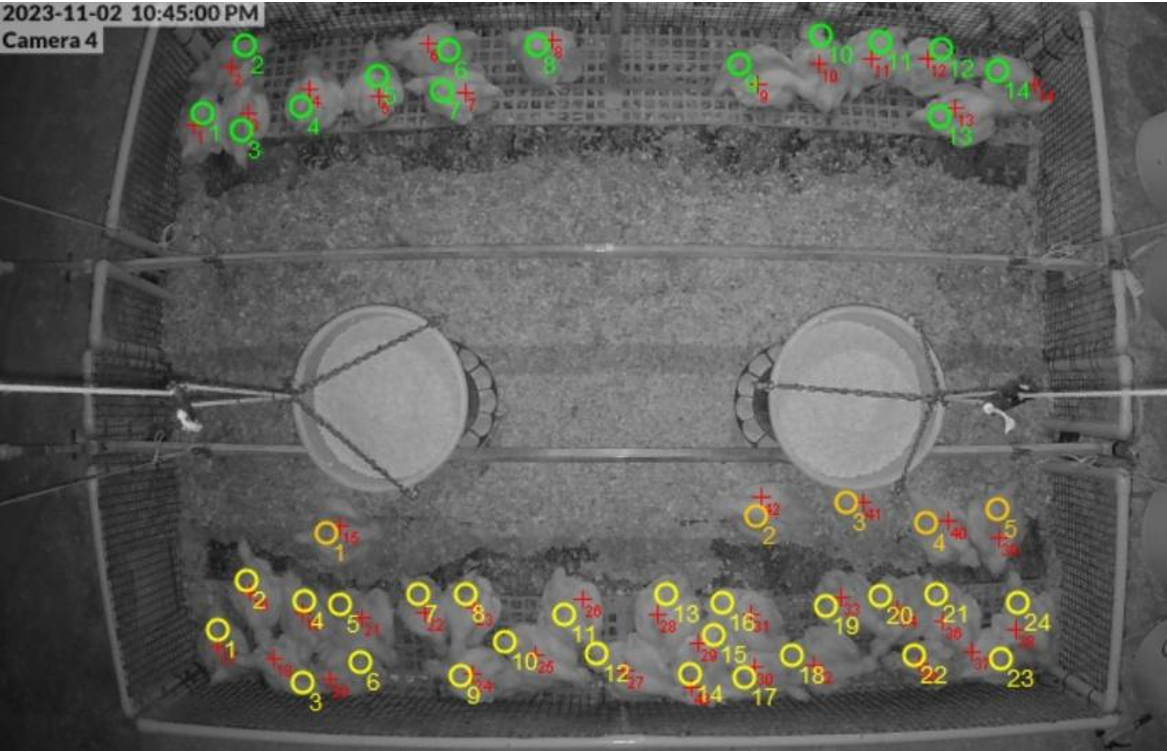
Figure 3. Overhead image of broilers on platforms in a pen during the dark period. Colored circles and numerical labels indicate the total number of birds (red), and positions within the pen: east platform (green), west platform (yellow), and litter area (orange). Images were measured using ImageJ. Adapted from Weimer et al. (2026).
Social environment
Broilers are social animals, and the presence of other birds can influence where they spend their time. Broilers tend to remain near flockmates, and this social attraction can result in clusters of birds within an area even when no physical feature is drawing the birds to that location13. Wall preference has also been linked to reduced disturbance from neighboring birds, especially as local density increases1.
What does it mean for broiler housing?
Broiler housing is more than the amount of floor space available. Broilers interact with boundaries, resources, lighting, litter, enrichment, flockmates, and environmental conditions, and these factors can shape where they spend time. For producers, regular observation of bird distribution can provide useful clues about how birds use their environment. The goal is to understand bird distribution patterns to help identify management practices that support bird welfare. Wall-hugging behavior should not be interpreted as a direct indicator of good or poor welfare without also considering the surrounding environment and other welfare indicators. Understanding how broilers use space and what motivates their behavior can help producers and researchers provide housing that considers the birds’ perspective.
Summary
- Broilers do not necessarily use all available space evenly; wall-hugging or thigmotaxis is one example of a spatial behavior.
- Spatial distribution can be influenced by boundaries, resource placement, stocking density, flock behavior, age, and time of day.
- A spatial pattern does not automatically indicate poor welfare or a production problem; it should be interpreted alongside the broader environment and other bird welfare measures.
- Observing where birds choose to spend time can help producers think about housing from the birds’ perspective.
References
- Buijs, S., Keeling, L.J., Vangestel, C., Baert, J., Vangeyte, J., & Tuyttens, F.A.M. (2010). Resting or hiding? Why broiler chickens stay near walls and how density affects this. Applied Animal Behaviour Science, 124, 97-103. https://doi.org/10.1016/j.applanim.2010.02.007
- Newberry, R.C., & Hall, J.W. (1990). Use of pen space by broiler chickens: Effects of age and pen size. Applied Animal Behaviour Science, 25, 125-136. https://doi.org/10.1016/0168-1591(90)90075-O
- Newberry, R.C., & Shackleton, D.M. (1997). Use of visual cover by domestic fowl: A Venetian blind effect? Animal Behaviour, 54, 387-395. https://doi.org/10.1006/anbe.1996.0421
- Arnould, C., & Faure, J.M. (2003). Use of pen space and activity of broiler chickens reared at two different densities. Applied Animal Behaviour Science, 84, 281-296. https://doi.org/10.1016/j.applanim.2003.07.003
- Collias, N.E., & Collias, E.C. (1967). A field study of the red jungle fowl in north-central India. The Condor, 69(4), 360–386
- Miragliotta, M.Y., Nääs, I.A., Manzione, R.L., & Nascimento, F.F. (2006). Spatial analysis of stress conditions inside broiler house under tunnel ventilation. Scientia Agricola, 63(5), 426–432. https://doi.org/10.1590/S0103-90162006000500002
- Tasistro, A.S., Kissel, D.E., & Bush, P.B. (2004). Spatial variability of broiler litter composition in a chicken house. Journal of Applied Poultry Research, 13(1), 29–43. https://doi.org/10.1093/japr/13.1.29
- Leone, E.H., & Estevez, I. (2008). Space use according to the distribution of resources and level of competition. Poultry Science, 87, 3-13. https://doi.org/10.3382/ps.2007-00026
- Cornetto, T., & Estevez, I. (2001). Influence of vertical panels on use of space by domestic fowl. Applied Animal Behaviour Science, 71, 141-153. https://doi.org/10.1016/S0168-1591(00)00171-4
- Cornetto, T., Estevez, I., & Douglass, L.W. (2002). Using artificial cover to reduce aggression and disturbances in domestic fowl. Applied Animal Behaviour Science, 75, 325-336. https://doi.org/10.1016/S0168-1591(01)00195-2
- Ventura, B.A., Siewerdt, F., & Estevez, I. (2012). Access to barrier perches improves behavior repertoire in broilers. PLOS ONE, 7, e29826. https://doi.org/10.1371/journal.pone.0029826
- Weimer, S.L., Kidd, M.T., Vaught, M., et al. (2026). Age and time of day influence broiler use of platform enrichments. Poultry Science, 105, 106720. https://doi.org/10.1016/j.psj.2026.106720
- Febrer, K., Jones, T.A., Donnelly, C.A., & Dawkins, M.S. (2006). Forced to crowd or choosing to cluster? Spatial distribution indicates social attraction in broiler chickens. Animal Behaviour, 72, 1291-1300. https://doi.org/10.1016/j.anbehav.2006.03.019
To view all issues of Poultry Press, click here.
Editor’s note: Content on Modern Poultry’s Industry Insights pages is provided and/or commissioned by our sponsors, who assume full responsibility for its accuracy and compliance.
The post Why do broilers hug the walls? Understanding how broilers use space appeared first on Modern Poultry.
Apa Reaksi Anda?
 Suka
0
Suka
0
 Kurang Suka
0
Kurang Suka
0
 Setuju
0
Setuju
0
 Tidak Setuju
0
Tidak Setuju
0
 Bagus
0
Bagus
0
 Berguna
0
Berguna
0
 Hebat
0
Hebat
0