































































Strength Training for Moms: A Simple At-Home Routine


Moms can build practical full-body strength at home with a repeatable routine. This plan uses five bodyweight exercises and two TRX movements, takes about 20 minutes, and needs very little floor space. When the day gets chopped up, complete one round as a useful 10-minute fallback.
Limited time is real. Interruptions are, too. At-home strength training for moms does not need a quiet house or a perfect schedule. A clear plan and steady form are enough, especially when the fallback still works after someone calls your name mid-set.
Key Takeaways: Strength Training for Moms
-
Strength training for moms can start at home with bodyweight movements and compact strength training equipment that helps the routine fit a small space.
-
Adults can begin with two short full-body sessions each week, and a one-round fallback keeps the plan workable when time is tight.
-
Progress by changing one variable at a time, such as reps, range, tempo, leverage, or resistance, and scale back whenever technique starts to slip.
-
TRX Training's Home2 System includes a door anchor and a suspension anchor, giving moms a compact setup for the row and hamstring curl in this routine.
-
Pregnant or recently postpartum readers should follow individual clinical guidance, stop if exercise causes pain or warning signs, and ask an obstetric clinician when it is safe to progress.
Why Strength Training Fits a Busy Mom's Life
Strength training for everyday life puts the basic patterns you use all day into a workout. You squat, hinge, push, pull, carry, and control your trunk when you lift a child, haul groceries, get up from the floor, or steer a loaded stroller.
Wondering how many days a week women should strength train? The Physical Activity Guidelines for Americans set at least two days a week as the baseline. The same guidance says small amounts of activity count. For a packed schedule, two short sessions are a solid place to begin.
A systematic review of resistance training in women found meaningful gains in upper- and lower-body strength among healthy adult women. No complicated program required. Regular resistance training works when you stick with it.
Think of this as functional fitness you can use beyond the workout. If you want more movement ideas later, these functional fitness exercises show how common gym patterns carry into daily life.
What You Need for This At-Home Routine
Strength training for women at home does not require a dedicated gym. You need enough clear floor space to step backward and lie down without meeting a toy, coffee table, or surprised pet. A mat can make the floor moves more comfortable, but it is optional.
For the two suspension exercises, use a securely anchored TRX Suspension Trainer™. The Home2 System includes a door anchor and suspension anchor, so you don't need a dedicated training room. Check the anchor, straps, handles, and foot cradles before you load them.
No straps? Use a securely closed backpack for bent-over rows in place of the TRX Low Row. For hamstring curls, put your heels on towels over a smooth floor or use furniture sliders. Clear tripping hazards first, and keep loose equipment out of children's reach.
If you want a longer progression after this session feels familiar, save the beginner bodyweight workout program for later. For now, one routine is enough.
Warm Up in Five Minutes
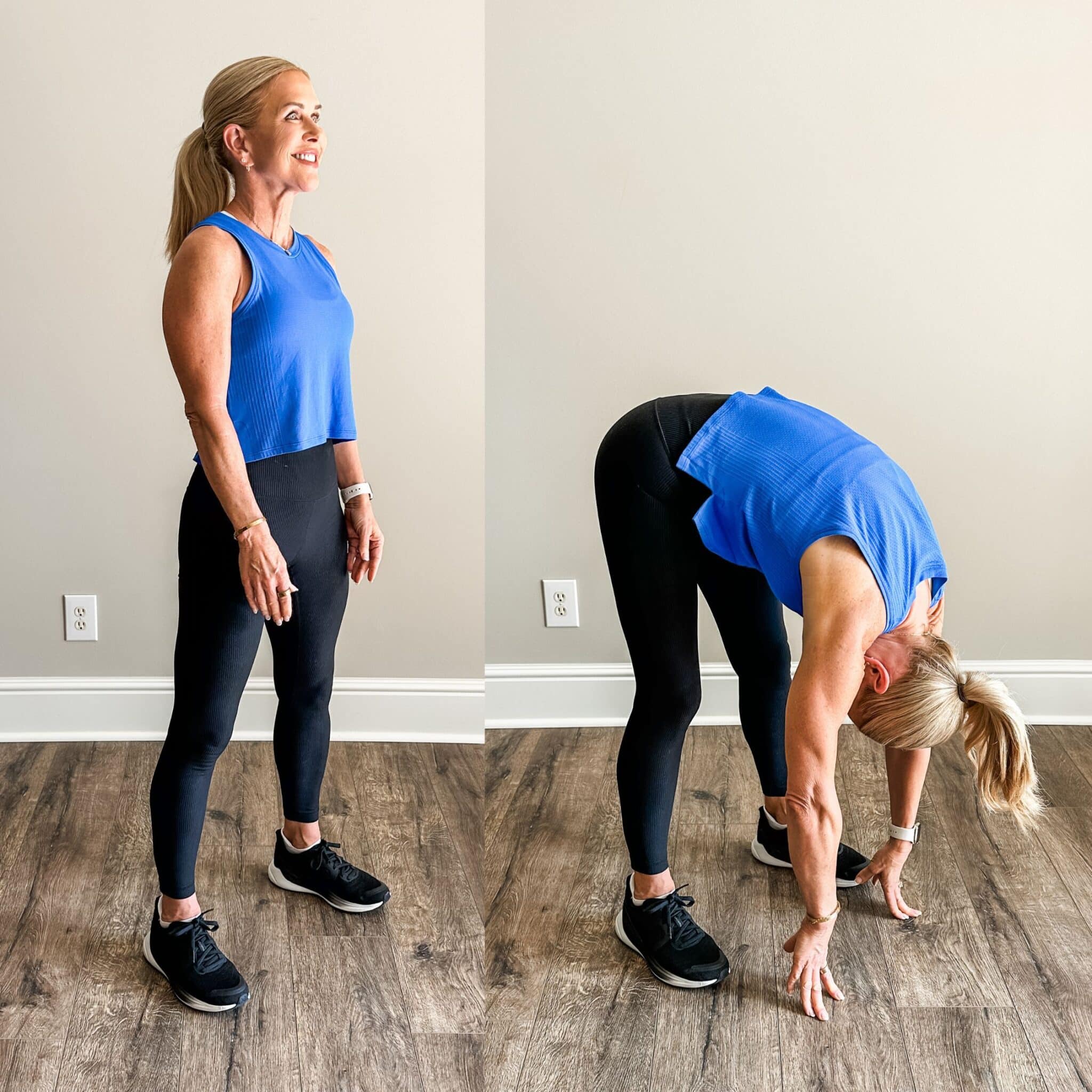
Use the warm-up to raise your temperature and rehearse the bodyweight strength exercises ahead. March in place for 60 seconds, then perform 10 shoulder circles in each direction. Follow with 10 controlled hip hinges, 10 bodyweight squats, and 6 alternating reverse lunges per side.
Move with control and skip the rush to the deepest range. Stiff today? Make the first few reps smaller and let your movement open up on its own. Finish the warm-up feeling warmer and more coordinated, with plenty left for the work ahead.
If you're pregnant or recently postpartum, follow your clinician's guidance before starting. The dedicated safety section below gives you a few more checkpoints.
Can Beginners Use Suspension Training at Home?
Suspension training can suit beginners because the load changes with your body angle instead of a fixed weight stack.
With the TRX Home2 Suspension Trainer™, stand more upright to make a row lighter, then move your feet closer to the anchor as your control improves. That gives you a clear progression without changing exercises or hauling out more gear.
Use the easiest angle that lets you keep a straight body line and smooth tempo. A harder angle counts as progress only when the last rep looks as controlled as the first.
A Simple 20-Minute Strength Training Routine for Moms
This 20-minute home workout uses two rounds of the seven exercises below. Perform 8 to 12 controlled reps per movement, rest 30 to 45 seconds between exercises, and take 60 seconds between rounds.
-
Two rounds take about 20 minutes.
-
One round becomes a 10-minute workout for busy moms on crowded days.
-
Split one round into two short blocks on the same day if that fits your schedule.
Five bodyweight strength exercises and two TRX strap exercises cover lower-body strength, upper-body pushing and pulling, the posterior chain, and trunk control. End the set when your form starts to slip.
Bodyweight Squat
The bodyweight squat trains your hips and thighs with no extra setup.
Stand with your feet about hip to shoulder width apart. Keep your ribs stacked over your pelvis, send your hips back and down, and let your knees track in line with your toes. Press through your whole foot to stand tall.
Use a chair as a target if you want more control. Tap the seat, then stand without dropping onto it. To progress, lower for three slow counts or hold a secure household load close to your chest.
Incline Push-Up
Start the push-up higher. An incline trains your chest, shoulders, triceps, and trunk while giving you room to choose a manageable angle.
Place your hands on a stable counter or heavy bench. Walk your feet back until your body forms one line from head to heels. Bend your elbows slightly back, bring your chest toward the surface, and press away without letting your hips sag.
Use a higher surface to make the exercise easier. Lower your hand position gradually as you get stronger. Skip anything that shifts, rolls, or wobbles.
Glute Bridge
The glute bridge trains your glutes and trunk through hip extension with no extra gear.
Lie on your back with your feet planted near your hips. Keep your ribs down, press through both feet, and lift until your hips and ribs stay aligned. Lower under control instead of dropping to the floor.
Start with a comfortable range. Progress by pausing at the top for two counts or taking three counts to lower. Build that control before trying a single-leg version.
Reverse Lunge
The reverse lunge trains your hips and thighs one leg at a time. A backward step can feel easier to place than a forward one.
Stand tall, step one foot back softly, and lower only as far as you can control. Keep the front foot planted, then drive through that leg to return to standing. Alternate sides or finish one side before switching.
Use a wall or sturdy chair for light support. A smaller step and shorter range are valid starting points. Add reps or hold a secure load only after the unweighted version feels steady.
Dead Bug
The dead bug trains trunk control while your arms and legs move. That coordination carries into lifting and plenty of other core exercises for beginners.
Lie on your back with your hips and knees bent. Brace gently, then reach one arm and the opposite leg away without letting your low back lift. Return with control and switch sides.
Shorten the reach as soon as your ribs flare or your back begins to arch. For an easier version, keep your arms still and tap one heel to the floor at a time.
TRX Low Row
The TRX Low Row trains your back and arms, and changing your stance adjusts the load in seconds.
Set the straps to a shorter length and face the anchor. Hold the handles, walk your feet forward only as far as you can control, and keep a straight plank line. Pull the handles toward your ribs, pause briefly, and lower slowly until your arms are long.
Stand more upright or step farther away from the anchor to reduce the load. Move your feet closer beneath the anchor to increase the challenge. Keep your body angle consistent from the first rep to the last.
TRX Hamstring Curl
The TRX Hamstring Curl trains the back of your legs and balances the squats and lunges. The foot cradles add a wobble, so own a shorter range before chasing a bigger one.
Set the straps to mid-calf length. Sit facing the anchor, place both heels in the foot cradles, then lie back with your legs extended. Brace, lift your hips, draw your heels toward you without losing hip height, and extend your legs slowly.
Keep your hips lower or shorten the curl to make it easier. To progress, slow the extension or hold the curled position for two counts. Save single-leg work until the two-leg version stays smooth.
Done with both rounds? Walk around for a minute and let your breathing settle. For another full-body strength workout at home, browse these strength training workouts at home.
How to Progress Without Making the Routine Complicated
Run the same routine twice a week on nonconsecutive days until the movements feel familiar. Repetition is useful. Once you stop spending energy remembering the plan, you can put it into cleaner reps.
Use progressive overload at home by changing one thing at a time. Add one or two clean reps. Later, add a third round, adjust your TRX leverage, slow the lowering phase, or use a secure external load.
Finish most sets before you reach failure. On a rough-sleep day, or when your technique gets shaky, shorten the range, ease the angle, trim the reps, or stop after one round. Scale smart and keep moving.
Put food and fluids first. If a supplement already fits your routine, TRX Nutrition™ Aminos + Adaptogens provides 6 g of BCAAs, 2 g of EAAs, and 1.25 g of adaptogens and minerals. The 25-calorie formula has no added sugar, artificial colors or flavors, or GMOs, and it is sweetened with stevia.
TRX frames the formula as support for recovery and resilience, not a guarantee of either outcome. If you're pregnant or nursing, ask your healthcare professional before using supplements.
How to Fit Strength Training Into Mom Life
A busy mom workout plan can be interrupted and still be worth doing. One completed round is still a completed workout on a packed day. That's a better deal than holding out for a perfect 45-minute window that never opens.
Pick the pattern that fits your week. Try two 20-minute sessions, four 10-minute blocks, or one weekday session plus one on the weekend. Choose your start time before the day gets crowded, then keep the fallback ready.
Reduce setup friction wherever you can. Keep a small training corner clear, save this routine on your phone, and put the straps where you can reach them but children cannot. When the plan is easy to start, you are less likely to negotiate with it.
What Weight Works in a Small Home Training Corner?
A compact home weight should add resistance without turning your training corner into a gear pile.
The TRX YBell® NEO Series works as a dumbbell, kettlebell, dual-grip medicine ball, or push-up stand based on where you grip it. Its stackable shape keeps storage simple if you add more than one weight over time.
Start with a load that lets you keep the same clean reps. The goal is one clear next step for squats, lunges, and carries after bodyweight work feels steady.
Pregnant or Recently Postpartum? Start With Clearance
Pregnancy exercise and postpartum strength training need individual guidance. The American College of Obstetricians and Gynecologists says that after a healthy pregnancy and uncomplicated vaginal delivery, some people can begin simple activity within days, or when they feel ready. A cesarean birth or complications require direction from your obstetric clinician.
Stop and seek qualified guidance if you experience pain, unusual bleeding, or dizziness, pelvic heaviness or leaking, or another symptom that concerns you. Do not push through a symptom to finish the round.
An obstetric clinician or pelvic floor physical therapist can help you choose your starting point. Clearance isn't a race. Your first version may look nothing like someone else's, and that's fine.
Keep Building Strength at Home
For strength training for moms, repeatable basics beat a perfect schedule. Try the 20-minute version twice this week, and grab the one-round fallback when the day falls apart. As you grow stronger, add reps, tempo, leverage, or resistance without replacing the whole plan.
Want a compact setup for rows and hamstring curls? Explore the TRX Home2 Suspension Trainer and guided sessions in the TRX App™. The beginner plan linked earlier offers another way to build strength. Pick the next step you'll actually use. Then let's move.
What's Your Reaction?
 Like
0
Like
0
 Dislike
0
Dislike
0
 Agree
0
Agree
0
 Disagree
0
Disagree
0
 Excellent
0
Excellent
0
 Useful
0
Useful
0
 Great
0
Great
0