


















































%20and%20Batch%20Production%20Records%20(BPR).png)
















Bayh-Dole Act’s benefits include $3 trillion in U.S. output, report finds
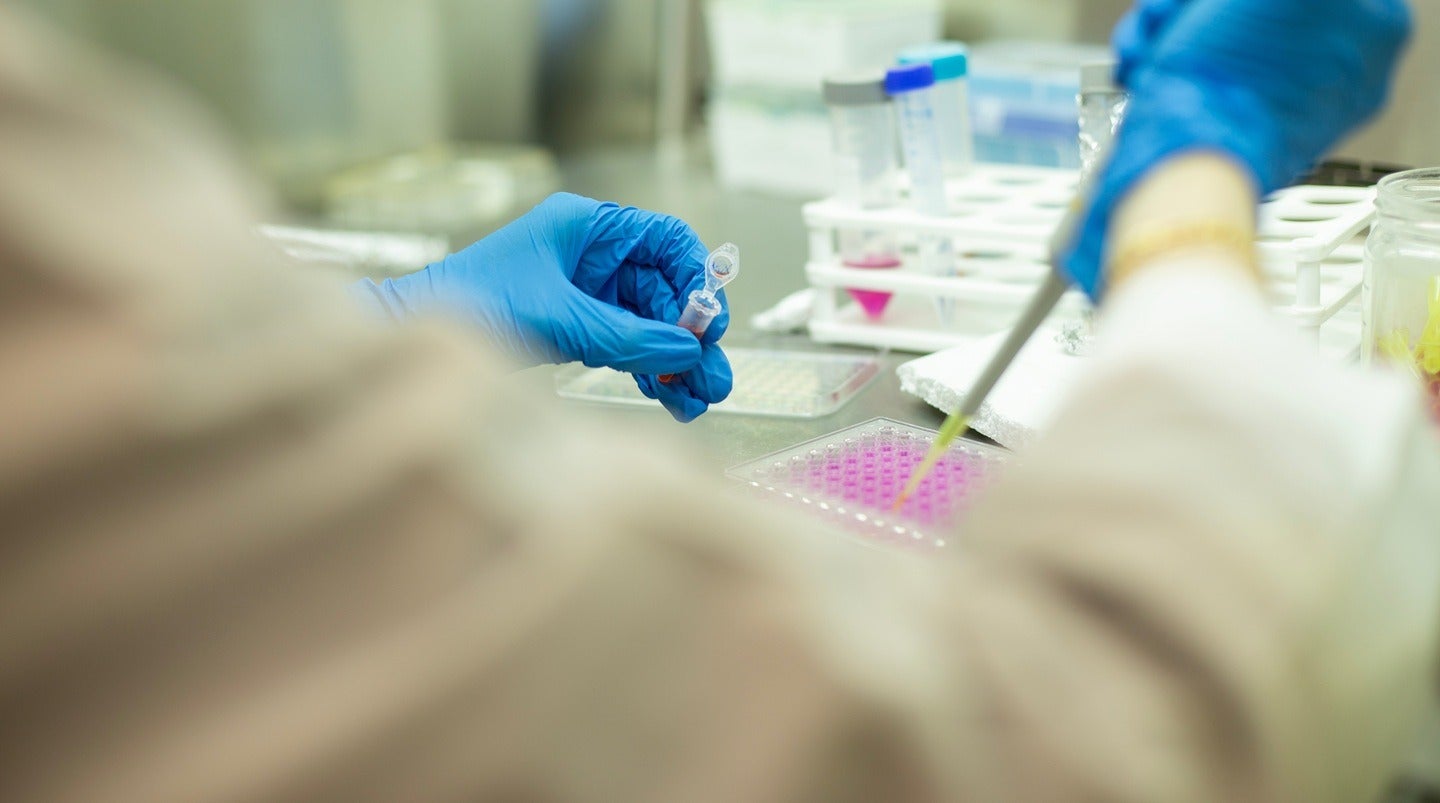
It’s been a long day at the university lab, but the researchers, who have been working on a niche bit of molecular biology research, are happy. They have just made a profound discovery that could change the way some cancers are treated, and investors are already lined up to support the work.
Before we know it, they think to themselves, lives will be saved.
In the United States, such technology transfer is often taken for granted—but it hasn’t always been this way. As recently as 45 years ago, if the university researcher had gotten a grant from the federal government, then the federal government took ownership over what was invented.
This system stymied innovation. At the time, the federal government held the patents on roughly 28,000 discoveries, yet licensed fewer than 5% for commercialization. Something had to change.
And so, in 1980 Senator Birch Bayh (D-IN) and Senator Bob Dole (R-KS) drafted the Bayh-Dole Act of 1980 (Patent and Trademark Law Amendments Act, P.L. 96-517) to allow universities, small businesses, and non-profits to retain ownership and patent rights of inventions developed through research supported by federally funding—incentivizing the public-private collaborations required to transform scientific discoveries into new technologies, industries, products and companies.
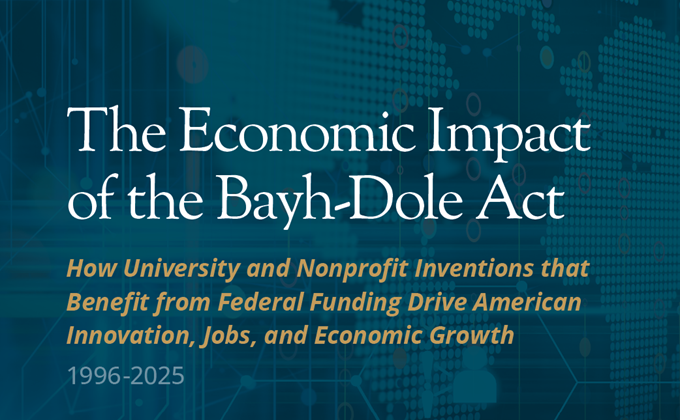
The results have been a renaissance of innovation and licensing. The legislation’s ongoing success is highlighted in a new report by the Bayh-Dole Coalition, which includes the Biotechnology Innovation Organization (BIO) as a member. The 2026 report, “The Economic Impact of the Bayh-Dole Act,” provides impressive statistics.
Overall economic impact is enormous
In the last 30 years alone, technology transfer facilitated by the Bayh-Dole Act between federal supported universities and non-profits and the private sector contributed as much as:
- $3.3 trillion to U.S. gross economic output,
- $1.7 trillion to the U.S. GDP, and
- 6 million job-years of U.S. employment.
Since 1980, the annual number of patents on inventions benefiting from government funding has increased more than 70-fold.
And in more recent years, from 2001-2025, technology transfer at academic institutions led to the launch of more than 19,000 startups and the introduction of more than 17,000 new products. It has also seen:
- $288 billion in GDP,
- $577 billion in gross economic output, and
- 08 million job-years of U.S. employment.
In fact, universities and nonprofit research institutions averaged about 19,387 income-generating licenses annually from 2021–2025, that is roughly twice the annual average in 2001–2005.
And furthermore, the report found that there have been:
- 5,972 running-royalty licenses annually from 2021–2025,
- $3.2 billion in average annual gross licensing income, and
- $1.9 billion in average annual running royalty income.
And while that doesn’t necessarily translate one-to-one to on-the-market products, it does reflect the pace at which private-public partnerships are moving and continuing to grow.
Put simply, the legislation did not just spur economic development in the short term, but has continued to generate significant innovation, progress, and economic activity year after year—continuing today.
And the benefits are both micro and macro to economic development.
A closer look—the regional benefits of Bayh Dole
This economic impact Bayh-Dole has positively affected every corner of the United States, generating economic activity in every state in the union. The economic development from 2021–2025 alone is notable.
For example, in the South (AL, AR, DE, DC, FL, GA, KY, LA, MD, MS, NC, OK, PR, SC, TN, TX, VA, WV) Bayh-Dole helped facilitate 5,482 startups, and the development of 4,772 products.
Comparatively, in the West (AK, AZ, CA, CO, HI, ID, MT, NV, NM, OR, UT, WA, WY) Bayh-Dole helped facilitate 4,931 startups, and the development of 3,667 products.
And in the Northeast (CT, ME, MA, NH, NJ, NY, PA, RI, VT) Bayh-Dole helped facilitate 4,823 startups, and the development of 2,331 products.
And finally, in the Midwest (IL, IN, IA, KS, MI, MN, MO, NE, ND, OH, SD, WI) Bayh-Dole helped facilitate 3,791 startups, and the development of 6,482 products.
States like Pennsylvania, Massachusetts, California, and Texas benefited particularly with Pennsylvania seeing $4.49B in gross licensing income and $2.30B in running royalties; Massachusetts seeing $1.98B and $924M; California seeing $1.48B and $578M; and Texas seeing $905M; $876M.
Following up the lead, New York saw $911M in gross licensing income and $517M in running royalties; Georgia saw $655M and $598M; Minnesota saw $733M and $389M; and North Carolina saw $641M and $418M.
And finally, from 2001–2025, Pennsylvania reported the facilitated creation of 1,100 startups, Massachusetts 1,762, California 2,488, and Texas 1,101.
The impact on the growth of the biotechnology industry was especially seen in the Northeast and West regions.
As the report notes, in the Northeast: “Notable innovations benefiting from federal funding emerging from the region’s research institutions include the HIV/AIDS therapy Zerit from Yale University, high-definition video and audio technologies from Columbia University, and mRNA and CAR T-cell technologies from the University of Pennsylvania.”
While in the West: “The University of Arizona has used federal funding to develop…. innovations benefiting from federal funding for the early detection and prevention of osteoporosis began in University of Washington labs.”
The 2026 Bayh-Dole Report supports BIO’s own research
The numbers uncovered in the 2026 Bayh-Dole report are supported by BIO’s own commissioned report from AUTM.
When it comes to biotech and life sciences, this report found that biotech and life sciences licensing is especially impactful within the Bayh-Dole landscape. Historically, about 80% of university licensing income and 90% or more of hospital/research-institute licensing income has historically come from life sciences, while 60%–70% of licenses were to small companies or startups.
Ultimately, the picture is clear. The public-private collaboration built by the Bayh-Dole Act has changed the fact of biotech and life sciences innovation and development across the U.S.—and the world. And the lives saved, and improved, are likely incalculable.
Read “The Economic Impact of the Bayh-Dole Act.”
The post Bayh-Dole Act’s benefits include $3 trillion in U.S. output, report finds appeared first on Bio.News.
Apa Reaksi Anda?
 Suka
0
Suka
0
 Kurang Suka
0
Kurang Suka
0
 Setuju
0
Setuju
0
 Tidak Setuju
0
Tidak Setuju
0
 Bagus
0
Bagus
0
 Berguna
0
Berguna
0
 Hebat
0
Hebat
0