

















































%20and%20Batch%20Production%20Records%20(BPR).png)














GDC challenged over lack of quality assurance for ORE prep courses
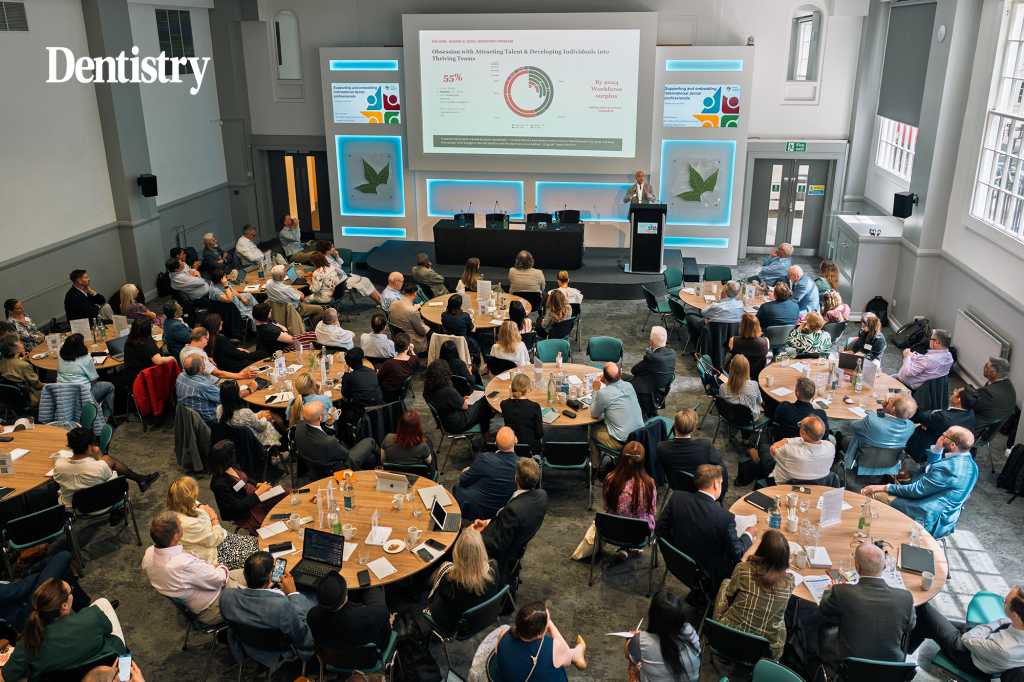
The General Dental Council (GDC) was challenged over the lack of formal quality assurance for Overseas Registration Examination (ORE) preparatory courses at a Dental Leaders Network event exploring how the growing number of internationally qualified dental professionals can be better supported in UK dentistry.
The event, held on 30 June, brought together regulators, educators, employers and professional support organisations to examine a workforce issue that is becoming increasingly central to NHS access, practice recruitment and patient care.
The informative and collaborative day opened with scenario modelling from Stefan Czerniawski, executive director of strategy at the GDC, showing how the make-up of the dental register could change if current and planned registration patterns continued. Under one scenario, fewer than a third of new dentists joining the register could be UK trained by 2029, with UK-trained dentists becoming a minority of the overall register by 2034.
Czerniawski stressed that the figures were scenarios rather than predictions, with future patterns dependent on factors including ORE and Licence in Dental Surgery (LDS) capacity, European registrations, retention and candidate behaviour.
He said this was not a negative trend, stressing that internationally qualified dental professionals made an ‘enormous and invaluable contribution’ to healthcare in the UK. However, the changing workforce raised questions about foundation training, supervised practice, support needs and how the UK remained attractive to internationally qualified dentists.
ORE preparation
One of the most noteworthy exchanges came towards the end of an afternoon panel discussion, when Fiona Sandom, senior lecturer and programme lead for dental hygiene and dental therapy at Bangor University, challenged Czerniawski and the GDC on oversight of ORE preparatory courses.
She asked whether the regulator quality assured ORE educational providers in the same way it quality assured other GDC-registered qualifications.
Czerniawski confirmed there was quality assurance of the ORE itself, but not of the courses candidates take to prepare for it. He said the ORE was structured as a self-contained assessment, with the regulator historically focused on the assessment rather than how candidates prepared for it.
However, he acknowledged that some form of accreditation or standard setting for preparatory courses could be valuable, adding that whether this should be done by the GDC, or under what powers, remained a separate question.
The exchange captured a wider theme running through the day: the ORE remained a central route into UK registration for many overseas-qualified dentists, but the journey around it was often fragmented, expensive and inconsistently supported.
Consistency and cost
Another panellist, Gauri Pradhan, honourable trustee of International Dental Organisation UK (IDO UK), said registration was often the first major hurdle for internationally qualified dentists, with some candidates unsure how to navigate the system despite recent improvements to the ORE booking process.
She said candidates could spend between £15,000 and £18,000 from the point they started the registration process to joining the register, with some paying thousands of pounds for preparatory support without clear validation or accreditation.
Kaushik Paul, clinical director at mydentist, used an earlier talk to discuss how course providers played an important role in preparing candidates, but argued that the profession needed more consistency. Given the cost of the ORE, he said more should be done to help candidates ‘get it right first time’.
Building support
The event, which featured a number of speakers who had come through the ORE pathway, also highlighted the scale of practical support needed after candidates pass the ORE, which has seen a significant rise in cost.
Sam James, overseas resourcing manager at mydentist, said more than 50% of clinicians working with the organisation had qualified outside the UK, and that 474 international dentists had started their journey with mydentist over the previous three years. This aligned with GDC figures released in May showing overseas registrants outnumbered those from the UK for the first time.
He said the company’s approach included overseas training partnerships, recruitment support, help with National Health Service (NHS) performer number applications, visa and relocation support, induction and mentoring.
But speakers were clear that support needed to go beyond formal onboarding. Paul said mentors often helped candidates with practical parts of settling into UK life, such as finding local shops, opening bank accounts, accessing accountants and settling families into new communities. He noted that you can’t just drop a dentist from Mumbai into Makerfield and expect it to work.
Mostafa Hassaan, deputy chief dental officer for Wales and an internationally qualified dentist, said passing the ORE was only the first stage of a longer journey. He argued, with specific examples from his own practice, that integration was fundamentally a leadership issue, with international dentists needing fair first opportunities, clear NHS pathways, mentoring, communication support and help understanding UK patient expectations.
NHS performer number
The NHS performer number process was repeatedly raised as a barrier. Hassaan described it as a major bottleneck, arguing that dentists could pass the ORE, join the register and still face delays before treating NHS patients.
Paul also called for a more consistent approach to NHS performer list systems, arguing that requirements varied between regions and nations.
The panel discussed whether a national induction programme could help internationally qualified dentists move into NHS practice more consistently. Pradhan suggested this could include structured training on NHS systems, local expectations and support from a buddy or supervisor.
However, panellists warned that a short induction alone would not be enough. Sandom said support needed to include tacit learning and mentorship, rather than becoming a tick-box exercise.
Culture and safety
The discussion also moved beyond dentists. Sandom said internationally qualified dental hygienists and dental therapists needed support, while questions were also raised about dental technicians and other registered titles.
She said integration was too often treated as something individual clinicians had to solve on their own, when many were entering complex systems where expectations were rarely spelled out. Clearer pathways, explicit expectations and consistent support, she argued, would allow internationally qualified professionals to contribute fully.
Speakers also raised concerns about exploitation. Neda Irani, restorative clinical teacher at King’s College London, used her lightning talk to highlight that many overseas dentists did not realise they were being exploited because they had not yet had time to learn UK workplace norms, contracts, regulation or professional support structures.
She said support needed to cover practical issues such as contracts, indemnity and professional expectations, as well as the emotional pressures of moving country and starting a career again.
Paul also warned that internationally qualified dentists could be treated as cheap labour, disrespected or discarded when they raised concerns about poor conditions.
Asked who should be responsible for regulating employers and tackling exploitation, Czerniawski said the GDC’s remit covered professional standards, but identifying and acting on exploitation was a wider responsibility shared across the profession.
He suggested that where leaders and colleagues were aware of exploitation, they needed to be prepared to act or provide enough detail for concerns to be followed up.
GDC ORE fee increase
Speakers also linked support for internationally qualified dentists directly to patient access and safety. They said overseas-qualified professionals brought much-needed capacity and clinical experience to areas struggling to recruit, but this needed to be matched with support around communication, consent, complaints handling and cultural expectations.
Biju Ramachandran, honorary secretary and immediate past president of the Indian Dental Association UK, said registration gave dentists permission to practise, while integration helped create belonging.
He also urged the GDC to reconsider its recent ORE fee increase, arguing many candidates were already stretched financially before they sat the exam.
Closing the event, Brid Hendron, postgraduate dental dean at the Northern Ireland Medical and Dental Training Agency, said the day’s central message was to ‘act now and act together’ in preparing for the incoming non-UK qualified workforce.
She said international dentists were an essential part of the workforce solution, with responsibility shared across regulators, employers, support organisations and practice teams.
Follow Dentistry.co.uk on Instagram to keep up with all the latest dental news and trends.
Apa Reaksi Anda?
 Suka
0
Suka
0
 Kurang Suka
0
Kurang Suka
0
 Setuju
0
Setuju
0
 Tidak Setuju
0
Tidak Setuju
0
 Bagus
0
Bagus
0
 Berguna
0
Berguna
0
 Hebat
0
Hebat
0