





























































How Big Meat Distorted the Evidence



Big Meat downplays the magnitude of meat mortality.
A series of studies published in the Annals of Internal Medicine found a statistically significant association between lower consumption of red and processed meats and lower total mortality (meaning living a longer life), lower cardiovascular disease mortality, as well as lower risk of dying from cancer—across the board. Yet, remarkably, the authors of these studies concluded that people should ignore all the other dietary guidelines and keep eating meat to their heart’s content (or rather discontent).
They offered three reasons why their panel reached a conclusion at odds with other contemporary dietary guidelines that advise people to cut down on meat. One reason is taste. In short, people who enjoy eating meat, enjoy eating meat. I talked about this in my last blog, but in short, taste preference probably should not be a major factor in developing dietary guidelines. Many people don’t want to exercise more or stop smoking or drinking, but that doesn’t change the science; it shouldn’t change the public health recommendations.
A second reason they explain why their recommendations differ from everyone else’s is that other guidelines didn’t use the so-called GRADE (Grading of Recommendations, Assessment, Development, and Evaluation) approach, and no wonder, since GRADE was largely created to evaluate evidence from drug trials. There are grading systems for dietary and lifestyle approaches, but the meat panel chose to inappropriately apply GRADE, which similarly “could be misused to undermine recommendations about secondhand smoke, air pollution, trans fats, or physical inactivity”—you name it. I have three blogs delving deep into all that, but this blog is about the third reason they give for ignoring meat reduction advice: Other guidelines didn’t highlight the “very small magnitude” of the effects of meat consumption. In other words, even if meat does cause heart disease, cancer, diabetes, and death, it doesn’t cause that many heart attacks, doesn’t kill that many people, doesn’t cause that much cancer to offset all those taste benefits.
Of course, it matters what people replace the meat with. Replacing even 3% of calories from animal protein with plant protein is linked to living longer. Eggs appear to be the worst. Yes, replacing red meat protein with plant protein sources may lower overall mortality by more than 10%, but eliminating egg protein could mean more than 20% lower risk of premature death. So, if someone reduces meat consumption by replacing a burger with an egg salad sandwich, that particular reduction in meat could mean more mortality.
But maybe the meat panel researchers concluded there was such a small effect only because “major bodies of evidence were omitted, [and] relevant studies excluded because the authors didn’t like the results.” It’s not that there aren’t tons of randomized controlled trials about meat; it’s just that they appeared to cherry-pick a few to fit their agenda, discarded studies that even met their own criteria, and wrongly rejected randomized controlled trials clearly showing that meat increased risk factors like cholesterol or blood pressure. Why wasn’t the PREDIMED trial included? What about the hundreds of randomized trials on the DASH diet?
What about the Lyon Diet Heart Study? It involved randomizing people to a more Mediterranean diet that included a significant drop in meat consumption, as you can see below and at 3:32 in my video How Big Meat Manipulated the Science.
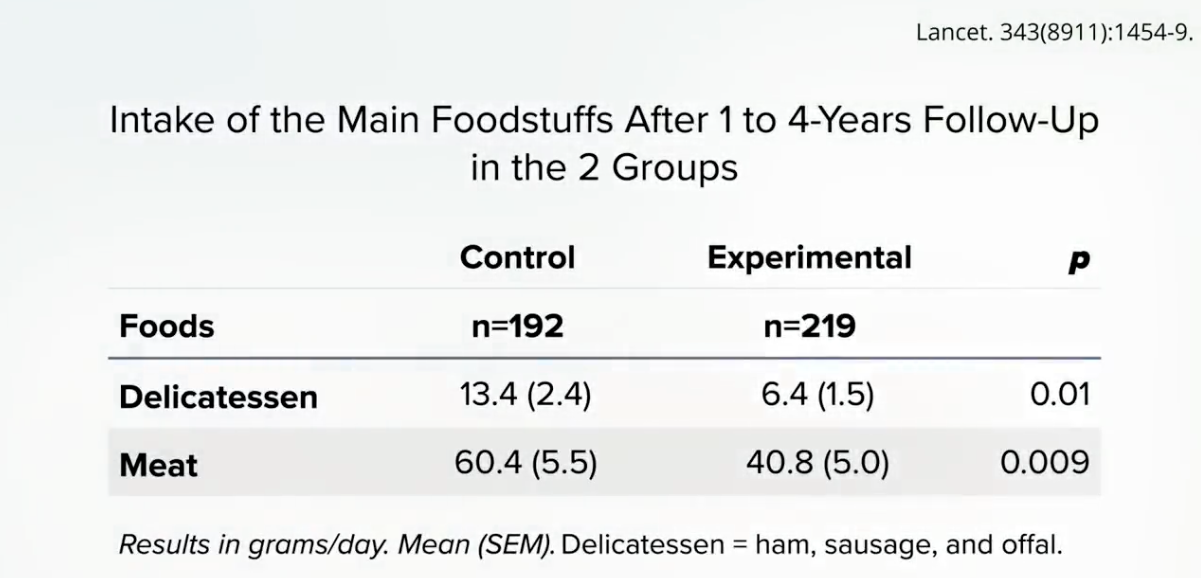
Compared to the control group, those on the lower-meat diet experienced a 70% reduction in mortality from all causes put together. Why did the meat panel exclude that study? They excluded it because, in their words, it reported “an implausibly large treatment effect.” In other words, it worked too well.
That’s no surprise, given that this so-called NutriRECS meat panel was partnered with—and had multiple people on the payroll of—Texas A&M AgriLife, which receives millions of dollars of meat industry money every year. So, it’s probably not shocking to find out that they also excluded research that compared health outcomes of vegetarians to meat eaters. As they described it, they were interested in “realistic decreases in meat consumption,” like cutting out three servings a week. In fact, the study that they mostly relied on, the Women’s Health Initiative, achieved only a difference of 1.4 servings of meat per week. That amounts to a difference in meat consumption of just half an ounce each day—about a fifth of a hamburger.
“Participants in the Women’s Health Initiative reduced meat intake only modestly, resulting in a modest reduction in mortality related to breast cancer. This finding in no way supports the notion that there is ‘No need to reduce red or processed meat consumption for good health.’ Rather, it shows that modest dietary changes yield modest benefits. As an analogy, if studies showed that modest reductions in tobacco use yielded only modest health benefits, it would be inaccurate and dangerous to suggest that there is ‘No need to reduce tobacco use for good health.’”
“To say that small increases in meat consumption only cause small increases in the risk of disease doesn’t mean that eating meat is good for you,” said Dr. Dean Ornish. “That’s like saying that smoking 24 cigarettes a day increases your risk of lung cancer only a little more than smoking 20 cigarettes a day”—and being careful not to include any studies that compared smoking 24 cigs to smoking none—“and then erroneously concluding that smoking isn’t that bad for your health.”
Despite ignoring and excluding evidence, the meat panel “nonetheless found entirely consistent, clinically meaningful, statistically significant adverse effects of eating more meat and processed meat on all-cause mortality, on cardiovascular disease, on cancer, and on diabetes. That they did so despite the obstacles they put on the path to this finding is nearly incredible, and directly bespeaks the magnitude of adverse effects of meat and processed meat intake on health.”
Based on their meta-analyses of large cohorts, dietary patterns with just a moderate reduction in the consumption of red and processed meats were associated with lower total mortality by 13%, lower cardiovascular disease mortality by 14%, lower cancer mortality by 11%, and a 24% reduced risk of type 2 diabetes. We spend tens of billions of dollars a year trying to tweak risk factors by about this magnitude. And this one intervention—a reduction in meat consumption—appears to do all those things at the same time. There are statin drugs that can reduce heart disease risk, but they actually increase risk for type 2 diabetes and have little effect on cancer. If there was a drug that did as much for your health, it would be a multi-billion-dollar blockbuster.
The chair of nutrition at Harvard estimates that moderately reducing red meat consumption could prevent 200,000 deaths each year. Now, the meat panel can call that a very small effect if they want to, but I imagine it’s no small effect to those 200,000 families.
The numbers are on par with the amount of cancer and heart disease attributable to secondhand smoke and based on the same kind of studies—population studies. (They didn’t randomize people to sit in smoky rooms all day for a couple years.) But no rational person who looks at the public health data around the effectiveness of smoke-free zones would argue that people should continue exposing themselves to secondhand smoke; so, why do the same for red meat and processed meats?
The smoking analogy is actually a good one. “[I]magine researchers select studies with extremely small between-group differences in the number of cigarettes smoked per week. They avoid any studies that actually compare smoking to non-smoking [i.e., meat-eating to vegetarian]. They find that despite the small differences in exposure, there is still a clear and consistent benefit of smoking less. They then apply methods of grading the evidence that strongly favor randomized trials over all other methods. Since there are few if any randomized trials of smoking, they conclude that they have very low confidence in the reliability of their own findings. On that basis, they publish guidelines recommending—that the public simply continue to smoke. After all, they reason, people who smoke like smoking.” That really does sum up the Annals of Internal Medicine papers in a nutshell.
That reminds me of a quote from a famous paper published in 1959, compiling all the most poignant evidence linking smoking and lung cancer, after coming up against those same charges of inadequate proof. This quote could just as well have been written about the state of science on meat today. If the mountain of evidence they found “had been made on a new agent, to which hundreds of millions of adults were not already addicted, and on one which did not support a large industry, skilled in the arts of mass persuasion, the evidence for the hazardous nature of the agent would be generally regarded as beyond dispute.”
Doctor’s Note
See this video for more on How Smoking in 1959 Is Like Eating in 2019.
This is the seventh in an eight-part series on how industries impact dietary and health guidelines. The first six parts are in the related posts below.
The final blog, coming up, is How Many Minutes of Life Does a Burger Cost?.
What's Your Reaction?
 Like
0
Like
0
 Dislike
0
Dislike
0
 Agree
0
Agree
0
 Disagree
0
Disagree
0
 Excellent
0
Excellent
0
 Useful
0
Useful
0
 Great
0
Great
0