








































How Mountain Forests Regulate Water: From Rainfall and Snowmelt to Streams
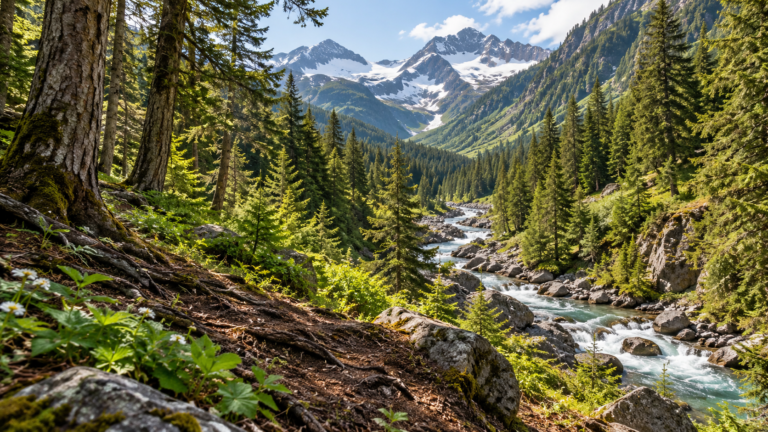
High in the mountains, forests do much more than provide habitat and cover steep slopes.
They are also closely connected to the movement of water through entire landscapes.
Rain and snow falling on mountain forests interact with tree canopies, roots, soils, leaf litter, rock layers, streams, and groundwater before continuing downhill.
These processes influence when water reaches rivers, how much soil is carried with it, how water quality changes, and how much moisture remains available within the ecosystem.
Understanding mountain forest water regulation is therefore important not only for forest ecology but also for agriculture, drinking-water supplies, aquatic ecosystems, communities, and watershed management downstream.
Forest Vegetation Intercepts Rainfall
When rain reaches a mountain forest, it does not immediately strike the soil.
Leaves, branches, trunks, shrubs, and other vegetation intercept some of the precipitation.
Part of this intercepted water may eventually drip to the forest floor.
Some may run down branches and trunks.
Another portion can evaporate back into the atmosphere.
By intercepting rainfall, vegetation changes the timing and distribution of water reaching the soil.
The amount intercepted varies according to factors such as:
- Tree species
- Canopy density
- Leaf area
- Rainfall intensity
- Rainfall duration
- Wind
- Season
- Forest structure
During a light rainfall event, a relatively large proportion of the water may remain temporarily on vegetation.
During prolonged or intense rainfall, the canopy becomes increasingly wet and more water reaches the ground.
Mountain Soils Store and Redistribute Water
Once water reaches the forest floor, soil becomes another important part of the mountain water system.
Healthy forest soils often contain roots, organic matter, pores, microorganisms, and decomposing plant material.
These characteristics can allow water to infiltrate rather than immediately flowing downhill across the surface.
Water entering the soil may:
- Remain available to plants
- Move deeper into the soil profile
- Travel laterally through hillslopes
- Contribute to groundwater
- Eventually reach springs and streams
The amount of water that can be stored depends on many factors.
These include soil depth, texture, organic matter, geology, slope, vegetation, previous moisture conditions, and disturbance.
Mountain soils should therefore not be viewed as unlimited reservoirs.
Their ability to absorb and retain water varies considerably from one landscape to another.
Forests Can Slow Surface Runoff
Steep terrain makes mountain watersheds naturally vulnerable to rapid water movement.
Vegetation can help modify that movement.
Leaves and branches reduce the direct impact of raindrops.
Leaf litter and fallen organic material make the forest floor rougher.
Roots help maintain soil structure and create pathways for infiltration.
Together, these characteristics can reduce the speed at which water flows directly across the land surface.
Slower surface movement can provide more opportunity for infiltration.
It can also help reduce the amount of sediment carried downhill toward streams.
This is one reason maintaining healthy soil and ground cover is so important in mountain watersheds.
Mountain Forests Support Streamflow
Water that infiltrates forest soil does not necessarily remain there permanently.
Some eventually moves toward streams.
Water may travel through shallow soils, deeper subsurface layers, or groundwater systems before reaching rivers and springs.
These different pathways operate over different timescales.
Some water reaches streams quickly following rainfall.
Other water may take much longer.
This movement can contribute to streamflow between individual storms or during periods without recent rainfall.
However, forests do not affect water yield in exactly the same way everywhere.
Climate, geology, soil depth, tree species, forest age, snow cover, evapotranspiration, and disturbance all influence the relationship.
In some environments, removing forest cover can temporarily increase water yield because fewer trees intercept and transpire water.
At the same time, forest disturbance may increase erosion, sediment movement, alter snow processes, or reduce other watershed benefits.
For this reason, forest-water relationships need to be understood at the watershed level rather than reduced to a simple rule that “more trees always produce more water.”
Roots Help Stabilize Mountain Slopes
Mountain landscapes are shaped by gravity.
On steep slopes, soil and rock naturally have a greater tendency to move downhill.
Tree and plant roots can help strengthen the upper soil layers by binding soil particles together.
Vegetation also helps protect the soil surface from direct rainfall impact.
Together with leaf litter and healthy soil structure, roots can contribute to slope stability and erosion resistance.
When forests are heavily disturbed, steep slopes may become more vulnerable to erosion.
The risk is particularly important where disturbance also involves:
- Road construction
- Soil compaction
- Removal of ground cover
- Severe wildfire
- Poorly managed logging
- Concentrated drainage
- Already unstable slopes
It is important, however, to recognize that forests cannot prevent every landslide.
Very intense rainfall, unstable geology, earthquakes, or saturated soils can still cause mass movement in forested landscapes.
Mountain Forests Influence Water Quality
The condition of mountain watersheds can affect the quality of water flowing downstream.
Healthy vegetation helps protect the soil from erosion.
Leaf litter and ground vegetation can slow runoff.
Soils and vegetation may retain sediment and some nutrients before water enters rivers and streams.
This is particularly important because many rivers originate in mountainous or upland areas.
Excessive erosion can increase sediment concentrations downstream.
Sediment can affect:
- Aquatic habitats
- Reservoir capacity
- Drinking-water treatment
- Irrigation systems
- Fish spawning areas
- Stream ecosystems
Protecting vegetation and soil within mountain watersheds can therefore contribute to water-quality protection far beyond the forest itself.
Forest Cover Influences Snowmelt
In cold mountain regions, snow can be just as important as rainfall.
Snowpack stores precipitation during winter and releases water during warmer periods.
Forests influence this process in several ways.
Tree canopies can intercept falling snow.
Shade beneath trees reduces incoming solar radiation.
Forests alter wind patterns.
Vegetation also influences local temperature and energy exchange.
These processes can change where snow accumulates and how quickly it melts.
Open areas often receive and melt snow differently from densely forested areas.
As a result, forest structure can influence the timing of snowmelt entering soils and streams.
This is especially important in regions where mountain snowpack provides a major share of annual downstream water supplies.
Forest Litter Protects Mountain Soils
The layer of organic material covering a forest floor is easy to overlook.
Leaves, needles, bark, twigs, woody material, mosses, and partially decomposed vegetation form an important protective layer.
Forest litter can temporarily intercept rainfall.
It also protects mineral soil from direct raindrop impact.
By increasing surface roughness, litter can slow water moving downhill and create additional opportunities for infiltration.
As the material decomposes, it also contributes organic matter to the soil.
Removing or severely disturbing this surface layer can therefore affect both erosion resistance and water movement.
Forest Loss Can Change Water Flow
Removing forest vegetation changes how water interacts with the landscape.
When trees are removed, interception and transpiration decline.
This can increase the amount of water reaching soils or streams in some circumstances.
But forest loss can also expose soils, reduce root reinforcement, disturb organic layers, increase erosion, and alter infiltration.
The overall effect depends greatly on how the forest is removed and what happens to the land afterward.
A carefully managed timber harvest will not necessarily have the same effects as extensive land clearing, severe wildfire, road construction, or conversion to agriculture.
Roads deserve particular attention.
Poorly designed forest roads can concentrate runoff, expose mineral soil, and become important sources of sediment.
For mountain watershed management, the location and construction of roads and drainage systems can therefore be just as important as tree removal itself.
Climate Change Creates Additional Pressure
Mountain forests are particularly sensitive to changes in precipitation and temperature.
Warmer conditions can alter snow accumulation and cause snow to melt earlier.
Precipitation that once fell as snow may increasingly arrive as rain in some mountain regions.
Longer dry periods can reduce soil moisture.
Higher temperatures can increase evaporative demand.
More intense rainfall events can increase runoff and erosion risk.
These changes may alter the timing and quantity of water moving through mountain watersheds.
Forests themselves may also experience additional stress from:
- Drought
- Wildfire
- Insects
- Disease
- Changing species ranges
- Heat stress
A forest already weakened by environmental stress may not provide the same watershed functions as a healthy and resilient forest.
Mountain Watersheds Connect Forests With Communities
The influence of mountain forests extends far beyond the upper slopes.
Water originating in mountain watersheds may eventually support:
- Communities
- Agriculture
- Drinking-water systems
- Hydropower
- Wetlands
- Fisheries
- Wildlife
- Industry
- Recreation
This makes mountain forest conservation a watershed issue rather than simply a forestry issue.
Changes taking place high on a mountain can affect people and ecosystems many kilometers downstream.
Managing these landscapes responsibly requires understanding these upstream-downstream connections.
Managing Mountain Forests for Water
There is no single management strategy appropriate for every mountain forest.
Different forests have different climates, soils, slopes, species, water demands, and disturbance histories.
However, several broad principles can help protect forest-water functions.
These include:
- Maintaining healthy vegetation cover
- Protecting forest soils
- Limiting unnecessary soil compaction
- Maintaining organic matter and forest-floor cover
- Carefully managing forest roads
- Protecting streamside vegetation
- Reducing excessive erosion
- Supporting appropriate forest regeneration
- Monitoring wildfire and drought impacts
- Considering water when planning forest management
Effective watershed management looks at the entire system rather than any one component in isolation.
Forests Do Not Simply “Create” Water
One important misconception should also be avoided.
Forests are extremely important to water cycles, but they do not simply create additional water.
Trees use water.
They return substantial amounts of it to the atmosphere through transpiration.
Canopies intercept precipitation, some of which evaporates before reaching the ground.
At the same time, forests can protect soils, encourage infiltration, reduce erosion, influence streamflow timing, and maintain water quality.
That combination is why forest-water relationships can appear complicated.
A healthy mountain forest is not simply a giant water tank.
It is a living component of a watershed that continuously exchanges water among vegetation, soil, streams, groundwater, and the atmosphere.
Conclusion
Mountain forests play an important role in regulating how water moves through landscapes.
Tree canopies intercept rainfall.
Healthy forest soils allow water to infiltrate and temporarily store moisture.
Roots and ground vegetation help protect steep slopes.
Forest litter slows surface flow and protects soil.
Snow-covered forests influence where snow accumulates and when meltwater enters streams.
These processes affect runoff, erosion, streamflow, groundwater, water quality, and downstream water supplies.
But the relationship between forests and water is not identical everywhere.
Climate, soil, geology, vegetation, slope, snow, and forest management all influence the outcome.
Protecting mountain watersheds therefore requires more than simply protecting trees.
It requires maintaining healthy soils, vegetation, stream corridors, forest-floor cover, and hydrological processes across the landscape.
When mountain forests are managed with water in mind, their benefits can extend far beyond the trees themselves—supporting ecosystems, farms, rivers, and communities throughout the watershed.
Learn More About Forest and Watershed Management
Understanding how forests, soils, water, and communities interact is an important part of responsible environmental management.
The Ecolonomics Action Team (EAT Community) connects people interested in forest ecology, water management, regenerative systems, environmental restoration, and sustainable business.
Join the EAT Community to learn from environmental professionals and explore practical approaches to protecting natural resources while supporting productive communities.
Sources & Further Reading
FAO — Forest and Water
Forest and Water FAOHome
FAO — Water and Mountains
Water and Mountains FAOHome
FAO — Mountain Forests / Sustainable Mountain Development
Sustainable Mountain Development FAOHome
FAO — A Guide to Forest–Water Management
A Guide to Forest–Water Management FAOHome
USDA Forest Service — Hydrology of Cold-Region Montane Forested Watersheds
Hydrology of Cold-Region Montane Forested Watersheds USDA Forest Service Research
USDA Forest Service — Protecting Soil and Water in Forest Road Management
Protecting Soil and Water in Forest Road Management

The post How Mountain Forests Regulate Water: From Rainfall and Snowmelt to Streams first appeared on WorldWide Aquaculture.
Apa Reaksi Anda?
 Suka
0
Suka
0
 Kurang Suka
0
Kurang Suka
0
 Setuju
0
Setuju
0
 Tidak Setuju
0
Tidak Setuju
0
 Bagus
0
Bagus
0
 Berguna
0
Berguna
0
 Hebat
0
Hebat
0