

































Mild feed restriction has variable effects on cage-free pullets’ weight, activity and egg production

Today’s cage-free laying systems provide extra vertical space for birds to be physically active, which can lead to variability in feed intake and body composition. If feed was restricted, would chickens change their activity levels, or would a hypothalamic response be triggered to increase feed intake?
Researchers from Auburn University and the University of Guelph conducted a trial to answer those questions. During the trial, they recorded where the birds spent their time, egg production and body fat deposition.
Olivia McGuire, a graduate student at Auburn, discussed the research and results during the 2026 International Poultry Scientific Forum.
Trial design
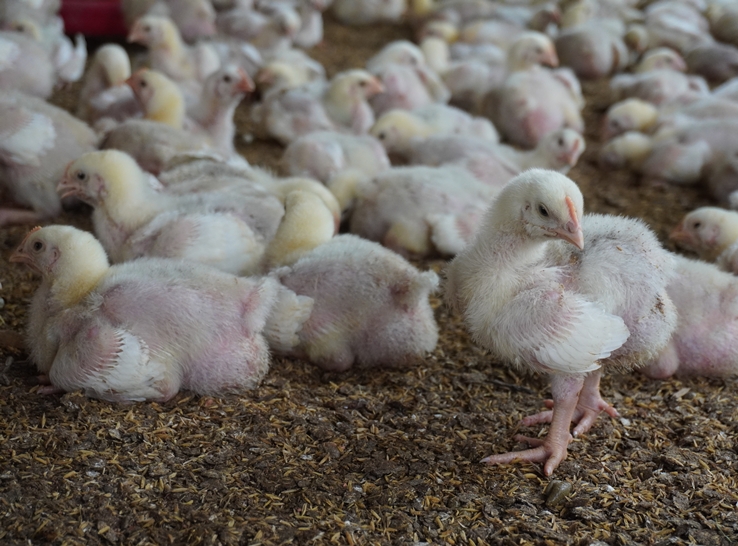
The study involved 600 Lohmann LSL Lite pullets at 12 weeks of age. The pullets were randomly assigned to four rooms divided into six aviary pens. Each pen had two perches, two elevated platforms, a 45-degree ramp and nest boxes.
At 13 weeks of age, birds in half of the pens were fed ad libitum. Birds in the other half were fed twice daily and received 20% less feed than average consumption. The feed restriction ended at 21 weeks of age.
Pen-mounted cameras scanned pens hourly to record bird locations. The number of eggs laid and where chickens laid the eggs were also recorded.
Every 2 weeks, one bird per pen was euthanized to measure abdominal fat, record weight and collect hypothalamus and pituitary tissue for analysis.
Feed-restricted outcomes
Overall, restricted birds spent more time on the litter while ad libitum birds preferred perches and elevated platforms, McGuire noted.
“We noticed a shift in location preference during the time of sexual maturation,” she added. “Between 18 and 20 weeks of age, both treatment groups spent more time on the litter than in other locations.”
Feeding treatment did not affect birds’ location at the start of the night. All birds chose to roost or seek shelter.
“But feed-restricted birds definitely had a delay in egg production compared to birds fed ad libitum from 20 to 21 weeks of age,” McGuire said. “We also observed that all birds preferred to lay eggs within the nest boxes rather than on the litter. So, restricted feed did not impact where eggs were laid.
“We expected to see a weight decrease with feed restriction,” she continued. “By the time feed restriction was lifted, those birds were 8.8% lighter than birds fed ad libitum.”
Feed-restricted birds had lower abdominal fat measurements at 16 to 20 weeks of age than ad libitum hens.
The researchers also tested whether the mild feed restriction elicited a hypothalamic response to increase feed intake or decrease locomotion. They did not observe an increase in neuropeptide Y (NPY) or Agouti-related peptide (AgRP) expression in either feeding group. McGuire added that the expression of these peptides, which stimulate hunger, typically increase during energy deficit.
Final takeaways
“Mild feed restriction caused a decrease in bodyweight, energy reserves and delayed maturation,” McGuire said. “The birds preferred to stay on the floor.
“Decreased energy intake did not affect NPY and AgRP expression,” she continued. “Feed-restricted birds ate less than an hour a day. They were fed twice a day but never reached chronic hunger.”
McGuire suggested that the level of energy restriction was not sufficient to trigger a hypothalamic response to hunger.
Feed restriction also did not affect the choice to seek shelter at night or the location of egg laying.
She also noted that the increased use of litter by the feed-restricted birds “is likely not to conserve energy but rather due to unmet behavioral satisfaction.”
The post Mild feed restriction has variable effects on cage-free pullets’ weight, activity and egg production appeared first on Modern Poultry.
Apa Reaksi Anda?
 Suka
0
Suka
0
 Kurang Suka
0
Kurang Suka
0
 Setuju
0
Setuju
0
 Tidak Setuju
0
Tidak Setuju
0
 Bagus
0
Bagus
0
 Berguna
0
Berguna
0
 Hebat
0
Hebat
0