























































Walking Through Istanbul: From Ancient Empires to Vibrant Neighborhoods


Istanbul is a historical treasure with landmarks dating back to the Byzantine and Ottoman Empires. Being the gateway for the Silk Road, Istanbul is where East meets West. Most of the historic landmarks are on the European side. So, it’s fun and accessible to explore many iconic sites that are close together. I enjoyed most of my time in Istanbul on my own DIY walking tours. So, read on and discover these top things to do on your own walking tour.
About Istanbul

As Turkey’s cultural and economic capital, Istanbul straddles the Bosporous Strait. It’s the boundary between Europe and Asia. The city becam founded by Greek settlers in the 7th century BCE. The Roman Emperor, Constantine the Great, made it the imperial capital, calling it Constantinople. In 1930, the city became renamed to Istanbul. The city served as the imperial capital for almost 1600 years during the Byzantine, Latin, Late Byzantine and Ottoman empires. It became an iconic landmark for the Silk Road.
The city advanced Christianity, hosting the first seven ecumenical councils. With the Fall of Constantinople in 1453 CE, it became an Islamic city seat for the Ottoman Caliphate. After the Turkish War of Independence in 1923, Istanbul became the capital of the Republic of Turkey.
Istanbul is primarily known for its Byzantine and Ottoman architecture. Despite its development as a Turkish city since 1923, it contains many ancient, Roman, Byzantine, Christian, Muslim, and Jewish monuments.
Istanbul’s historic area is a UNESCO World Heritage Site. It was strategically located for trade and defense. The confluence of the Bosporus, Golden Horn and Sea of Marmara provides ideal defense and a natural toll-gate. Istanbul’s temperate climate is transitional between the Mediterranean and Oceanic climates.
Check out my YouTube Video!
Istanbul Walking Tour Highlights
on European Side
The Bosporus Strait divides Istanbul, with the eastern side in Asia and western side in Europe. The Asian side of the Bosporus makes up a suburb for the commercial and economic centers. The European side makes up the historic peninsula or Fatih District. This corresponds with the city of Constantinople until the Ottoman conquest. Also, the historic district includes the Galata and Besiktas neighborhoods.
Cruise Between Two Continents

Along the waterfront, there are many opportunities to take a cruise of ferry on the Bosphorus Strait. This iconic strait marks the waterway between the European and Asian continents. It connects the Sea of Marmara and Black Sea. This is a great way to get an overview of Istanbul and explore the iconic sites from water. For instance, cruises go by the Dolmabahce Palace, Maiden Tower, Rumeli Fortress, Ortakoy Mosque and Bosphorus Bridge. This bridge was the first built on the strait between Europe and Asia.
Dolmabahce Palace and Clocktower
Bestikas District

Near Galata in the Bestikas District on the Bosporus waterfront is the opulent Dolmabahce Palace and Clocktower. It was the administrative center of the Ottoman Empire from 1856 to 1887 and 1909 to 1922. As the largest palace in Turkey, its eclectic design blends Baroque, Rococo and Neoclassical styles with Ottoman architecture.
The palace is elaborately decorated with crystal and gold. It displays the world’s largest crystal chandelier in the Ceremonial Hall. Also, Dolmabahce offers the largest collection of Baccarat and Bohemian crystals in the world. The stunning Crystal Staircase is shaped as a double horseshoe and built with Baccarat crystal.
The Dolmabahce gardens are stunning in a well-manicured area to explore the palace waterfront. Indoor palace tours are controlled and organized. You follow a one-way walkway through the palace with no photo-taking allowed.
Galata Tower, Bridge and District

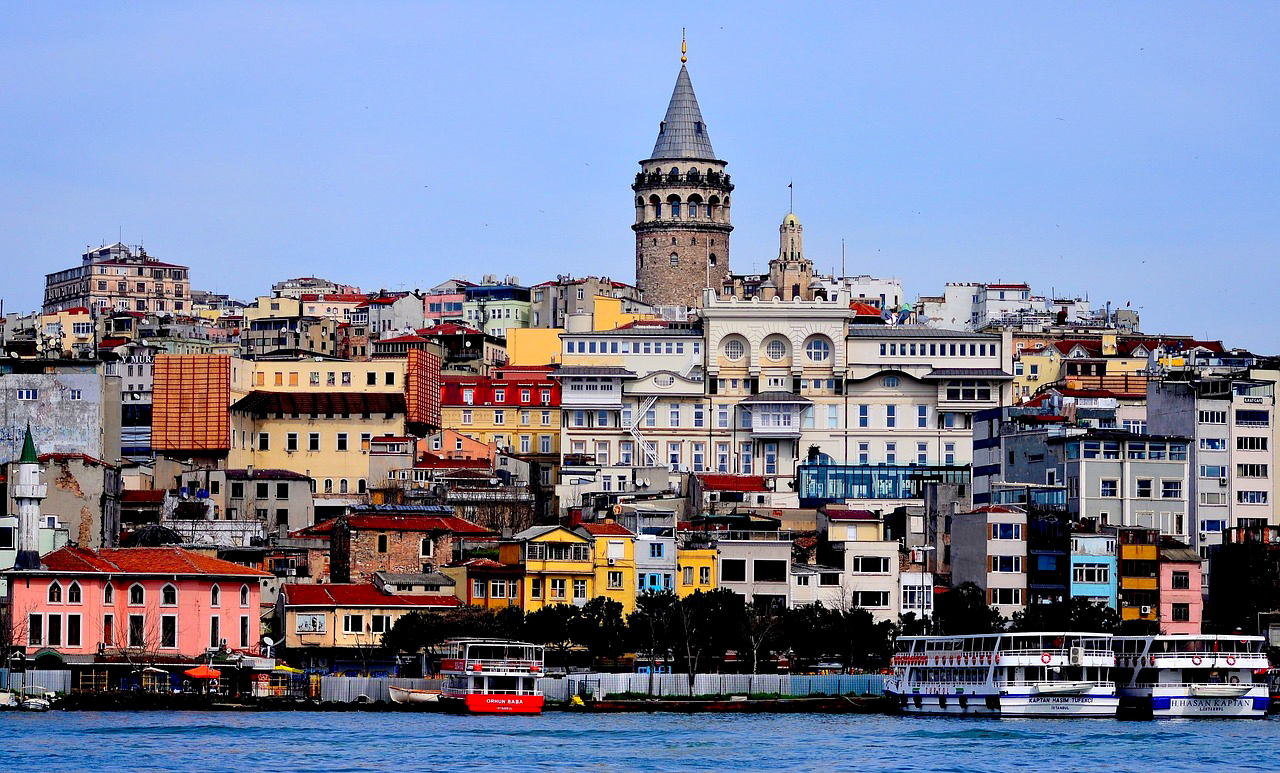
The Galata District is one of Istanbul’s oldest and most historic districts. It dates back to the Byzantine Era. The hilltop Galata Tower is the symbol of Istanbul. Built as a lighthouse in 528, it became damaged during the Crusades. Rebuilt by the Genoese in 1348, it became part of the Galata walls. Today, it’s a museum with one of the best observation decks with 360-degree views of Istanbul.
The vibrant neighborhood, Kuledibi, surrounds the tower with shops, cafes and restaurants. The must-see Istiklal Street is the most famous street in Istanbul. It connects the Galata Tower to Taksim Square. Near the Galata Tower is the Galip Dede Ramp, a steep and winding street lined with traditional Ottoman houses. Also, the Kamondo Stairs offers a great photo op, leading from Bankalar Caddessi to the Galata Tower.
Galata Bridge crosses the bay known as the Golden Horn. Furthermore, the bridge joins the cruise terminal to the old town with 2 levels. You can walk or drive across the bridge. Many fishermen dangle their bait from the top. Below, many restaurants and cafes offer outdoor seating with spectacular views of the water and city.
Fatih or Historical Peninsula
Istanbul Turkey Attractions
The Fatih district is the historical peninsula, also known as old Constantinople. It is surrounded by the Golden Horn to the north, Sea of Marmara to the south. The Theodosian wall is on the west and Bosphorus Strait on the east. Many of the famous historic landmarks are on this peninsula.
Egyptian Spice Bazaar


Near the Galata Bridge and the east end of the Grand Bazaar is the Egyptian Spice Bazaar. The bazaar has been the center for spice trade in Istanbul for centuries. It is part of the New Mosque, with revenues used for maintaining the mosque.
Overall, the indoor halls of the bazaar offer more than 80 shops for selling spices, Turkish delight, dried fruit and nuts and souvenirs. Interestingly, this market is well-known for selling natural medicines from herbs, spices, seeds, barks and roots.
Inside the Spice Bazaar is a local favorite since 1901, the Pandeli Restaurant. I reserved my table for a world-class, culinary experience. It’s Michelin recommended for their delicious Turkish cuisine. The vibrant, blue-tiled setting is a colorful reminder of their culture. I loved every morsel of my borek, arugala salad, seabass with mashed potatoes and spinach with dessert.
Grand Bazaar

This world famous 500-year-old landmark is one of the largest covered bazaars in the world. Nothing takes you back to the historic origins of Istanbul more than the sights, sounds and smells of the Grand Bazaar. It is one of the first covered shopping mall in the world. The bazaar offers more than 4,000 shops with numerous restaurants and even mosques. Getting lost is easy in the maze of shops filled with carpets, ceramics, spices, souvenirs and gold jewelry.
Sultanahmet Square
Istanbul Turkey Attractions
Next to the Blue Mosque, the Sultanahmet Square is where the Hippodrome of Constantinople once stood and chariot races happened. An Egyptian Obelisk still stands. However, only a third of the original height displays. Other monuments in the square include the Serpentine Column, the Colossus and the German Fountain.
Sultanahmet or Blue Mosque
The famous Blue Mosque is an iconic monument of Ottoman architecture. Officially, the Sultan Ahmed Mosque, it was completed in 1617. The Blue Mosque is named for its turquoise color. Also, the word turquoise means ‘stone from Turkey.’
Its central dome is surrounded by four semi-domes over the prayer hall with six minarets. Inside, the mosque is covered with thousands of blue, green and white Iznik tiles and painted floral motifs.
The religious complex includes Ahmed’s tomb and madrasa. The Blue Mosque stands close to both Sultanahmet Square and Hagia Sophia.


Hagia Sophia
A short walk from the Blue Mosque, the Hagia Sophia is a multi-cultural monument with an impressive history. It is one of the most visited sites in Istanbul. The Hagia Sophia is a symbol of Byzantium. It began as a Byzantine church in 600 AD. Later, the church converted to a mosque. Now, you can tour inside and see the Byzantine mosaics and the altar moved to face mecca. It retains human forms in the mosaics, even though Muslims only praise Allah in their mosques’ decorum. The main feature of the building is its massive spherical dome. Some legends say its structural dynamic is divine intervention.
I enjoyed a tour to understand better the complex history of this monument. The building is currently undergoing its largest restoration in history. The ground level is currently utilized as a mosque. The upper floor is a museum. The tour includes iconic remnants from the Byzantine mosaics. The interior once shimmered in gold and colored glass tessarae depicting the heaveanly realms.
Don’t miss the Adhan or Islamic Call to Prayer done 5 times a day! I was in awe standing at Hagia Sophia during the Adhan. For about 10 minutes the hauntingly loud Duet Prayer Call chanted back and forth between Hagia Sophia and Blue Mosque!
Basilica Cistern Museum

Across the road from the Hagia Sophia is the historic Basilica Cistern Museum. This covered cistern provided water to the grand palace used by the Eastern Roman Emperor, Justinian in the 6th century. Furthermore, this engineering marvel once brought drinking water with aqueducts from current Bulgaria to Istanbul.
This spectacle showcases 336 marble columns, Medusa heads and sculptures. Colored lights reflect on the water with classical music. It is an artistic revival of old and new for tours of this eerie but enchanting site.
Topkapi Palace

The Topkapi Palace complex construction started after the conquest of Istanbul by Mehmet II the Conqueror in 1478. Used as a palace for about 380 years, it became the official residence of the Ottoman sultans until the construction of the Dolmabahce Palace. It displays opulent decorum of Iznik tiles and Ottoman carvings.
This massive complex is best explored with a guide and tickets purchased in advance. Top attractions at the complex are the Harem and treasury storing the crown jewels with the famous Topkapi dagger.
Istanbul Archeological Museums

Near the Topaki Palace and Tulhane Park is the Istanbul Archeological Museum. It is one of the largest museums in the world with more than one million works. Its main cultural collections include Turkish, Hellenistic and Roman. Popular artworks showcase the sarcophagus of Alexander the Great, depicting phases of his life. Plus, the Tiled Kiosk Museum features cobalt blue Iznik tiles and ceramics. Also, in the Museum of the Ancient Orient is the Treaty of Kadesh, the world’s first peace treaty.
It consists of 3 main museums:
1. Archeological Museum located in main building
2. Museum of the Ancient Orient
3. Museum of Islamic Art, housed in the Tiled Kiosk
Gulhane Park

The Gulhane Park was once part of the outer garden of Topkapi Palace, mainly consisting of a grove. Now, it’s a historical, urban park that is one of the oldest and biggest parks in Istanbul. It’s an incredible green space with gardens and benches to relax and ruminate on all the incredible history in the area.
Yudikule Fortress and City Walls

The city walls of Istanbul protected the city for over a thousand years. This Byzantine fortification first became constructed by Emperor Constantine I in the 4th century. Later, it became enhanced by Emperor Theodosius II in the 5th century. His walls consisted of a triple-layered defense with an outer and inner wall with a moat. This massive wall surrounded Constantinople on the sea and land. The western land wall was the most important for protecting against invaders. A massive chain spread across the Golden Horn.
One of the best ways to explore the walls is at the Yedikule Fortress or “Fortress of 7 Towers.” This monument is strategically at the point where the land meets the Marmara Sea. It helped protect the city for hundreds of years until the Ottoman conquest of 1453.
I visited the Yedikule Fortress to best understand the history behind these walls. The fortress provides stunning views of the backdrop of the city and sea with perspective on its location. Also, the fortress features the Golden Gate. It was the main ceremonial gate through which Byzantine emperors entered the city during processions. We also explored inside a tower, that later became a prison.
Chora Church or Kariye Mosque

The Chora was one of my biggest surprises in Istanbul! This iconic site is one of the best marvels for Late Byzantine art in Istanbul. With 6 domes on the outside, the interior is almost covered in vibrant mosaics and frescos. One could easily spend a whole day here observing the artistic detail and story-telling.
It is located in the western Fatih District near Fener-Balat neighborhoods. Interestingly, when the Byzantine Empire collapsed to the Ottoman Empire, the Chora became an inspiration for the Italian Renaissance. The Europeans fled Istanbul back to Italy and Greece with the Chora as a muse. Thankfully the art was covered and protected during the Ottoman era.
Originally, The Chora was a Byzantine church named after Chora meaning countryside in Greek. Later, it became a mosque, then museum and again a mosque.
The building is divided into 3 sections:
1. Entrance or Narthex – The mosaic depicts scenes from Virgin Mary’s life on the left side. The right side portrays miracles performed by Jesus Christ.
2. Body of the Church or Naos – The largest dome looms over the center of the naos. Three mosaics remain in this body of the church.
3. Funerary Chapel or Parekklesion – This side chapel was used for funerary services. This section is adorned with frescos depicting scenes from the Holy Bible. The theme is salvation with images of Anastasis and Last Judgement. The Anastasis scene is a famous example of late Byzantine art referred to by scholars.
Fener-Balat Walking Tour

The Fener-Balat historic neighborhoods are where the non-Muslims lived during the Ottoman period. Fener was the Greek quarter and Balat the Jewish quarter. Just up the Golden Horn from Eminonu Square these neighborhoods lie next to each other. I took the purple line on the tram from Eminonu to Fener. I had a blast and even observed a scene from a movie being made.
These prosperous areas left behind many historic buildings. Today, the neighborhoods are upcycled into a colorful, hip scene ready for Instagram at every turn. They are is overflowing with restaurants, cafes, shops and boutiques. Many of the buildings are painted in vibrant colors. Here are the Fener-Balat highlights:
- Golden Horn Waterfront
- St. George’s Cathedral – Spiritual Center for Greek Orthodox Christians
- Greek Orthodox College
- Fener and Balat Colorful Houses
- Colorful Stairs/Merdiveli Street
- Bulgarian St. Stephen Church – Unique for cast-iron construction
Plus, Three Iconic, Turkish Things to Do:
Baklava Tasting with Turkish Coffee at Karakoy Gulluoglu

You can’t go to Istanbul without taste-testing baklava and Turkish coffee. Baklava is the most popular sweet pastry of Ottoman cuisine. It’s made of filo pastry, layered with goodies. Near the Galata cruise port is the charming Karakoy Gulluoglu. It offers a variety of baklava options, such as pistachio, walnut, gluten-free, hazelnut, diabetic, vegan and tray baklavas.
I enjoyed my tray with 3 baklava pastries: chocolate, pistachio and walnut. Also, I savored a cup of Turkish coffee with the pastries. Turkish coffee is ground to a powder and served with a small cup of water. According to tradition, you drink the water first to cleanse the palate for the coffee.
In Turkey, coffee culture is often accompanied by fortune telling or “tasseography.” After finishing the coffee, you read the leftover coffee grounds. For example, here are some impressionistic meanings:
double line: journey to somewhere
bird: good news
fish: good luck or kismet
peacock: money
Get a Hammam or Turkish Bath

When visiting Turkey, you must try one of their greatest traditions, the Hammam or Turkish Bath. This is an elaborate therapeutic process that can last hours. It starts with a steam bath to sweat out toxins. Then, wearing nothing but a cotton cloth, you receive a deep exfoliation and scrub all over the body from a therapist. Lastly, you can enjoy a massage. Your skin will never feel so clean and muscles so relaxed!
In Istanbul, I indulged in a hamam at the historic Cagaloglu Hamam. It was one of the last hamams built during the Ottoman period. The building consists of a double dome hamam in the Ottoman Baroque style of the 18th century. Also, it provided services for many famous guests, such as John Travolta, Oprah Winfrey and Steve Irwin. Interestingly, the book called 1,000 Places to See Before You Die features the Cagaloglu Hamam.
Whirling Dervish Ceremony

The Sufi whirling dervishes is a worshipping service of the Mevlana followers. It became founded by the Persian poet, Rumi in the 13th century. During the ceremony, Dervishes whirl into circles. Going into a prayer-induced trance, they become a bridge between Gods and humans. UNESCO honored the ritual as a Heritage of Humanity. There are many venues to buy tickets for the performances.
I attended the Whirling Dervish performance at the Hodjapasha Cultural Center. The building is a nicely restored Ottoman haman. Go early to learn more about this ritual from the exhibits. The performance lasts about an hour with an intimate experience watching these mystics. During the performance, no photos or videos are allowed.
Enjoy Istanbul!
This historic city is truly where East meets West. The Istanbul European side is easy to explore with many of the historic landmarks within walking distance. Istanbul is a treasure and filled with gems to discover a deep history of multicultural influences. If your travels bring you to Istanbul, please leave comments below on travel tips.
Read Next!
Enchanting Bodrum, Turkey Travel Highlights
The Best of Ephesus and Five Must-See Historic Sites
The post Walking Through Istanbul: From Ancient Empires to Vibrant Neighborhoods appeared first on True Wind Healing Travel.
What's Your Reaction?
 Like
0
 Dislike
0
 Agree
0
 Disagree
0
 Excellent
0
 Useful
0
 Great
0