
































































7 Core Exercises for Beginners to Try at Home: TRX Training Workout Guide


You finish your first real lower body workout, stand up, and your back feels worked harder than your legs. That is your core telling you it is the weak link, and it has been the weak link in every workout. Good news. Core exercises for beginners can fix it at home, on a yoga mat, in about twenty minutes a session.
This guide walks you through seven beginner core exercises you can do at home, with the form cues that keep you out of trouble and a full sample workout you can use today. Five of them need nothing but the floor. The last two introduce the TRX Suspension Trainer™, which is the natural step up once the bodyweight versions get easy. Smart to clear any new training with your doctor first, especially if you are nursing existing back issues.
Need help figuring out where to start? Take the TRX Training Quiz and get pointed toward the workouts and equipment that fit your goals and current fitness level.
Take Our Training Quiz Today
How Do You Strengthen Your Core as a Beginner?
Pick five to seven foundational core strength exercises for beginners that train you in multiple directions, start with static holds before you add dynamic movement, train two to three times a week, and progress by adding time, reps, or instability rather than load. That is the entire playbook for a beginner.
Here is what you will learn to do:
-
Dead Bug
-
Bird Dog
-
Glute Bridge
-
Forearm Plank
-
Side Plank
-
TRX Suspension Trainer Plank
-
TRX Suspension Trainer Standing Roll-Out
The next sections break each one down step by step.
What Counts as Your Core (And Why It Matters)
Your core covers way more than your abs. It includes the rectus abdominis (the visible "six-pack"), the deeper transverse abdominis, the internal and external obliques on the sides, the erector spinae and multifidus running up the back, and the deep stabilizers around the pelvis and hips. All of those muscles work together to keep your spine stable while your arms and legs do the work.
Why does that matter for a beginner? Because your core's main job is to resist motion, not create it. Strong, well-trained core muscles protect your spine, improve posture, and transfer force from your legs to your upper body in every athletic movement. Research from spinal biomechanics expert Stuart McGill found that training the core to resist motion translates directly into better performance and fewer injuries in real-world activity. That is the point of every exercise in this guide. Train your core to do what it actually does in real life, and you will move better, grow stronger, and live longer.
What You Need for This At-Home Core Workout
Setting up a core workout at home does not require much. You need almost nothing for the first five exercises. A yoga mat or a patch of carpet. A few square feet of floor space. Comfortable clothes you can move in. Water within arm's reach. That is the entire abs training equipment kit for exercises one through five.
For the last two exercises, you will reach for a TRX Suspension Trainer. The Suspension Trainer is the original tool of suspension training, invented in the 1990s by Navy SEAL Randy Hetrick using a jiu-jitsu belt and parachute webbing during deployment. It weighs about two pounds and anchors to almost anything overhead. A door, a beam, a sturdy tree branch, a pull-up bar all work. If you do not have one yet, do not stress. Exercises one through five are pure bodyweight, so you can start today.
One safety note before you start. If you have an existing back, hip, or core injury, or you are coming back from surgery, talk to your physician before starting this or any new exercise routine.
7 Core Exercises for Beginners You Can Do at Home
The order matters because the best core exercises for beginners are not always the most aggressive ones. The first three are static or low-dynamic and teach you what core engagement feels like. Exercises four and five add a more dynamic and unilateral demand. Exercises six and seven bring in the Suspension Trainer to introduce instability. Sets, reps, and the full workout layout are in the next section. For now, focus on what each movement is and how to do it well.
1. Dead Bug
Dead bug teaches your core to stay rigid while your arms and legs move. That is exactly what your core has to do in real life every time you walk, run, lift something, or change direction. It is part of what is known as McGill's "big 3" for spinal stability, and it earns its place because the spine stays neutral and supported on the floor, which makes it forgiving for beginners.
How to do it:
-
Lie on your back with knees bent at 90 degrees stacked over your hips and arms straight up over your shoulders.
-
Press your lower back gently into the floor and brace your core.
-
Slowly lower your opposite arm and opposite leg toward the floor without letting your lower back arch up.
-
Pause for a beat, return to the start position, and alternate sides.
-
Do 8 to 10 reps per side.
Form cues: Keep your ribs pulled down toward your hips. Exhale on the way down. The moment your lower back starts to lift off the floor, you have gone too far. Shorten the range until your back stays flat.
2. Bird Dog
Bird dog is the dead bug from a quadruped position, and it trains anti-rotation, which is one of the core's most underrated jobs. It is the second exercise in McGill's "big 3" and it builds the foundation for everything from squats to running to picking up groceries without tweaking your back.
How to do it:
-
Start on your hands and knees with your wrists directly under your shoulders and your knees under your hips.
-
Brace your core and find a long, neutral spine.
-
Extend your opposite arm and opposite leg until both are parallel to the floor.
-
Hold for 2 seconds without letting your hips twist toward the floor.
-
Return to the start and alternate. Do 6 to 10 reps per side.
Form cues: Think "long spine." Keep your eyes pointed at the floor so your neck stays neutral. If your hips twist, slow the rep down or shorten the reach.
3. Glute Bridge
Most beginner core guides skip the glute bridge. They should not. It teaches your pelvis to stay neutral, fires up the posterior chain that most beginners under-train, and reinforces the connection between strong glutes and a stable spine. Strong glutes are a feature of every strong core, and the carryover shows up in nearly every functional strength training pattern you build from here.
How to do it:
-
Lie on your back with knees bent and feet flat on the floor about hip-width apart.
-
Press through your heels and lift your hips until your shoulders, hips, and knees form a straight line.
-
Squeeze your glutes hard at the top for one second.
-
Lower with control. Do 10 to 12 reps.
Form cues: Do not let your lower back arch at the top of the rep. The lift comes from squeezing your glutes, not from cranking your lower back. If you feel it in your spine instead of your glutes, slow down and reset.
4. Forearm Plank
The plank teaches whole-body tension. It is one of the most-prescribed core exercises in the world, and one of the most commonly butchered. Beginners hold it too long with broken form, which is worse than not doing it at all. Shorter holds with perfect form will build a real core faster than 60-second misery sessions ever will.
How to do it:
-
Place your forearms on the floor with elbows directly under your shoulders.
-
Extend your legs straight back so your body forms one line from head to heels.
-
Squeeze your glutes, brace your core, and breathe.
-
Hold for 20 to 30 seconds. Do 3 sets.
Form cues: Your hips should be in line with your shoulders. Not sagging toward the floor. Not piked up like a tent. Keep your neck neutral by looking just in front of your hands. Exhale through pursed lips to maintain your brace. The set ends when your form breaks, not when the timer runs out.
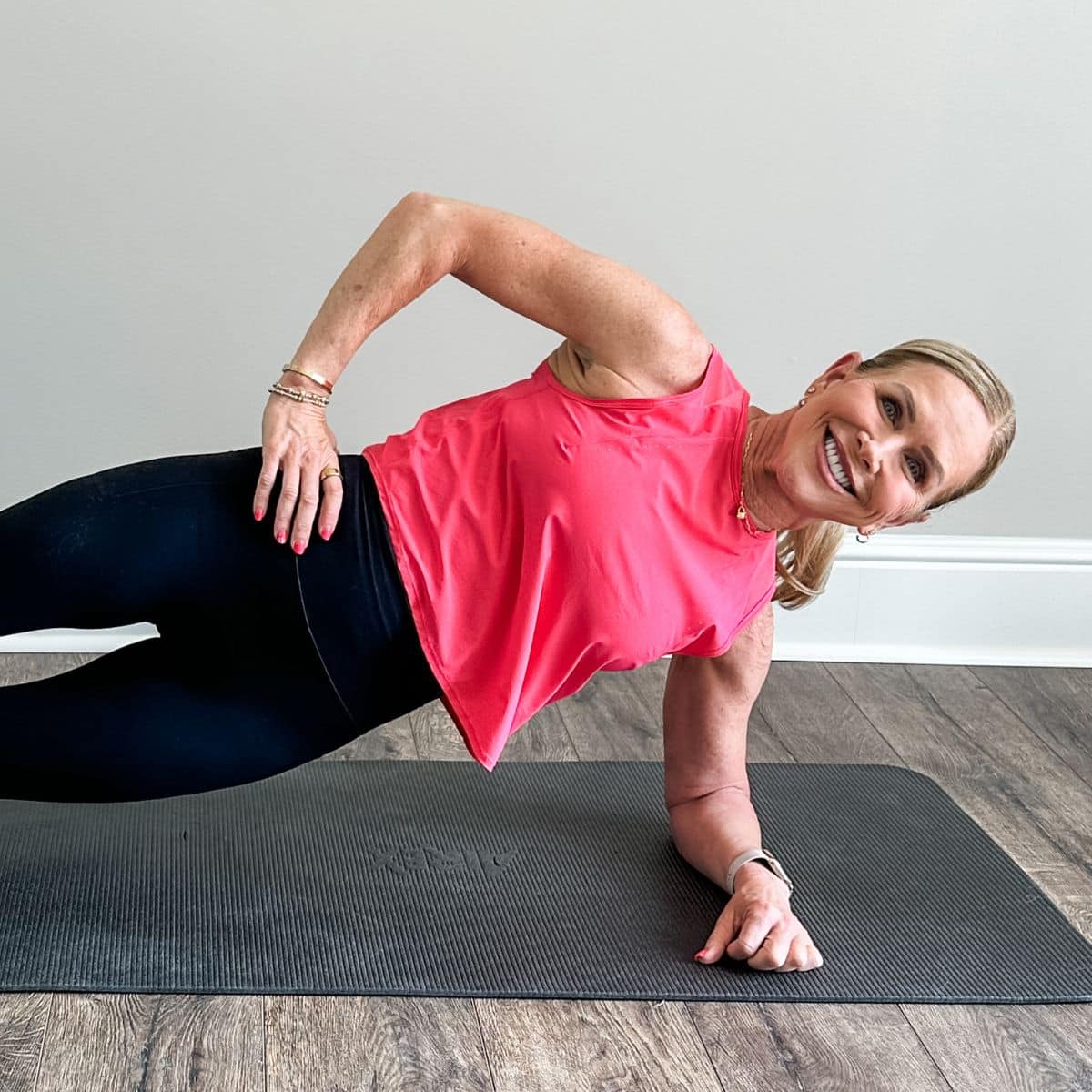
5. Side Plank
The side plank is the third exercise in McGill's "big 3," and it is where most beginner routines fall short. It trains the obliques and the quadratus lumborum on the side of your trunk, which most people ignore completely. Skipping lateral core work is one of the fastest ways to end up with a lower-back tweak you did not see coming.
How to do it:
-
Lie on one side with your bottom forearm on the floor and your elbow directly under your shoulder.
-
Stack your feet on top of each other.
-
Lift your hips so your body forms a straight line from head to feet.
-
Place your top hand on your hip or extend it straight up toward the ceiling.
-
Hold for 20 to 30 seconds per side.
Form cues: Do not let your hips dip toward the floor. Drive the lift from your obliques, not your shoulder. If a full side plank feels brutal at first, stack your knees instead of your feet to shorten the lever.
6. TRX Suspension Trainer Plank
The Suspension Trainer changes the math here. Putting your feet into the foot cradles turns a stable, floor-based plank into an instability challenge that recruits more of the deep stabilizers around your hips and spine. You scale up the demand without adding weight, which is exactly what a beginner needs.
How to do it:
-
Anchor your Suspension Trainer overhead and set the straps to mid-calf length.
-
Get into position on the floor first, then place your toes into the foot cradles facing down.
-
Lift your hips into a forearm plank position with your elbows directly under your shoulders.
-
Brace your core, squeeze your glutes, and breathe.
-
Hold for 15 to 30 seconds. Do 3 sets.
Form cues: Anchor first, body second. Settle into the foot cradles before you lift your hips. Keep your hips locked, exhale on every breath, and keep your eyes pointed at the floor.
7. TRX Suspension Trainer Standing Roll-Out
Most beginners cannot do a stability ball or ab wheel roll-out without their lower back collapsing into compensation. The standing version on a Suspension Trainer is the smartest entry point into roll-out training because you control the difficulty entirely with your foot position. Less lean equals less load. More lean equals more load. You progress at exactly the rate your core can handle.
How to do it:
-
Face the anchor point and set the straps to mid-length.
-
Hold one handle in each hand with your arms extended forward at chest height.
-
Walk your feet back to create a slight body lean.
-
Brace your core and slowly raise your arms overhead while keeping your body in one straight line.
-
Pause briefly at full extension, then pull back to the start. Do 6 to 8 reps.
Form cues: Start at a shallow angle, closer to vertical, until you have the movement down. Do not let your lower back arch on the way out. The moment your hips start to break the straight line, end the rep.

Your Beginner Core Workout (Full Routine)
Here is the full at-home workout. Screenshot it. Use it.
Do three rounds of the following:
-
Dead Bug, 8 to 10 reps per side
-
Bird Dog, 6 to 10 reps per side
-
Glute Bridge, 10 to 12 reps
-
Forearm Plank, 20 to 30 seconds
-
Side Plank, 20 to 30 seconds per side
-
TRX Suspension Trainer Plank, 15 to 30 seconds (optional in week 1)
-
TRX Standing Roll-Out, 6 to 8 reps (optional in week 1)
Rest 30 to 45 seconds between exercises. Rest 60 seconds between rounds. Train two to three times a week with at least one rest day in between sessions. Total time per session is 15 to 20 minutes.
If you are brand new to all of this, do the first five for the first week and add the two TRX movements in week two. Quality first, volume later. Pair this with a balanced bodyweight workout plan to round out your routine.
How to Progress When These Get Easy
The basics will get easy. When they do, most beginner guides leave you stranded. Here are the four levers you can pull, in roughly the order you should pull them.
-
Time under tension first. Add five seconds to your plank holds each week until you can hold a clean 60-second plank with perfect form. That alone will build a noticeably stronger core.
-
Volume second. Add a fourth round to the workout. Same exercises, same form, more work.
-
Instability third. Move bodyweight exercises onto the Suspension Trainer. Plank with feet in the foot cradles. Single-arm roll-outs. Pikes. Same movements, far more demand on the stabilizers.
-
Load last. Introduce real resistance with a TRX YBell™ or a weighted vest for dynamic movements like weighted bridges, Russian twists, or loaded carries. Load only after your form holds up under everything above.
If you want guided programming once you are past the beginner phase, the TRX Training Club App™ has a deep library of follow-along workouts that progress with you.
Beginner Core Training Tips That Work
Most beginner core advice misses the few details that make the difference. These do.
-
Learn to brace. The biggest mistake beginners make on planks is holding their breath. Instead, exhale slowly through pursed lips while you keep your ribs pulled down and your abs locked. You should be able to talk in short bursts mid-plank. If you cannot breathe, you have crossed from bracing into gripping. Ease off, exhale, and start the brace again.
-
Find neutral spine. Neutral keeps the natural slight curve in your lower back, with your ribs stacked over your hips and your pelvis level. Pressing your back flat against the floor or tipping your pelvis forward will both break it. Practice the position lying on the floor before you load it.
-
Quality beats time on the clock. A 20-second plank with perfect form will build a stronger core than a 60-second plank that turns into a sag halfway through. Stop the set when your form breaks, not when your timer goes off.
-
Train all three planes. The core moves your trunk forward and back (sagittal), side to side (frontal), and rotationally. Dead bug and plank cover sagittal. Side plank covers frontal. Anti-rotation work, and eventually loaded twisting, cover rotational. Most beginner routines skip frontal and rotational entirely, which is exactly why so many people still tweak their backs after weeks of "core work."
-
Be patient. Noticeable core strength takes four to six weeks of consistent training. Anyone selling you "results in seven days" is selling you something. Show up two to three times a week, focus on form, and the strength comes.
Frequently Asked Questions
How do I strengthen my core as a beginner?
Pick five to seven foundational core strength exercises for beginners that train you in multiple directions, start with static holds before you add dynamic and rotational work, train two to three times a week, and add time or instability before you add load. The seven movements in this guide are exactly that starter set.
What are the big 3 exercises for the core?
Spinal biomechanics researcher Stuart McGill identified the "big 3" as the curl-up, side plank, and bird dog. They are foundational because they train the core to resist motion (flexion, lateral flexion, and rotation) rather than create it, which is what the core does during real-world movement and athletic performance.
How do I strengthen my core after 50?
The same principles apply, but the implementation shifts. Skip floor-based crunches, which can stress the neck and lower back, and lean on dead bug, bird dog, side plank, and glute bridge variations instead. Prioritize neutral-spine work over high-flexion movements, and use the Suspension Trainer when you want to adjust the load by walking your feet to different angles.
What are 5 good core exercises?
Dead bug, bird dog, glute bridge, forearm plank, and side plank. Train all five, two to three times per week, using the form cues from this guide. That is enough to build a foundational core in four to six weeks.
How often should beginners do core exercises?
Two to three times per week with a rest day in between sessions is the sweet spot. Daily core work without recovery turns into junk volume and overuse, not strength.
Build a Stronger Core, Move Better, Live Stronger
Fifteen to twenty minutes, two to three times a week, four to six weeks. That is the floor for core exercises for beginners that change how you move in every other workout, sport, and daily task. Stack the work and you will feel it in your squats, your runs, your posture, and how your lower back feels at the end of a long day. When the bodyweight version of this routine starts to feel easy, the TRX Suspension Trainer is the natural next step, and TRX core exercises scale the difficulty without you adding weight. It is the same training tool trusted by Navy SEALs, pro athletes, and the more than 300,000 coaches TRX has certified in 30-plus countries, and it scales from beginner planks to advanced single-arm work without you ever buying another piece of equipment. Pair it with the TRX Training Club App, and you have 500-plus follow-along workouts that progress with you, week after week. Pick up a Suspension Trainer when you are ready for the next progression, or open the TRX Training Club App today and run your first guided beginner core session. Train the way your body is built to move, and you will move better, grow stronger, and live longer.
What's Your Reaction?
 Like
0
Like
0
 Dislike
0
Dislike
0
 Agree
0
Agree
0
 Disagree
0
Disagree
0
 Excellent
0
Excellent
0
 Useful
0
Useful
0
 Great
0
Great
0