























































Ancient Pompeii Self-Guided Tour with 15 Points of Interest
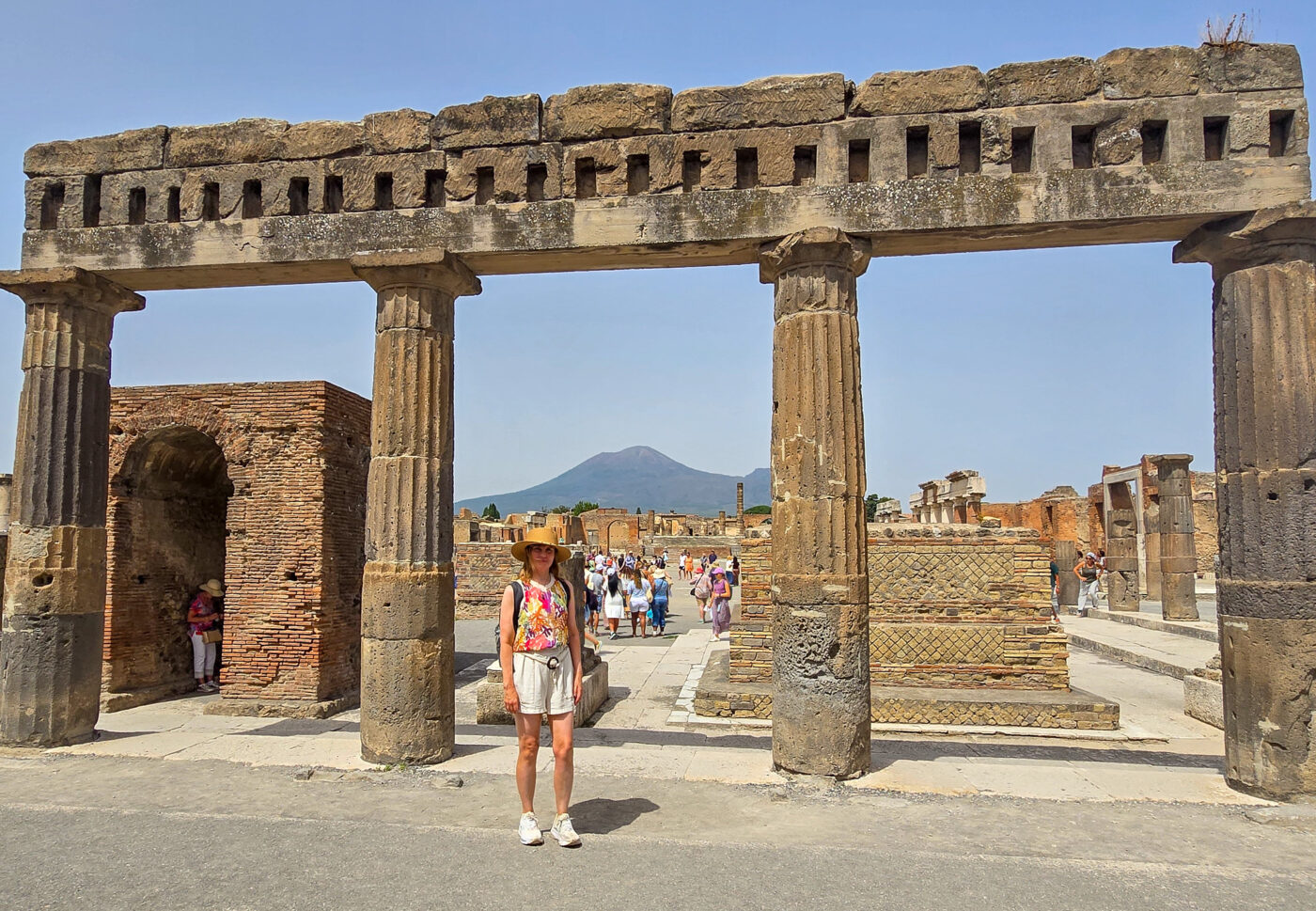


Pompeii takes you back to 79 AD, when Mount Vesuvius erupted, burying Pompeii in ash and petrifying all life. Today, you can learn about how people lived at this time at its archeological site. Exploring Pompeii can be overwhelming for many of its 2.5 million tourists per year. However, by researching beforehand, exploring on your own can be a meaningful experience at your own pace. I experienced Pompeii twice on guided tours. Then, recently I ventured off on my own to explore Pompeii. So, read on and learn tips from my Pompeii self-guided tour with 15 points of interest.

About Pompeii
On August 24, 79 AD Mt. Vesuvius erupted, spewing ash and poisonous gases for 18 hours. Nearby Pompeii became buried under 30 feet of ash and pumice and almost everyone instantly died. Pompeii remained buried for about 1700 years, when the excavations began in 1748.
Overall, about 75% of Pompeii’s 165 acres were excavated. It’s estimated that most of the 20,000 people from both Pompeii and Herculaneum fled when the volcano first began rumbling. Most of the 2,000 that stayed, immediately perished. About 1,000 bodies were recovered and some were later preserved in plaster casts, that you can see at the archeological site.
An interesting fact is that the direction of the wind could have changed the outcome for the better at Pompeii. When Vesuvius erupted, the wind was blowing northwesterly toward Pompeii. Usually, the wind would have blown southwest instead, which would have saved and blown everything away from Pompeii.
Train to Pompeii: In southern Italy, just 15 m (24 km) from Naples, Pompeii is easily accessible by train. The Circumvesuviana Train goes from Naples and Sorrento to Pompeii Scavi. Also, from Rome there are day tours to Pompeii.
Visiting Mt. Vesuvius

From Pompeii Scavi train station, there’s a kiosk that sells bus tickets to Mt. Vesuvius entrance. I took the 30-minute bus ride to the volcano and hiked up to the crater. This completes the Pompeii experience, by visiting the volcano that caused the disaster.
Pompeii’s 3 Entrances with 9 Regions
Pompeii offers 3 main entrances. The massive archeological site is divided into 9 regions. The western strip of Regions VIII, VII and VI is the most excavated area with most important monuments. I purchased skip-the-line tickets with an audio guide.
Porta Marina – arrive by train quick Access to Forum
Piazza Esedra – group tours shorter ticket lines closer to theaters
Piazza Anfiteartro- eastern side of modern Pompeii – disabilities nest to amphitheater and large palaestra
My Solo Walking Path Layout in 5 Hours

Pompeii Self-Guided Tour
& 15 Points of Interest
From the train station, I entered Porta Marina and walked right on the Viale delle Ginestre path to the Theatres District. I walked nonstop at Pompeii for 5 hours exploring the sites. I researched these 15 points of interest beforehand. Overall, I explored the western strip of Regions VIII, VII and VI (in that order). Even though I missed 6 regions, the western strip is the most excavated area with most important monuments.
However, I did not see the amphitheater and eastern residential area. Also, I missed 2 points of interest on this list: Isis Temple and House of Vettii.
Pompeii Theatres Area – Region VIII

Quadriporticum
This covered walkway was a passage to the theatres. The central area was surrounded by a portico with 78 Doric columns. After an earthquake in AD 62, its central courtyard became converted to gladiatorial housing and gyms.
Large Theatre
Built in 2nd century BC, this theatre was among the first buildings unearthed in the 18th century excavations. With a Greek appearance, this venue was used for shows in the Greco-Roman tradition. It seated 5,000 spectators.
Odeion (Small Theatre)
Built in 80 BC, this smaller roofed, Roman theatre was used for council meetings and entertainment. It seated 1,500 spectators.
Temple of Isis
Just behind the Large Theatre is the Temple of Isis. (I regretfully missed this temple.) This temple is dedicated to the Egyptian Goddess, who was a popular Roman Empire cult. It’s still relatively intact and one of the first temples discovered in excavation.
Built in the 2nd century BC, this temple shows that the Pompeii residents were open to foreign religions. It highlights a purgatorium involving water from the Nile River and Egyptian frescoes. Also, most of the temple’s paintings and sculptures are now exhibited in the National Archeological Museum of Naples.
Central-Western District or Region VII
This area contains the city’s civic, religious and commercial core.

Lupanar (Brothel)
This is the largest and most famous Roman brothel in Pompeii. It’s known for displaying erotic wall frescoes with stone beds. The frescoes depict the Roman sexual culture and may have served as a menu. In ancient Rome, prostitution was legal and taxed. Lupa means “she-wolf” as slang for prostitute, emphasizing the primal nature of the profession.

Stabian Baths
Near the Lupanar, this was the oldest thermal bath complex in Pompeii. It separated men and women sections. Patrons followed a ritual sequence.
They progressed through the tepidarium (warm room), caldarium (hot bath) and lastly the frigidarium (cold room). The rooms were adorned with frescoes and mosaics to enhance the experience.

Forum of Pompeii
The Forum was the heart of Pompeii for political, social, religious and economic reasons. It is a large, open rectangular space used as a pedestrian zone. A double-tiered colonnade surrounded the square on 3 sides. The Forum contained both the Temple of Jupiter and Sanctuary of Apollo.
Temple of Jupiter
On the northern end of the forum, this temple dominates the skyline with the backdrop of Mt. Vesuvius. The Roman Jupiter replaced the Greek Apollo as Pompeii’s main God. Jupiter was the ruler of all the gods. He was also the protector of Rome, where his temple was the center of Roman religion.

Sanctuary of Apollo
On the western side of the forum, the Apollo Sanctuary is one of the oldest places for worship in Pompeii. Apollo was the Greek God of the sun and light, music, poetry, healing, archery and agriculture. Many of the 48 Ionic columns still remain, with the replica bronzed statue of Apollo.
Basilica
On the southwestern corner of the Forum, the Basilica served as the city’s court of law and business center. It was not a religious site. The interior was colonnaded, with 28 wide brick columns, supporting a tile roof.
Northwest District or Region VI
This area housed the wealthy elite residences, luxurious villas and busy commercial shops.

House of the Faun
This is one of the largest private houses at Pompeii. The house is famous for its bronze dancing faun statue and massive Alexander Mosaic. Also, the statue on site is a replica of the original in the National Archeological Museum of Naples (MANN). In addition, the House of Faun had spectacular floor mosaics, that are now in the MANN.
House of The Tragic Poet
This middle-class home is known for its mosaic floors and frescoes depicting Greek mythology. Originally, it contained more than 20 painted and mosaic panels. The MANN houses 6 of them.
The vestibule’s floor tile inscription says “Cave Canem” or Beware of Dog. Only the House of Vetti displays more mythological frescoes. When I was there, the house was gated off with only a viewing of the vestibule fresco through glass.
House of the Vettii
This site contains the highest number of large (about 4 ft. square) mythological frescoes than any other home in Pompeii. The house was owned by wealthy freedman or former slaves. It’s also known for the fresco with the fertility God, Priapus, weighing his phallus against a bag of gold. Overall, this is one of the largest houses in Pompeii with a colonnaded courtyard garden.

Villa of the Mysteries
Located on the outskirts of Pompeii, I passed through the Herculaneum Gate to the entrance. This villa was famous for its stunning frescos in room 5. They show the initiation of a young woman into a Greco-Roman mystery cult. Overall, the 7 frescoes with a red background depict the following scenes: Reading of Rituals, Silenus playing Lyre, Satyr and Nymph, Silenus offering wine to Satyr, Bacchic rite, Cupid holding up mirror and lastly, the Initiate on a throne.
Last Stop at Antiquarium near Porta Marina Exit

Antiquarium
Just inside the Porta Marina entrance/exit is the onsite museum, Antiquarium. Originally built in 1873, it underwent an official inauguration for reopening with new layout in 2021. It exhibits excavations from Pompeii, such as, frescoes, silver and body casts. There is body casts of a family’s last moments displayed. After getting the big picture from the archeological site, it’s nice to learn the details at the museum.
Also, don’t miss Herculaneum archeological site, even better preserved than Pompeii! Check out my article and video!
Herculaneum Sightseeing Guide and 10 Points of Interest

Enjoy Pompeii!
It is such a wonderful opportunity to explore this archeological site. There’s so much to learn about history, volcanoes and archeology from Pompeii. Also, the nearby Herculaneum is just as fascinating for different reasons. So, if you have time, catch it as well. And to think, if the wind blew another direction on that monumental day, Pompeii may still be here alive and well. It’s intriguing to ponder this possibility. If you visited Pompeii, feel free to leave suggestions below.
The post Ancient Pompeii Self-Guided Tour with 15 Points of Interest appeared first on True Wind Healing Travel.
What's Your Reaction?
 Like
0
Like
0
 Dislike
0
Dislike
0
 Agree
0
Agree
0
 Disagree
0
Disagree
0
 Excellent
0
Excellent
0
 Useful
0
Useful
0
 Great
0
Great
0