











































%20and%20Batch%20Production%20Records%20(BPR).png)
















KLK1 Expands Possibilities to Restore Vascular Health
Knowing that the protein tissue kallikrein-1 (KLK1) is effective in treating ischemic diseases is one thing. Manufacturing it as a recombinant protein has been quite another. So, when DiaMedica Therapeutics cracked the manufacturing aspect, it was well on its way toward commercializing KLK1 therapeutics.
The manufacturing breakthrough came when researchers realized that protein activity (which is essential for therapeutic benefit) was linked to certain glycosylation patterns. DiaMedica engineered the molecule to reflect those glycosylations and also made two changes to the amino acid sequence to improve manufacturability. “Then we partnered with Catalent,” Rick Pauls, president and CEO, says. “We are using its GPEx® technology with CHO cells,” which produces more cells within the same timeframe and thus lowers manufacturing costs.
Tenacity in action
This happened neither easily nor quickly. To understand the measure of this achievement, we need to look at DiaMedica’s history.
KLK1 came to DiaMedica’s attention because of liver research. “A liver physiologist cut the vagus nerve [which regulates liver metabolism] and discovered that the rats, effectively, became diabetic,” Pauls recounts. “We hypothesized that when a healthy person consumed a meal, the liver releases something that acts as an insulin sensitizer. We did some basic work and identified KLK1 as that insulin sensitizer.”
The company was founded in 2004 to develop a KLK1 therapeutic for complications related to Type II diabetes. Those trials failed. “It’s a long story,” says Pauls, that left the company “pretty close to bankrupt.”
DiaMedica, though, was tenacious. “We knew there was a human urine form of this protein that had been used for a few decades in Asia to treat acute ischemic stroke, and a porcine form treating hypertension for decades as well,” Pauls recalls. DiaMedica had the protein and the manufacturing know-how to produce active, recombinant proteins, and—with KLK1 levels low in stroke patients—a reason to pivot.
Ischemic stroke and preeclampsia
Its lead compound, DM199 (rinvecalinase alfa), is enrolling patients in Phase II/III trials for acute ischemic stroke. Called the ReMEDy2 trial, the company anticipates an interim readout near year’s end. Additionally, Phase I and II studies for preeclampsia and Phase II studies for fetal growth restriction are underway.
“This is protein restoration,” Pauls says. It targets ischemic stroke patients who have missed the three-to-four-hour post-stroke treatment window for tissue plasminogen activator (tPA) therapeutics or mechanical thrombectomy. Those patients constitute approximately 80% of acute ischemic strokes today, so “there is a huge unmet medical need,” Pauls says.
DM199 works by restoring normal levels of the KLK1 protein. KLK1, in turn, is thought to enhance the production of nitric oxide, prostacyclin, and endothelium-derived hyperpolarizing factor. Pouring through their own preclinical and clinical results, the DiaMedica team noticed that DM199 consistently enhanced blood circulation and lowered blood pressure.
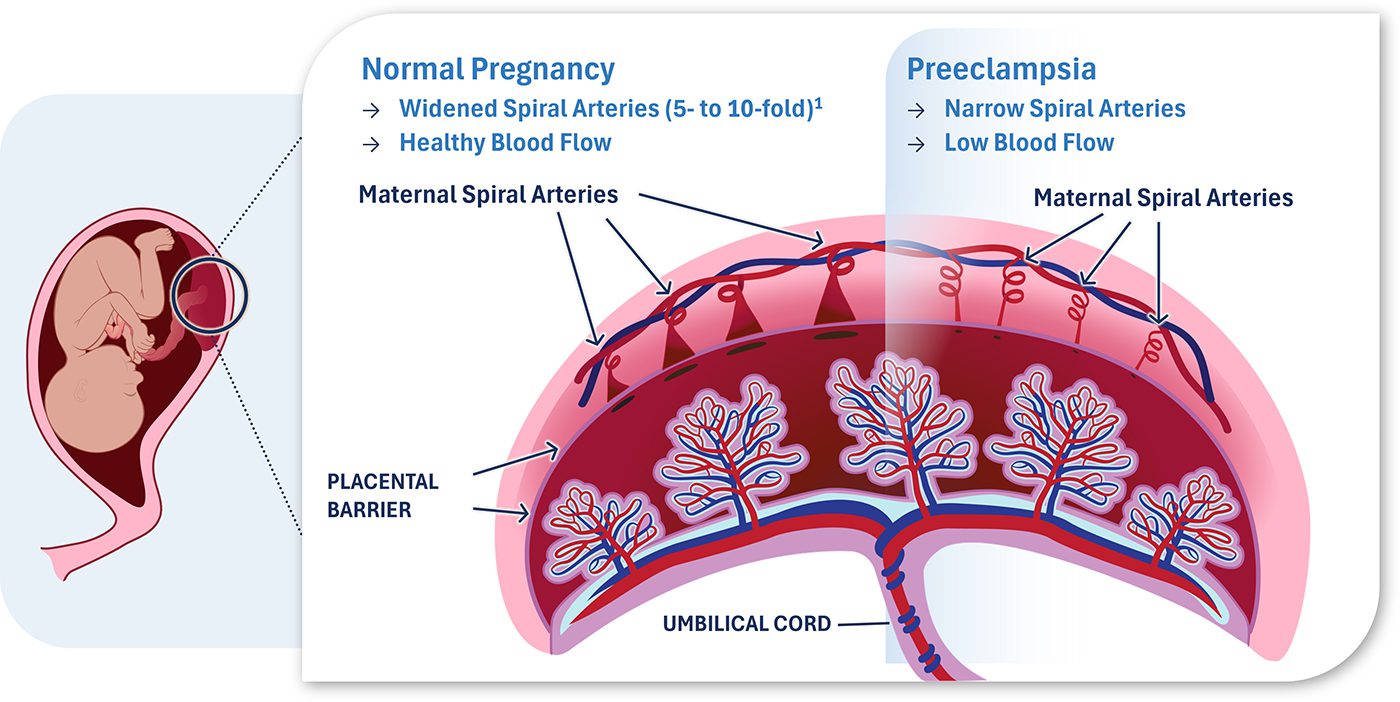
That realization drove the team to also target preeclampsia, a hypertensive disease of pregnancy that Pauls says may be the company’s most exciting application for investors.
Unlike approved blood pressure therapeutics, DM199 does not cross the placental barrier, a critical safety feature that protects the fetus. After examining early clinical data, DiaMedica scientists also realized that increasing blood flow to the placenta could target the root cause of the disease and perhaps gain another few weeks of crucial time in utero for the fetus.
“Today, there are no approved treatments. Mothers are given labetalol and nifedipine to control blood pressure and to extend the baby’s time in utero for only a few days.” Results are less than ideal, and the consequences can be severe.
Pauls says, “Some 40% of babies born before 28 weeks could have long-term disabilities, and 10 to 15% will have problems with eyesight for life. There’s been a real lack of drugs in development because developers are worried about harming the baby.”
An investigator-led Phase II clinical trial is enrolling. Later this year, the company plans to initiate its own Phase II study focused on early-onset preeclampsia after recently receiving regulatory clearance to start the study in Canada.
If the molecule eventually is approved for preeclampsia, DM199 seems poised to become, perhaps, the first approved treatment that offers the potential to extend gestational days and possibly address a root cause of preeclampsia.
Leveraging the pivot
Unlike many biopharmaceutical companies, DiaMedica has been able to bypass some of the usual first steps by leveraging existing studies on KLK1, as well as existing clinical data for stroke and preeclampsia.
That allows researchers to focus on humans without the translational issues inherent in animal studies. It also helps the company identify the human subgroups most likely to benefit from these treatments and the most appropriate dosing regimen early. “Having that clinical data helps de-risk our program and gives a better possibility of success,” Pauls says, because, as he points out, “Animals are not the same as people.”
Once the company pivoted to its current indications six or seven years ago, the challenge shifted from getting and manufacturing the active form of the protein to selecting the best indications and assembling the right team members.
“In the early days, maybe we didn’t have the right level of experience with limited capital,” he admits. Today, “we’ve been able to bring people on board who have brought drugs to market.”
Readouts due in 2027
Currently, the company is focused tightly on its clinical trials. The next step for DiaMedica is to get readouts from many of those, with five readouts on various aspects of the programs expected between now and the end of 2027. Each of those readouts will report on about 30 patients and will be factors in the design of a subsequent pivotal trial.
Additionally, an interim analysis of the first 200 patients in its acute ischemic stroke trial is expected by the end of the year, Pauls says. “If we see a drug effect that’s comparable to our Phase II trial or the data with the urine form (of KLK1) from China—which treats close to a million patients per year—we’ll be looking at completing enrollment the following quarter for stroke and then for preeclampsia. DiaMedica is dedicated to offering second chances to acute ischemic stroke patients and others who haven’t had them before, all while pivoting to new opportunities itself. Now, as trials advance, Pauls says, “I think this should be a straightforward path.”
The post KLK1 Expands Possibilities to Restore Vascular Health appeared first on GEN - Genetic Engineering and Biotechnology News.
Apa Reaksi Anda?
 Suka
0
Suka
0
 Kurang Suka
0
Kurang Suka
0
 Setuju
0
Setuju
0
 Tidak Setuju
0
Tidak Setuju
0
 Bagus
0
Bagus
0
 Berguna
0
Berguna
0
 Hebat
0
Hebat
0