































































Using elastics with Invisalign: when, why and how to use them
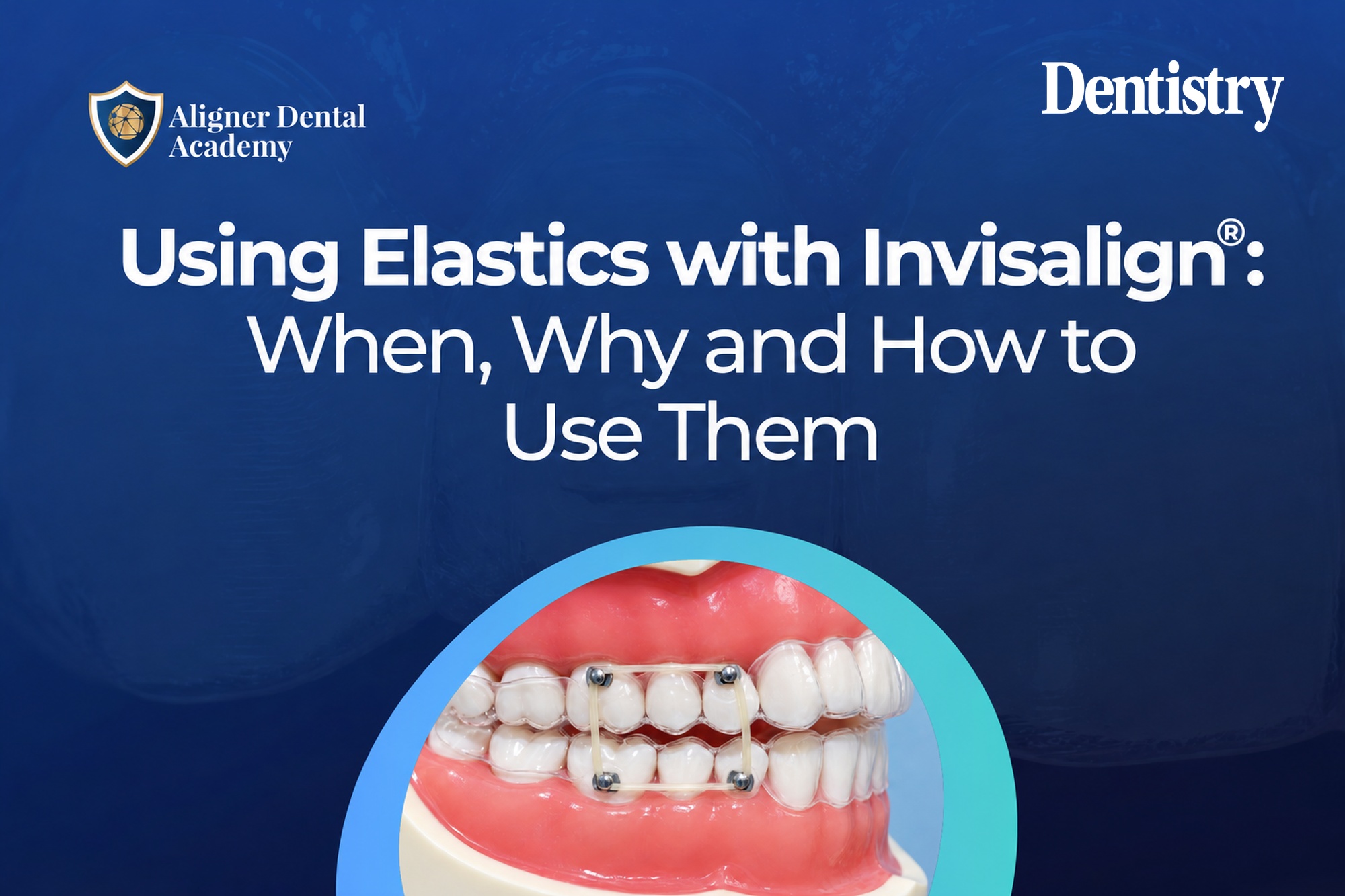
This clinical guide explains when elastics can support Invisalign treatment, from anchorage and sagittal correction to settling and tracking.
Elastics have sometimes been considered the dark arts of orthodontics. However, when clinicians understand their biomechanics, uses and limitations, they can improve the predictability of clear aligner treatment.
Clear aligners can deliver effective tooth movement, but some cases benefit from additional force control. In Invisalign treatment, elastics are most useful as an adjunct for anchorage reinforcement, sagittal correction, crossbite correction, posterior settling and management of selected tracking problems. They do not replace the aligner; instead, they help the aligner express the programmed movement more predictably.
Class II correction and anchorage reinforcement
Class II Division 1 cases requiring maxillary anterior retraction may benefit from elastics, particularly where significant interproximal reduction is planned or increased overjet raises the risk of a lower-lip trap.
The goal is to minimise mesial drift of the lower posterior teeth and preserve posterior anchorage while the aligner carries out the programmed anterior movement. A practical configuration involves precision cuts at UR3/UL3 with bonded buttons at LR6/LL6.
Rongo et al (2022) evaluated 20 adults treated with Invisalign and Class II elastics. They reported an average overjet reduction of 1.4 mm and maxillary molar distalisation of 0.93 mm, without significant skeletal changes. These findings support predominantly dentoalveolar correction in adults, although the uncontrolled study design limits conclusions about the independent contribution of elastics. (Fig. 1)
Similarly, Laganà et al (2025), in a randomised clinical trial involving 40 adolescents, reported favourable lower-incisor inclination control with aligners and Class II elastics compared with fixed appliances.
Class III cases and lower-arch retraction
Class III elastics may support lower anterior retraction, particularly in patients with edge-to-edge incisor relationships, limited remaining lower-arch interproximal reduction or increased anchorage requirements. A commonly used configuration incorporates precision cuts at LR3/LL3 with bonded buttons at UR6/UL6.
Careful attention should be given to vertical facial proportions and overbite. Patients presenting with reduced overbite may be vulnerable to unwanted vertical changes. Class III elastics primarily achieve dental compensation and should not be considered a substitute for skeletal correction in patients with significant discrepancies. Evidence specific to Invisalign Class III protocols remains limited.
Crossbite correction
In comprehensive aligner cases, cross-elastics can assist in correcting selected dental posterior crossbites when aligner-generated forces alone are insufficient. Correct button positioning and force-vector management help to avoid unwanted extrusion, tipping or aligner dislodgement.
Elastics should complement appropriate transverse expansion or individual tooth movement rather than compensate for inadequate treatment planning.
Posterior open bite and settling
Posterior open bite represents a recognised finishing challenge in clear aligner therapy. The occlusal coverage of aligners, unintended posterior intrusion and incomplete extrusion can contribute to reduced posterior contacts.
Vertical or triangular settling elastics may improve intercuspation during refinement. Xiao et al (2026), in a prospective clinical study involving 52 Invisalign patients and 172 molar sites, investigated 95 sites treated with settling elastics and 77 managed with aligners alone. Their findings supported greater correction of posterior open bite with elastic traction, providing emerging clinical evidence for this finishing approach.
Bootstrap elastics for tracking problems
Bootstrap elastics may be useful when individual teeth, particularly maxillary lateral incisors, fail to track appropriately. By introducing an additional seating or extrusion-directed force, they may help engage the tooth with the aligner.
Before prescribing bootstrap elastics, clinicians should assess available space, attachment integrity, aligner seating and movement staging. Persistent tracking discrepancies may require refinement rather than additional elastic force. Evidence for specific bootstrap protocols remains primarily clinical rather than supported by high-quality comparative trials.
Practical clinical protocol
Elastic selection, force magnitude and wear duration should be individualised according to the intended movement, anchorage requirements and response to treatment. Metal or tooth-coloured buttons can be placed using bracket cement and standard bonding techniques.
A practical part-time protocol may involve medium-force elastics of approximately 99 g (3.5 oz) or 126 g (4.5 oz), measuring 4.8 mm (3/16 inch) or 6.4 mm (1/4 inch), worn for 12-18 hours, commonly during the evening and overnight, with regular replacement.
However, this is a clinical example, not a universally validated regimen. Published protocols vary considerably; Rongo et al, for example, prescribed 1/4-inch, 6-oz elastics with full-time wear.
Video guides
Aligner Dental Academy provides a video guide on troubleshooting tracking issues during Invisalign treatment: Troubleshooting Tracking Issues During Invisalign Treatment with Dr Kavita Malkan.
An additional guide is available: Troubleshooting in Invisalign with Dr Jasmine Piran.
Conclusion
Elastics are a valuable adjunct to Invisalign treatment when used strategically rather than routinely. Their applications include Class II and selected Class III correction, crossbite management, posterior settling and individual tooth tracking.
Successful outcomes depend on biomechanical planning, appropriate anchorage, patient compliance and regular evaluation of aligner fit. Predictable clear aligner treatment requires a combination of digital planning, sound orthodontic principles and continuous clinical monitoring.
References
1. Rongo R, Dianišková S, Spiezia A, Bucci R, Michelotti A, D’Antò V. J Clin Med. 2022;11(24):7333. doi:10.3390/jcm11247333.
2. Laganà G, Malara A, Lione R, Bollero P, Cozza P. Front Dent Med. 2025;6:1613037. doi:10.3389/fdmed.2025.1613037.
3. Xiao L, et al. Am J Orthod Dentofacial Orthop. 2026.
This article is sponsored by Aligner Dental Academy
Apa Reaksi Anda?
 Suka
0
 Kurang Suka
0
 Setuju
0
 Tidak Setuju
0
 Bagus
0
 Berguna
0
 Hebat
0