





















































In the Hunt for Collagen, Are We Forgetting About Elastin?



Collagen has become the beauty industry's shorthand for youthful skin. But as clinics and clients chase firmness and volume, a type of structural protein is getting far less attention than it warrants: elastin. For years the skin longevity conversation has belonged to collagen. It is the language of supplements, injectables, radiofrequency, microneedling, exosomes, LED and lasers, and of almost every professional treatment that promises firmer, smoother skin. Collagen gives skin much of its strength and structure, and its decline is central to how ageing shows up on the face. But skin does more than hold itself up. It moves. It creases, stretches and settles back again thousands of times a day, and it has to return to where it started.
That is the part elastin does.
The subject came up at ALASTIN's launch breakfast for its new C-RADICAL Defense Antioxidant Serum, where the brand explained that emerging formulation-specific laboratory research has raised questions about how some L-ascorbic-acid (featured in traiditonal vitamin c skincare) affects elastin production and protection, Conversely, C-radical defense antioxidant serum contains a novel form of vitamin C and 14 additional antioxidants, stimulating renewal and protecting the structures skin already has.
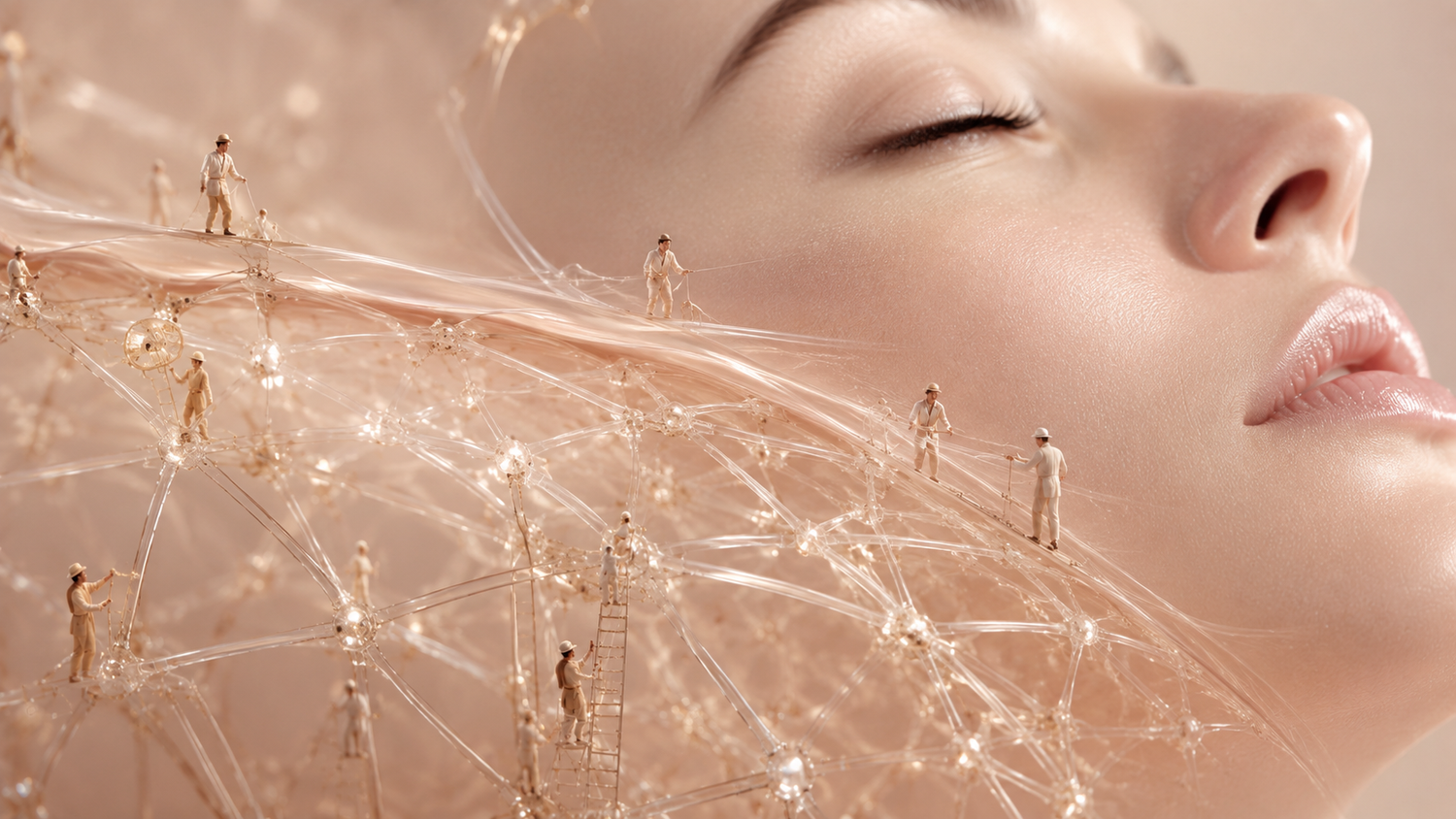
Elastin is not new science, but it is often under-discussed; in the dermis, elastic fibres form a network that lets skin stretch and recoil. A major review in Clinical, Cosmetic and Investigational Dermatology describes elastin as a critical skin protein that combines with microfibrils to form elastic fibres, giving skin its stretch and recoil. The same review notes that with age and environmental damage these fibres degrade, leaving skin looser, more prone to sagging and lower in structural integrity.
Two proteins, two different jobs
Dr Amiee Vyas explains the distinction. "Collagen and elastin are both essential structural proteins in the skin, but they perform very different roles."
"Collagen provides the skin with its strength, firmness, and structure. Think of it as the scaffolding that keeps everything supported. When we're young, healthy collagen allows the skin to remain smooth after we smile, frown or squint. As we age, collagen production naturally declines, while factors such as UV exposure, pollution, smoking, and other lifestyle influences accelerate its breakdown. The result is the gradual development of fine lines, wrinkles and a loss of firmness."
Clients understand firmness, lines, and the idea of rebuilding a structure that has weakened over time but elastin is harder to picture. It has less to do with how firm the skin looks at rest and more to do with how it behaves once it moves.
"Elastin, as its name suggests, gives the skin its elasticity and resilience," says Dr Vyas. "You can think of elastin fibres as tiny, coiled springs or elastic bands woven throughout the skin. They allow the skin to stretch during facial expressions and then spring back into place. A simple demonstration of this is the skin pinch test where younger, healthier skin snaps back quickly because of its elastic properties, whereas skin with reduced elasticity takes longer to return to its normal position."
In practice, a good number of the complaints clients bring into clinic, crepiness, laxity, sagging, loss of bounce, etched-in expression lines, are not really collagen problems (even if clients think they are), instead it is a recoil problems, the mark of skin that no longer springs back the way it once did.
"Elastin is essential for maintaining smooth, resilient skin," Dr Vyas adds. "Its network of elastic fibres allows the skin to stretch and recoil repeatedly throughout the day as we make facial expressions, helping to prevent permanent creasing. Healthy elastin fibres can stretch around 1.5x before returning to their original shape, which is why youthful skin appears bouncy and resilient."
A protein that resists replacement
The complication is that elastin is far harder to replace than collagen. Research indicates that elastogenesis, the formation of elastic fibres, happens largely in early life, and that elastin turnover in adult skin is very low. One review puts the half-life of skin elastin on a par with a human lifespan, which means that once elastic fibres are damaged they are unlikely to be replaced to any meaningful degree without intervention.
Dr Vyas echoes this. "As elastin fibres become damaged or fragmented, the skin loses its ability to spring back effectively. This contributes to crepey skin, laxity and sagging, which are often among the earliest visible signs of skin ageing. Over time, repeated facial movement, alongside gravity and environmental damage, makes these changes more noticeable."
"One of the challenges with elastin is that, unlike collagen, the body produces very little new elastin after puberty. While collagen production gradually declines from our mid-20s and falls more sharply during menopause, elastin has an even more limited capacity for renewal. This makes protecting existing elastin particularly important. Daily sun protection is one of the most effective ways to preserve elastin fibres, and any skincare ingredient or technology that can demonstrably protect elastin or stimulate new elastin production is of significant interest because true elastin regeneration has historically been very difficult to achieve."
Protection over correction
In a category built on boosting, stimulating and regenerating, elastin calls for a different way of thinking, one in which protection counts for as much as correction. Sunscreen, antioxidant protection and anything that reduces oxidative stress are part of how long-term skin quality is built and central to this is UV exposure. Photoageing is linked to damage in both collagen and elastin, and chronically sun-exposed skin shows marked changes in elastic fibre structure, including solar elastosis. Oxidative stress from UV and environmental aggressors is one of the mechanisms behind that damage, which is why antioxidants remain a fixture of professional skin health protocols. Vitamin C also belongs in the same conversation, working both as an antioxidant and as a co-factor in collagen synthesis. Reviews on vitamin C and skin health set out its role in supporting collagen synthesis and guarding against oxidative damage.
While collagen is still central to firmness and dermal structure, elastin accounts for something clients recognise without having the words for it, the difference between skin that is merely smooth and skin that looks alive and responsive. The more useful way to talk about skin ageing may be less about chasing a single protein and more about respecting the whole dermal matrix. Collagen gives skin its support, elastin its spring and hyaluronic acid its hydration and volume. Between them they produce what clients tend to call healthy skin, even when they have no technical name for it.
Elastin, on that reading, is the word that has been missing from the treatment room. The collagen boom got clients thinking about ageing as a question of structure. Elastin adds the other half of the picture, which is how well skin moves and recovers rather than simply how firm it sits. For a sector increasingly built around longevity and prevention.
What's Your Reaction?
 Like
0
Like
0
 Dislike
0
Dislike
0
 Agree
0
Agree
0
 Disagree
0
Disagree
0
 Excellent
0
Excellent
0
 Useful
0
Useful
0
 Great
0
Great
0