































A systems approach to antimicrobial stewardship: from principles to performance

By Ken Opengart, DVM, PhD, DACPV
3 Birds Consulting
Signal Mountain, Tennessee
I have spent my career as a poultry veterinarian working at the intersection of science, ethics, animal welfare, public health and consumer expectations. Few issues sit more squarely at that crossroads than antimicrobial use and antimicrobial resistance (AMR).
My perspective on these issues has always been grounded in the Veterinarian’s Oath — to protect animal health and welfare, prevent suffering, conserve resources, promote public health and advance medical knowledge — and I view antimicrobial stewardship (AS) as one of its clearest expressions. To me, robust AS extends well beyond individual treatment decisions, encompassing culture, governance, prevention, monitoring and accountability across the system. Although these principles may appear straightforward, antimicrobial use and AMR remain areas of intense focus due to their far-reaching implications for human, animal and environmental health.
World AMR Awareness Week (WAAW — November 18-24, 2026) is an opportunity not only to raise awareness of the ongoing threat posed by AMR but also to critically examine how we strengthen AS in practice.
This article uses WAAW as a moment to explore what effective stewardship truly looks like: how culture, governance, veterinary partnership and continuous improvement come together to protect animal health, preserve antimicrobial effectiveness and support a sustainable food system.
A brief note: The terms “antibiotic” and “antimicrobial” are interchangeable but not identical. An antibiotic is a type of antimicrobial specifically used to target and kill or inhibit bacteria, whereas “antimicrobial” is the broader term that includes agents effective against bacteria, viruses, fungi and parasites. In this article, I have used the broader term. You will see “antibiotic” used in places where the work I am citing uses “antibiotic,” and I have elected to leave the term for accuracy.
Building credibility, trust and transparency
The US poultry industry has made tremendous strides in reducing antimicrobial use. Randy Singer, DVM, PhD, has published analyses quantifying on-farm antibiotic use in the US poultry industry that demonstrate a sustained focus on judicious use, particularly for medically important antibiotics.1
Even with this progress, there remains an important opportunity to further embed AS principles throughout our production systems. As we have done with food safety and animal welfare, we need organization-specific, robust stewardship programs that are transparent, measurable and continuously improving programs that clearly demonstrate accountability, reinforce veterinary oversight and build lasting trust with stakeholders.
Developing a clear AS position statement is an essential first step, as it defines an organization’s values, operating principles and boundaries for action. Building from that foundation, a formal stewardship framework enables organizations to move beyond stated commitments and translate intent into structured, measurable practice.
Framework for AS
I have found that using a framework is helpful when designing and implementing programs in integrated operations at scale. A framework that outlines program components provides clarity and consistency by defining what an effective program looks like and establishes a common language across the organization. It guides intentional program design, enables assessment and benchmarking, and supports accountability. Most importantly, it helps translate good intentions into disciplined execution and continuous improvement.
Relative to AS, the Framework for Antibiotic Stewardship in Food Animal Production provides an excellent starting point. The framework was the product of a multi-stakeholder initiative focused on ensuring the responsible use of antibiotics in livestock to protect animal and public health and was developed through a 2-year dialogue led by the Farm Foundation and The Pew Charitable Trusts.2
The framework provides a practical, scalable and structured approach for assessing and strengthening stewardship practices across hatcheries, feed mills and farms, enabling transparent, consistent and ongoing evaluation of stewardship principles and practices. These principles and practices support animal health and welfare, reinforce veterinary oversight, strengthen accountability and promote continuous improvement across complex production systems.
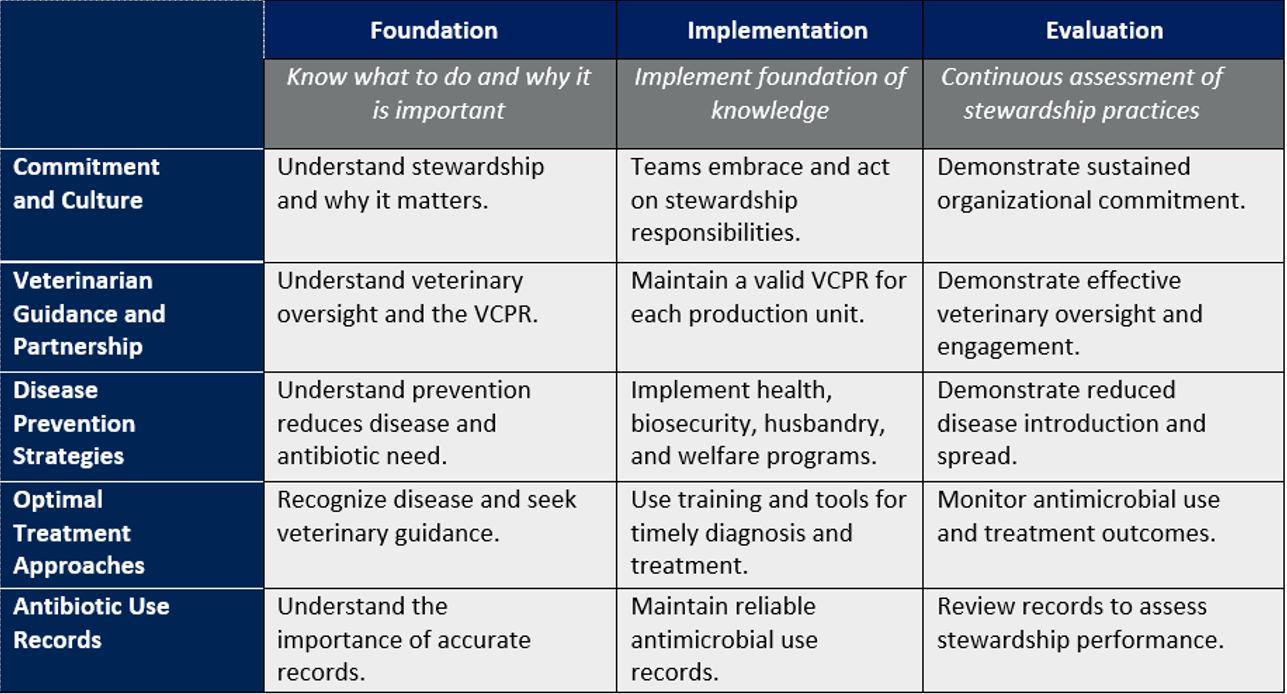
The framework includes governance, policies, standard operating procedures (SOPs), training, metrics, reporting and verification. It is built around five core elements:
- Strong commitment and culture that prioritizes responsible use
- Close partnership and guidance from veterinarians
- Robust disease prevention strategies
- Optimal treatment approaches grounded in science
- Accurate, reliable antibiotic use records
Additionally, the framework outlines how AS progresses through three stages — foundation, implementation and evaluation — and is applied consistently across the five core elements (Figure 1).
Figure 1. Framework for antibiotic stewardship in food animal production
Adapted from the Framework for Antibiotic Stewardship in Food Animal Production. Click to enlarge.
At the foundation stage, the emphasis is on understanding. Organizations ensure that people know what AS is, why it matters and how their roles contribute. Individuals understand the need for stewardship, the importance of veterinary oversight and a valid veterinary-client-patient relationship (VCPR), the role of disease prevention in reducing antibiotic need, how to recognize illness and seek veterinary guidance, and why accurate antibiotic-use records are essential. This stage establishes knowledge, expectations and governance.
The implementation stage focuses on operationalizing stewardship. Individuals are educated about and embrace their stewardship responsibilities. Veterinary partnerships are formalized and maintained through VCPRs. Animal health plans are implemented to reduce disease pressure. Training and diagnostic tools support early detection and appropriate treatment decisions. Robust recordkeeping systems are implemented to capture antibiotic use accurately and consistently.
The evaluation stage demonstrates credibility. Organizations show sustained commitment to stewardship through measurable outcomes and verification. Veterinary oversight is evident, and prevention programs have been shown to reduce disease introduction, exposure and spread. Antibiotic use records are maintained and reviewed, and disease treatment outcomes are monitored. Stewardship practices are assessed continuously, allowing organizations to validate performance, identify opportunities for improvement and adapt as science and operations evolve.
When stewardship is structured this way, it becomes easier to connect what we already do (biosecurity, vaccination, surveillance, sanitation, welfare programs) to the broader goal of reducing the need for antimicrobials. It also builds credibility when engaging with customers, investors, non-governmental organizations and regulators.
Managing risk and reducing pathogen pressure
Antimicrobials remain essential tools for protecting animal health when they are used responsibly. In alignment with guidance from the World Health Organization, the World Organization for Animal Health and the American Veterinary Medical Association, and within the scope of applicable regulatory frameworks, medically important antimicrobials may be used under veterinary direction when clinically indicated, based on sound veterinary judgment, the best available scientific evidence and in a legal and ethical manner. Their appropriate use is a critical part of our ethical obligation to treat sick animals and, when necessary, control disease.
Efforts to reduce antimicrobial use are most effective when they focus on preventing disease introduction and spread and identifying effective alternatives where appropriate, thereby lowering the need for treatment in the first place. In contrast, arbitrary reduction targets or elimination programs may undermine animal welfare and compromise human and environmental health if they discourage timely, appropriate care.
I have approached managing responsible antimicrobial use much like we, as an industry, have addressed food safety. We do not rely on a single intervention to manage potential risks. Rather, we use a multiple-hurdle approach using Hazard Analysis and Critical Control Point (HACCP) principles.
Although live-production environments do not readily allow for true critical control points in the traditional sense, the disciplined application of hazard analysis, preventive controls, monitoring and verification provides a structured approach to risk management. By identifying potential sources of pathogen exposure and implementing targeted control measures (programs, processes, SOPs), these systems reduce overall pathogen pressure in the production environment, thereby lowering disease risk and, in turn, reducing the need for antimicrobial intervention.
By systematically evaluating each stage of production, it is possible to identify, using HACCP terminology, hazards that are reasonably likely to occur, points where risk factors increase birds’ exposure or susceptibility to infectious agents and, consequently, the likelihood that antimicrobial intervention may be required.
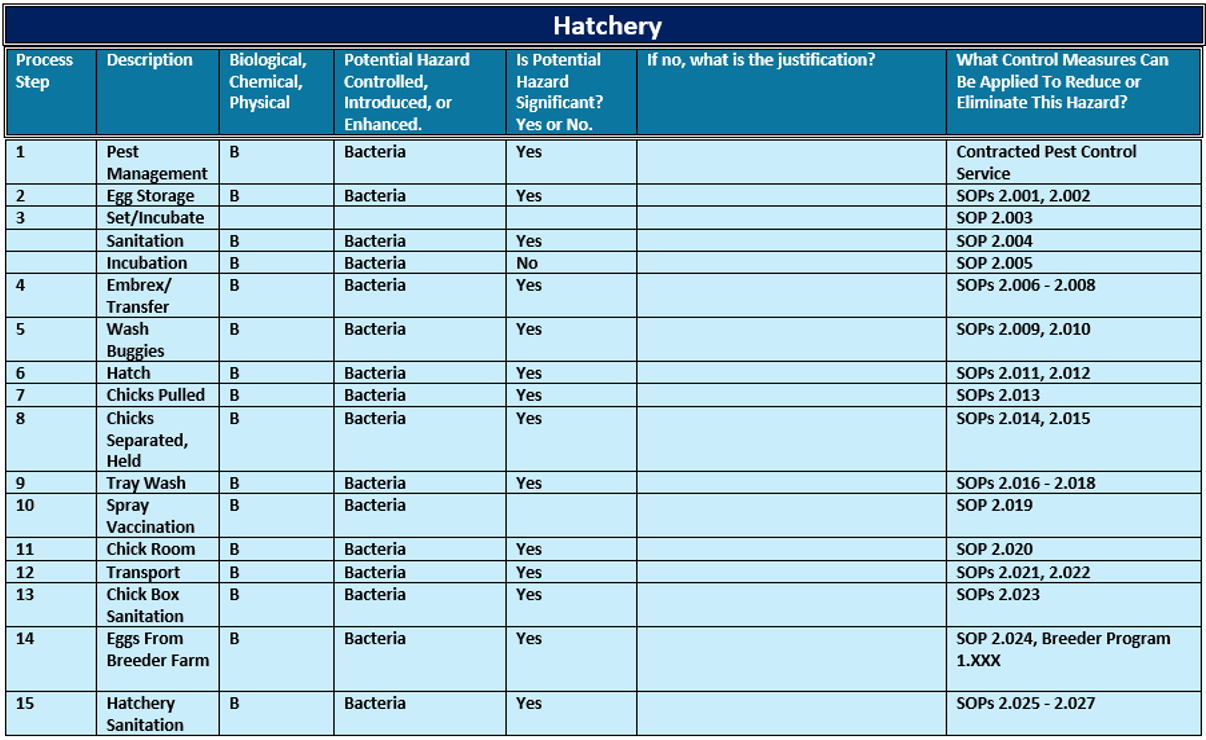
Once potential hazards are identified, a structured program can be developed to address them, either by leveraging existing controls such as biosecurity, sanitation, vaccination and management programs, or by establishing specific SOPs that clearly define practices and expectations to ensure consistent performance and compliance. I have included a sample hazard evaluation and control measure chart for the hatchery as an illustration (Figure 2), though similar assessments can be completed for pullet and breeder operations, broiler farms and feed mills.
Figure 2. Hazard evaluation and control measures
Click to enlarge.
Final thoughts
AS in poultry is most effective when treated not as a single decision or isolated policy but as a disciplined, system-wide management approach grounded in veterinary science and operational reality integrated within a robust and comprehensive animal health plan.
Effective animal health programs emphasize disease prevention as the first line of defense. These programs integrate robust biosecurity, effective vaccination strategies, appropriate environmental and production system management, well-designed sanitation practices, judicious use of therapeutics and management approaches that minimize stress. In many cases, these programs and SOPs already exist; however, placing them within a cohesive, enterprise-level framework as a foundational element of an AS program helps clearly demonstrate intent, integration and a focus on stewardship to internal and external stakeholders.
Although the industry has made measurable progress in reducing antimicrobial use, lasting credibility and continued improvement depend on embedding stewardship into organizational culture, governance, prevention strategies, monitoring and accountability. Framework-based stewardship programs provide a practical way to move from intent to execution, systematically reducing pathogen pressure, strengthening disease prevention and lowering the need for antimicrobial intervention. This not only protects animal health and preserves antimicrobial effectiveness but also builds transparency, trust and confidence with stakeholders across the poultry value chain.
AS succeeds when it is designed as a durable management system, grounded in prevention, reinforced by culture and proven through performance. WAAW is the reminder; the work is what we do every day after it ends.
1USPOULTRY-AntibioticStewardshipReport-2025.pdf
2Framework for Antibiotic Stewardship in Food Animal Production.pdf
Editor’s note: The views expressed in this article are solely those of the author.
The post A systems approach to antimicrobial stewardship: from principles to performance appeared first on Modern Poultry.
Apa Reaksi Anda?
 Suka
0
 Kurang Suka
0
 Setuju
0
 Tidak Setuju
0
 Bagus
0
 Berguna
0
 Hebat
0