


































The role of the G20 group in global meat production and trade. Part 3: global meat imports
Two previous articles examined the role of the G191 countries in global meat production and exports (Windhorst, 2026, 2026a). These studies highlighted the significant role of this group of countries, as they accounted for approximately 70% of the production volume of the four most important meat types2 and 55% of global meat exports. Another article analyses whether a similar dominance of a few countries existed in trade involving the meat types considered here. The findings revealed that exports increased faster than production, indicating a growing demand for meat. Furthermore, it was found that the concentration of exports to just two countries was very high for poultry meat, and to just one country for sheep and goat meat, while for pork and beef, four countries each accounted for over 80% of the export volume. This article aims to analyse whether there are corresponding patterns in meat exports and in meat imports, or whether they differ.
Imports rose faster than production
A comparison of the long-term development of global meat production and meat imports reveals that the trade volume has increased more sharply than the production volume. Between 2010 and 2024, global production increased by 28.4%, while meat imports grew by 45.2%. The development was similar in the G19 group. Here, production increased by 34.3%, but imports by only 42.5%, remaining below the global average. This had impacts on the G19’s share of global production and imports. The G19’s share of production grew from 72.3% to 75.7% during the period under review, but its share of imports increased only from 51.4% to 52.7%. Figure 1 shows that meat imports increased, in particular between 2000 and 2005, and then again after 2010, especially for poultry meat.
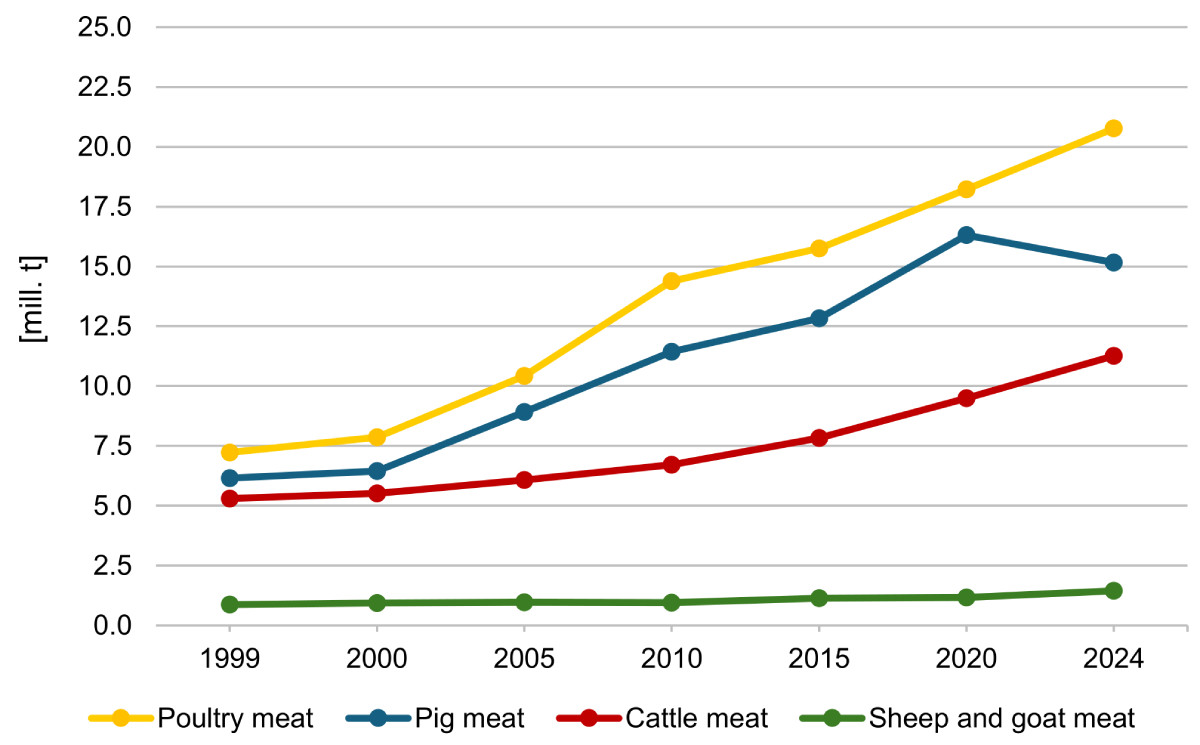
Design: A. S. Kauer based on FAO data.
A comparative analysis of the dynamics, broken down by meat type, from 2010 onwards is interesting (Table 1). Globally, poultry meat showed the highest absolute increase in both production and imports, but the relative increase was higher for beef, sheep and goat meat exports. However, the significantly lower starting values must be taken into account. This pattern was repeated in the G19 group. Here, too, the production volume of poultry meat increased much faster than that of the other three meat types. The high import volume of pork is surprising at first glance. The collapse in pork production in China following the massive outbreaks of African swine fever and the resulting supply problems led to a sharp increase in imports of other meat types for several years. The shortage of pork in other Asian countries, which were also affected by the disease, had a similar impact on beef trade and explains the high absolute and relative growth rates.
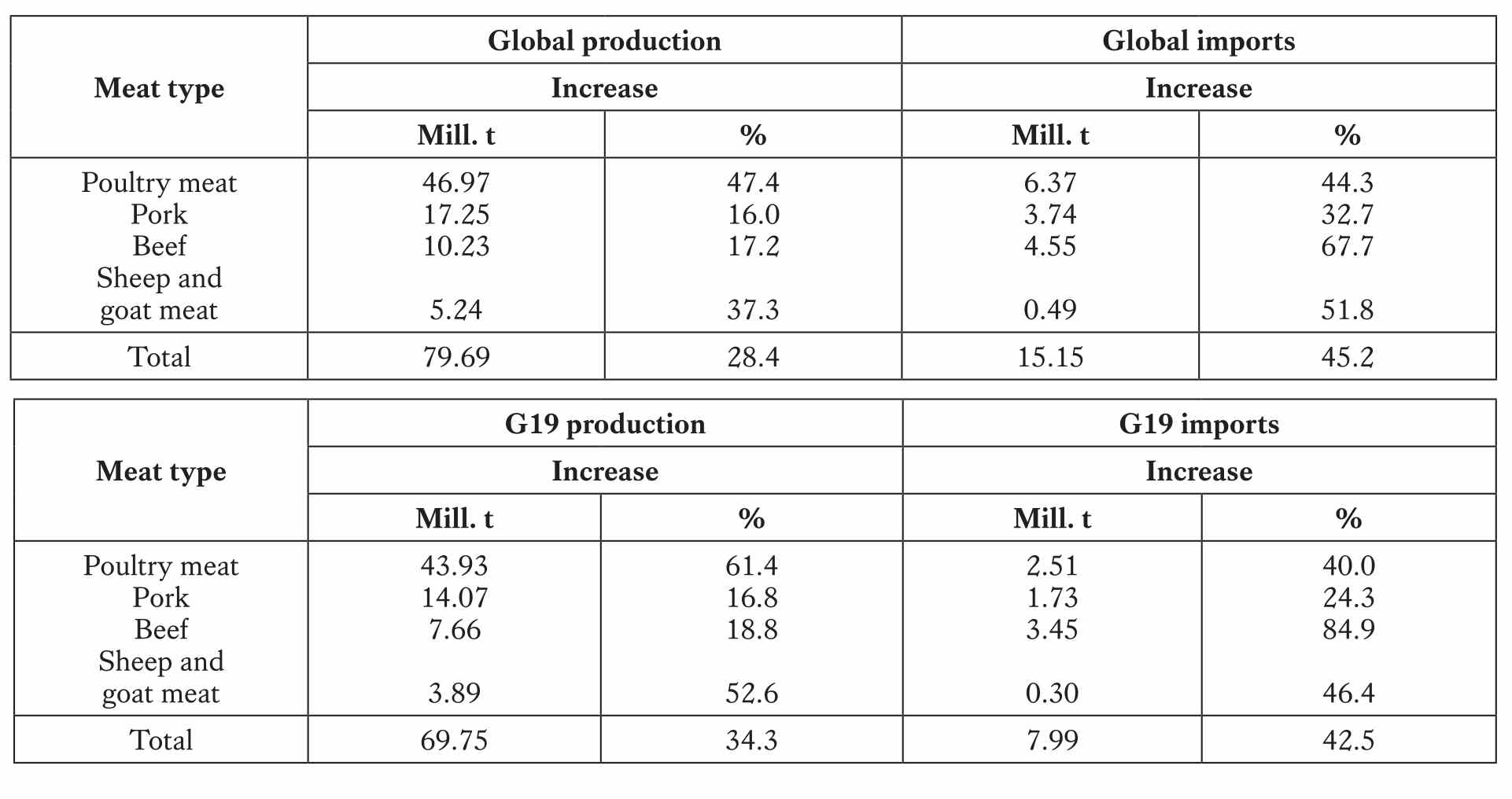
Source: own calculation based on FAO data.
It is noteworthy that despite the high absolute increase in poultry meat production among the G19 countries, which accounted for almost 94% of the global increase, the relative increase in imports was roughly in line with the global average. It must be taken into account that in some G19 countries in Asia, Europe, and in Mexico, demand rose significantly, and production was insufficient to meet the domestic needs, thus increasing imports became necessary (see also Table 2).
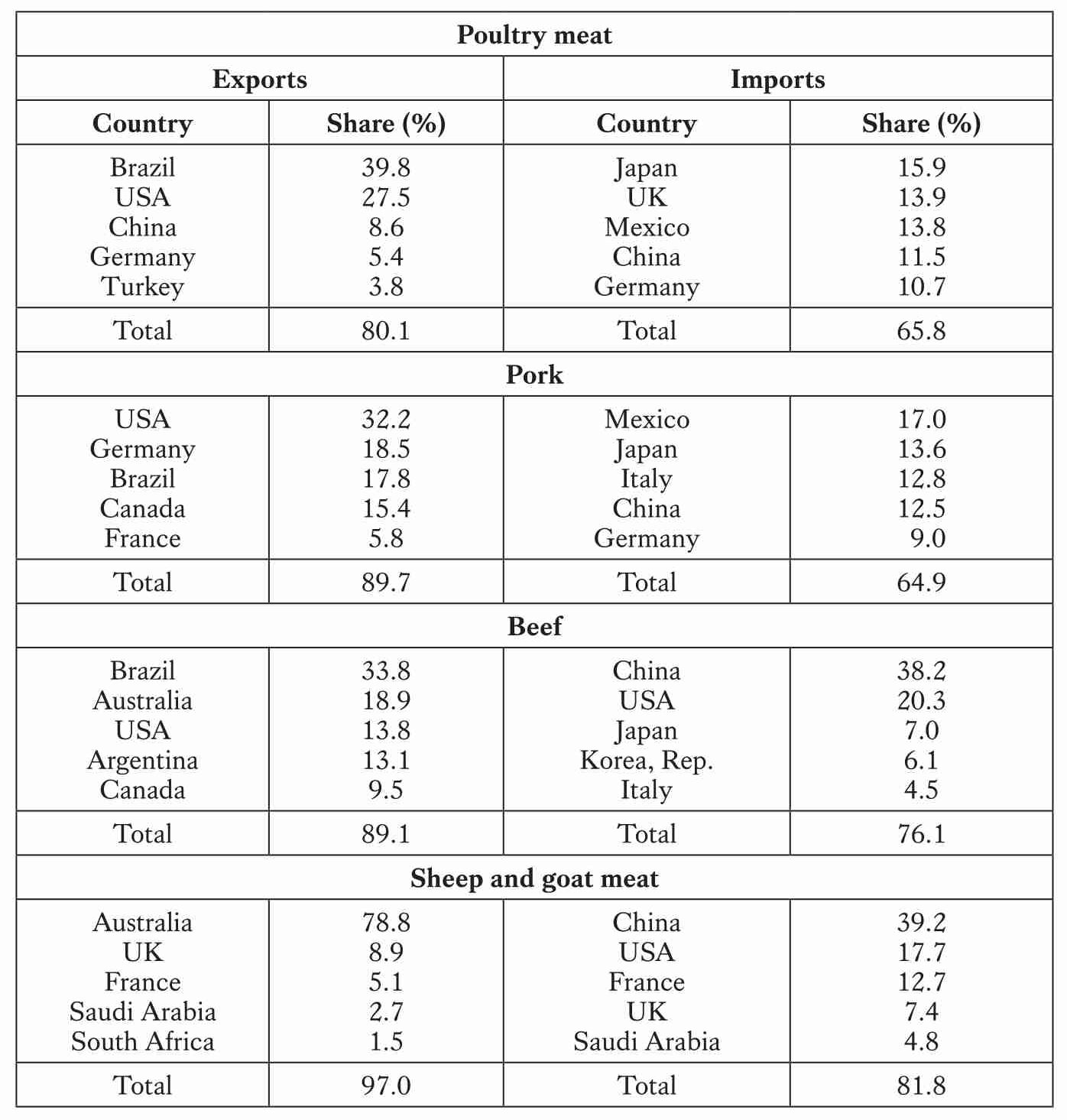
Source: own calculation based on FAO data.
Significant differences between exports and imports at the country level
A comparison of the composition and ranking of countries in meat exports and meat imports reveals similarities, but also significant differences depending on the meat type. For poultry meat, the regional concentration in imports was considerably lower than in exports. While Brazil and the USA accounted for over two-thirds of the export volume, imports were more evenly distributed. The five leading countries accounted for 65.8% of the import volume (Table 2).
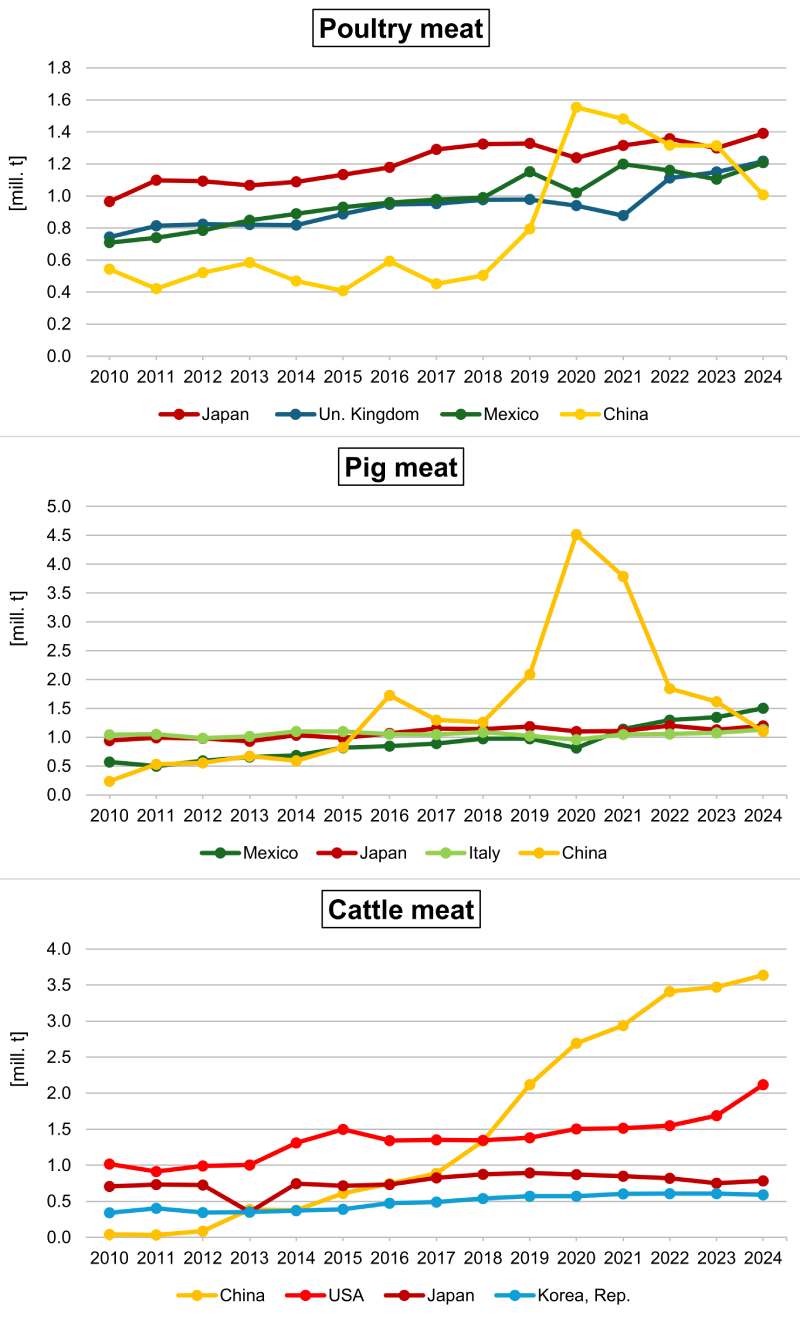
A detailed analysis of the development in the four leading importing countries (Figure 2) reveals a remarkable correlation in the absolute increase in their import volumes between 2010 and 2024, with values ranging from 425,000 tons to almost 500,000 tons. However, the relative growth rates differed significantly, with Japan‘s increase at 44.0% compared to China‘s at 85.5%. The graph for China reveals that the outbreaks of African swine fever in China triggered a doubling of imports starting in 2019, but that these imports declined significantly once the disease was contained. Germany’s imports are attributable to the steadily increasing per capita consumption of chicken, which led to a drop in its self-sufficiency rate below 100%. The significant undersupply of duck and goose meat also contributed to the rising imports.
Design: A. S. Kauer based on FAO data.
The pattern was repeated for pork. Here, too, the concentration of imports in just a few countries was about 25% lower at 64.9% than at exports.
A closer look at the import trends of the four leading countries reveals significant differences, as reflected in the respective graphs in Figure 2. While Italy‘s imports remained very consistent over the period under review, increasing by only 8.5%, Mexico‘s imports rose by 930,000 tons, or 163%. China experienced particularly large fluctuations. Imports roughly quadrupled between 2010 and 2024. A relatively steady increase until 2018 was followed by a dramatic rise between 2019 and 2021. The peak was reached in 2020 at over 4.5 million tons, representing a relative increase of 1,800% compared to 2010. With the successful control of African swine fever, imports fell by 3.4 million tons, 76% since 2021. This unusual dynamic had far-reaching consequences for the global pork trade. Rapid gains in exports to China by some countries, e.g. Spain, were offset by equally rapid declines in exports and caused economic problems.
In the beef sector as well, regional concentration was 13% lower for imports than for exports. However, there were significant differences in the spatial pattern. While four countries in the Americas, in addition to Australia, led the export markets, three Asian countries were leading in the import rankings, with China, for the reasons already mentioned, ranking first by a considerable margin. Surprisingly, the USA, despite its high domestic production and substantial exports, ranked second among importing countries. The unusual dynamics are reflected in the import trends of the four leading countries. While Japan’s import volume changed only slightly, increasing by 76,500 tons or 10.8%, it rose by 3.6 million tons or 9,150% in China and by 1.1 million tons or 109% in the USA. The dynamics in China are particularly interesting. Imports saw a slow increase until 2017, after which they rose significantly faster, reaching a preliminary peak of 3.6 million tons in 2024. In addition to supply problems resulting from the collapse in pork production, which led to compensatory imports of other meat types, the increasing consumption of beef by higher-income groups, which is regarded as an indicator of wealth and a status symbol, was also an important steering factor.
The trade in sheep and goat meat also showed a considerable imbalance between exports and imports. Here, Australia, the dominant exporter, contrasts with China, two European countries, and the USA as the main importers. It is noteworthy that the United Kingdom and France were represented in both top groups. Looking at the overall dynamics across the four meat types, it becomes obvious that China, Japan, and Mexico were the most significant importing countries within the G19 group. The USA was only a major destination for beef. Several European countries imported larger quantities of poultry meat and pork; however, trade within the EU (27) was more significant than trade with other G19 countries. A detailed analysis of trade flows would document this.
Summary: lower concentration in imports than in exports
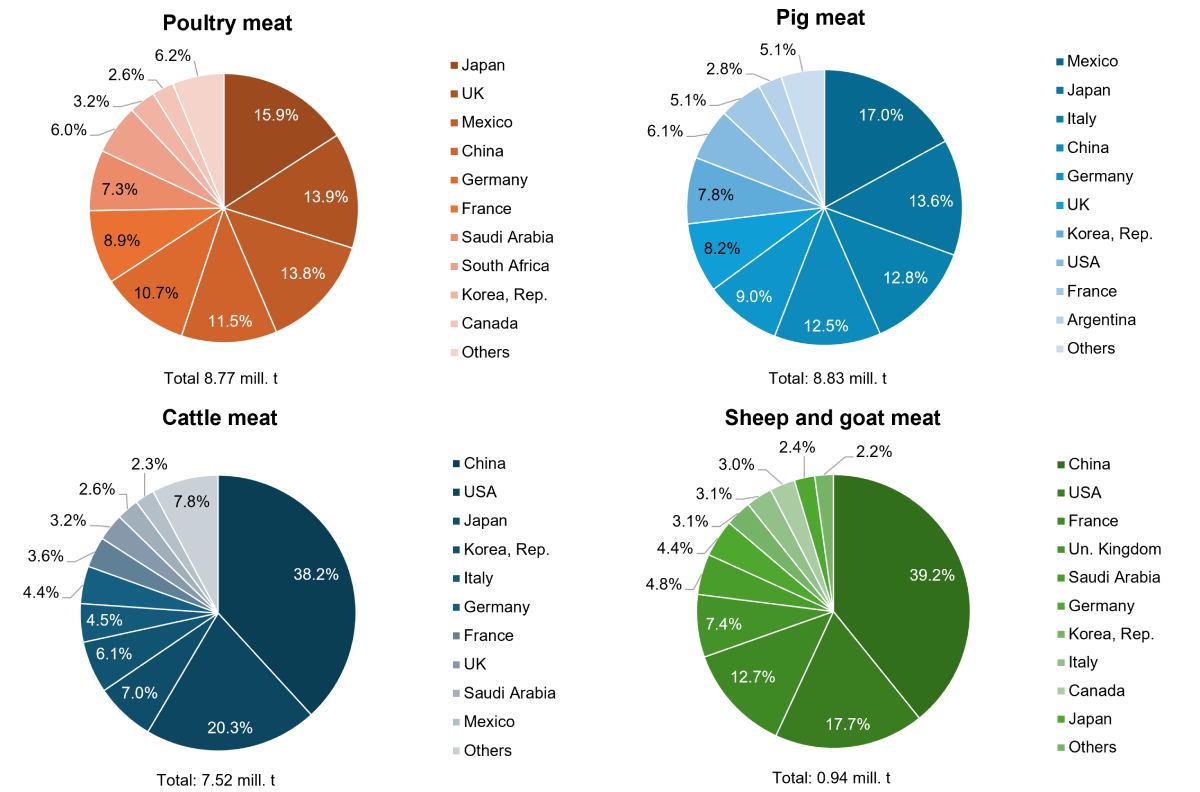
The preceding analysis of the role of the G19 countries in global meat imports focused on whether the countries that dominated exports also played a leading role in imports. It was shown that, overall, the degree of concentration in imports was lower than in exports, and the composition of the leading importing countries differed considerably from that of the exporting countries. Figure 3 shows the share of the top ten importing countries in the total imports of the group for each of the four meat types. For poultry meat and pork, there was no high concentration in just a few countries. For beef, sheep, and goat meat, however, the concentration was significantly higher due to the large shares of China and the USA.
Design: A. S. Kauer based on FAO data.
In conclusion, it can be noted that the G19 countries dominated meat production and exports. Regarding imports, it became clear that, in addition to trade between member countries, sales to countries outside the group were of great importance for countries with a production surplus.
Data source and supplementary literature
Food and Agriculture Organization of the United Nations. (n.d.). FAOSTAT. https://www.fao.org/faostat
Windhorst, H.-W. (2026). The role of the G20 countries in global meat production and trade. Part 1: Production. Zootecnica Poultry magazine, (4).
Windhorst, H.-W. (2026). The role of the G20 countries in global meat production and trade. Part 2: Global meat exports. Zootecnica Poultry magazine, (5).
1 Only the 19 member states are considered in the analysis, not the EU (27) and the African Union.
2 Poultry meat, pork, beef, as well as sheep and goat meat.
See also:
The role of the G20 in global meat production and trade. Part 1: meat production
Apa Reaksi Anda?
 Suka
0
Suka
0
 Kurang Suka
0
Kurang Suka
0
 Setuju
0
Setuju
0
 Tidak Setuju
0
Tidak Setuju
0
 Bagus
0
Bagus
0
 Berguna
0
Berguna
0
 Hebat
0
Hebat
0