






































Posture and Balance After 50: The Reason You Feel Wobbly Might Start at Your Chin


Your balance problem might not be in your feet. It might be in your chin.
I know that sounds strange, so stick with me. Posture and balance are so tightly connected that when one changes, the other follows, and for most women over 50, posture changes first. Quietly. A little more screen time, a little more rounding in the upper back, the head creeping forward year by year, and suddenly turning quickly in the kitchen feels different than it used to.
There’s a 10-second test I use to check this, and you can do it against any wall in your house. I’ll give it to you before the end of this post. But first you need to understand what’s actually happening, because once you see it, you can’t unsee it (and you can absolutely fix it).
Why Balance Feels Different After 50
Let’s name the stakes, because this is bigger than feeling a little wobbly. According to the CDC, more than 1 in 4 adults over 65 falls each year, and falls are the leading cause of injury in older adults. Falls are also one of the biggest threats to the thing we all want most: our independence.
But here’s what I want you to hear. Balance is not something you lose because a birthday came. Balance is a skill, and skills respond to practice. As a trainer, I’ve watched women in their 50s, 60s, and 70s dramatically improve their steadiness in a matter of months. Every single one of them started by working on posture and balance together, not separately.
How Posture and Balance Actually Work Together
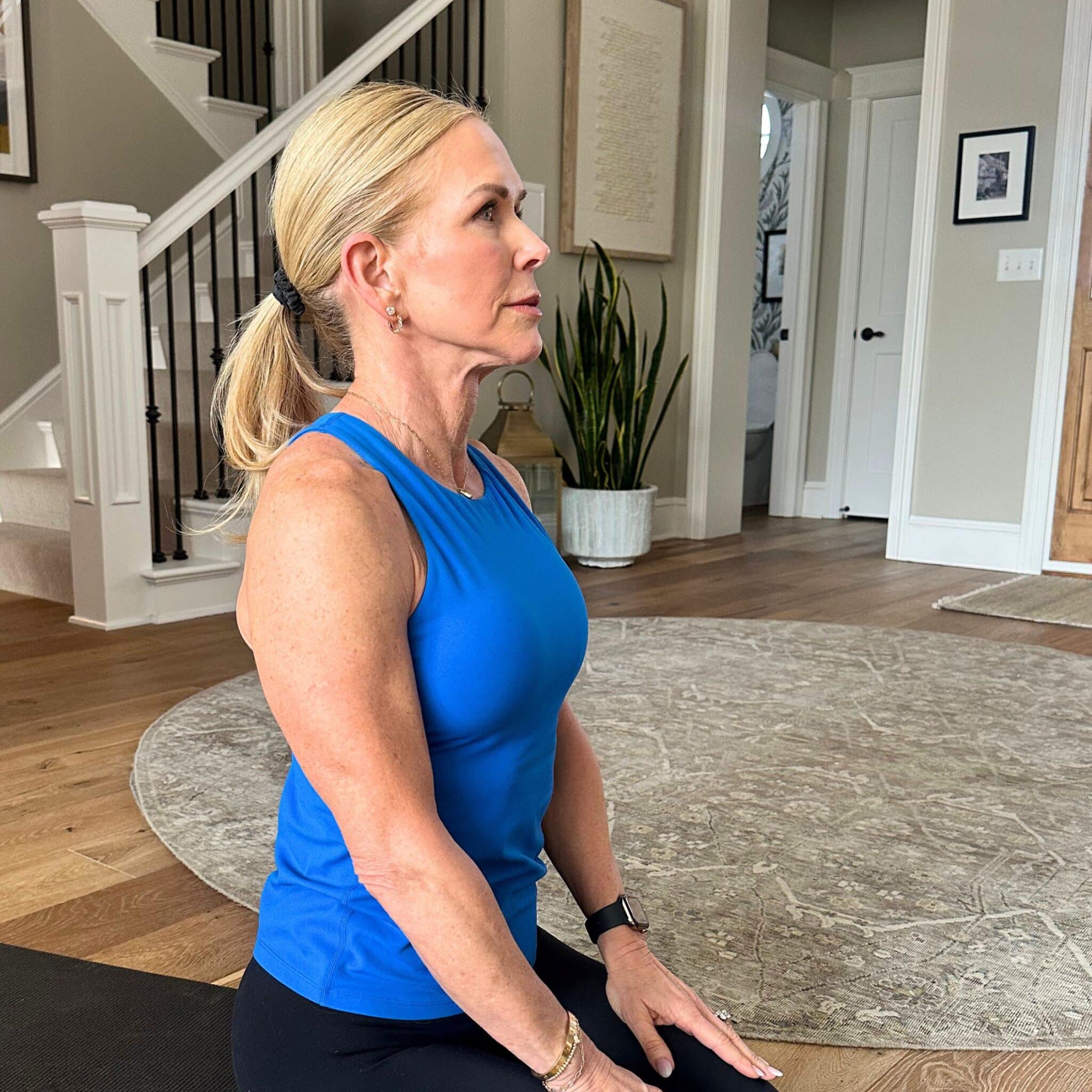
Think of your body as a stack: head over ribs, ribs over pelvis, pelvis over feet. When the stack is lined up, staying upright is almost effortless. Your muscles make tiny corrections all day and you never notice.
Now slide the top of the stack forward. When your head shifts ahead of your shoulders (hello, kyphosis, commonly known as tech neck) and your upper back rounds, your center of gravity moves toward your toes. Your muscles and nervous system have to work overtime just to keep you steady, which leaves less in the tank for reacting when you catch a toe on the sidewalk or turn to grab something.
This isn’t just my theory from 35 years of training women. A 2025 research review found that hyperkyphosis (the excessive upper-back rounding that becomes more common as we age) is linked with reduced postural stability and higher fall risk in older adults.
The wobble you feel when you stand on one leg to put on a sock? It may have started years earlier, inches higher.
The Posture Changes That Sneak Up on Us
Nobody wakes up with rounded shoulders one morning. It builds slowly, and these are the usual suspects:
- Hours of sitting (desks, cars, couches, repeat)
- Looking down at phones and screens all day
- Muscle loss as we age, especially in the upper back and core, when we’re not strength training
- Tight chest muscles from all of the above
- Bone changes, including osteoporosis-related shifts in the spine
That last one matters, ladies. Bone health and posture are deeply connected, which is why I’m always pointing you back to how to build bone density. And if a strength routine isn’t part of your week yet, my strength training moves for women over 50 is the place to start. Strength training is healthcare, and your posture is one of the first places it pays off.
Still with me? Good, because the test is coming. One more thing you need to know first.
“Stand Up Straight” Is Bad Advice (Here’s What Works Instead)
I’m going to say something that would horrify our mothers: stop trying to stand up straight.
Forcing yourself into a rigid, shoulders-pinned, military posture doesn’t fix anything. You can’t white-knuckle your way to better alignment for more than about 90 seconds, because you can’t simply decide your way to good posture. Your posture reflects your strength, your mobility, and your habits. If the muscles of your upper back and core are weak, no amount of “remembering to sit up” will hold.
What actually works is training.
Strengthen the upper back so it can hold you tall without effort. Open up the tight chest. Build the deep core that keeps your spine supported. I’ve put my favorite moves in one place in my posture exercises to stand taller post, and if your back needs extra love, these back strengthening exercises pair with it perfectly.
Train Posture and Balance Together
Here’s where it all comes together. Posture work makes balance work easier, and balance work makes posture work stick. Train them as a team:
- Strengthen your upper back and open your chest. Start with my posture exercises, a few minutes most days.
- Build your core (no crunches required). Your deep core is your built-in balance system. Try my standing core exercises that beat crunches or these core exercises for seniors.
- Practice actual balance moves 2 to 3 times a week. Single-leg stands, heel-to-toe walking, weight shifts. My favorite exercises to improve your balance walk you through all of them with modifications.
- Sneak balance into daily life. Stand on one leg while you brush your teeth. Heel-to-toe walk down the hallway. I balance on one foot while I wait for my coffee, and yes, my husband thinks I’m nuts.
Five to ten minutes a day is enough to see real change. Consistency beats duration every single time.
The 10-Second Wall Test I Promised
OK, here it is. This is a simplified version of a screening tool physical therapists use, and it takes ten seconds.
Stand with your back against a wall, heels about two inches away from it. Let your bottom and shoulder blades touch the wall. Now, without lifting your chin toward the ceiling, try to gently bring the back of your head to the wall.
If your head touches easily with your chin level: wonderful. Your alignment is in good shape, so your job is to keep it.
If your head doesn’t reach the wall, or you have to tip your chin way up to get it there: your upper back and neck have started to round forward. Don’t panic! This is exactly the kind of thing that responds to training, and now you know where your starting line is. (If the gap is significant or getting worse, mention it to your doctor, since it can sometimes relate to bone changes in the spine.)
Retest once a month. Watching that gap shrink is one of the most motivating progress markers I know, right up there with watching your grip strength climb.
When to Check In With Your Doctor
A little unsteadiness that improves with training is normal. But please get checked out if you’re experiencing dizziness, sudden balance changes, a recent fall, unexplained back pain, or if you have osteoporosis or a history of fractures.
Some balance issues come from the inner ear, medications, or other medical causes, and no exercise post replaces a professional evaluation.
Frequently Asked Questions
Yes. Posture determines how your weight is organized over your feet. When your head and shoulders shift forward, your body has to work harder to keep you steady, which makes balance feel more difficult, especially after 50.
They help, especially combined with balance training, core work, and strength training. Posture exercises alone aren’t a complete fall-prevention plan, but they’re a powerful piece of one.
Most women notice better body awareness within 2 to 3 weeks of consistent practice. Meaningful strength and alignment changes typically take a few months. Start where you are and keep showing up.
One Last Thing
At 60, I don’t train my balance so I can stand on one leg like a flamingo. I train it so I can hop off a curb without thinking, carry laundry down the stairs, and keep up with my granddaughter for decades to come. That’s what posture and balance really buy you: a body you can trust.
So go do the wall test right now, before you close this tab. It takes ten seconds, and it might be the most useful ten seconds of your week.
PS. If the test humbled you a little, don’t spiral. Bookmark my posture exercises and balance exercises, pick one move from each, and start tonight. Then come tell me your one-month retest results in the comments!
What's Your Reaction?
 Like
0
Like
0
 Dislike
0
Dislike
0
 Agree
0
Agree
0
 Disagree
0
Disagree
0
 Excellent
0
Excellent
0
 Useful
0
Useful
0
 Great
0
Great
0