






































Avian influenza detections fall, but autumn migration calls for vigilance

Only two outbreaks were reported in European poultry between early June and late August 2026. The seasonal picture is favourable, but the expected increase in virus circulation among wild birds calls for continued attention to farm biosecurity.
Highly pathogenic avian influenza detections in Europe remained at very low levels throughout the summer, continuing the decline recorded in spring.
Between 5 June and 28 August 2026, 110 detections were reported in 12 European countries, according to the latest joint monitoring report from the European Food Safety Authority (EFSA), the European Centre for Disease Prevention and Control (ECDC) and the EU Reference Laboratory for Avian Influenza (EURL).
Most involved wild birds, with 103 detections. Seven occurred in domestic birds: two in poultry establishments and five in captive birds. The poultry outbreaks were reported in Germany and Sweden.
Compared with the same period in 2025, detections fell by 72% in domestic birds and 45% in wild birds. All 110 detections involved HPAI A(H5N1), while no new detections of HPAI A(H5N5) were recorded.
A different pattern in wild birds
Waterfowl accounted for most of the detections in European wild birds. This differs from summer 2025, when colony-breeding seabirds were the main group affected. No unusual HPAI-related mortality events were reported in wild birds during the latest monitoring period.
With so few outbreaks in domestic birds, it was not possible to make a meaningful comparison with the geographical and temporal distribution of the virus in wild populations. The outbreaks that did occur, however, were in areas where HPAI had also been detected in wild birds.
Direct or indirect contact with wild birds remained the main source of introduction into establishments keeping domestic birds.
The summer figures should therefore be read in their seasonal context. The joint report indicates that detections in wild birds are expected to increase in the coming months. The arrival of migratory birds, together with the addition of immunologically naïve juveniles to wild populations, will create more favourable conditions for avian influenza virus circulation.
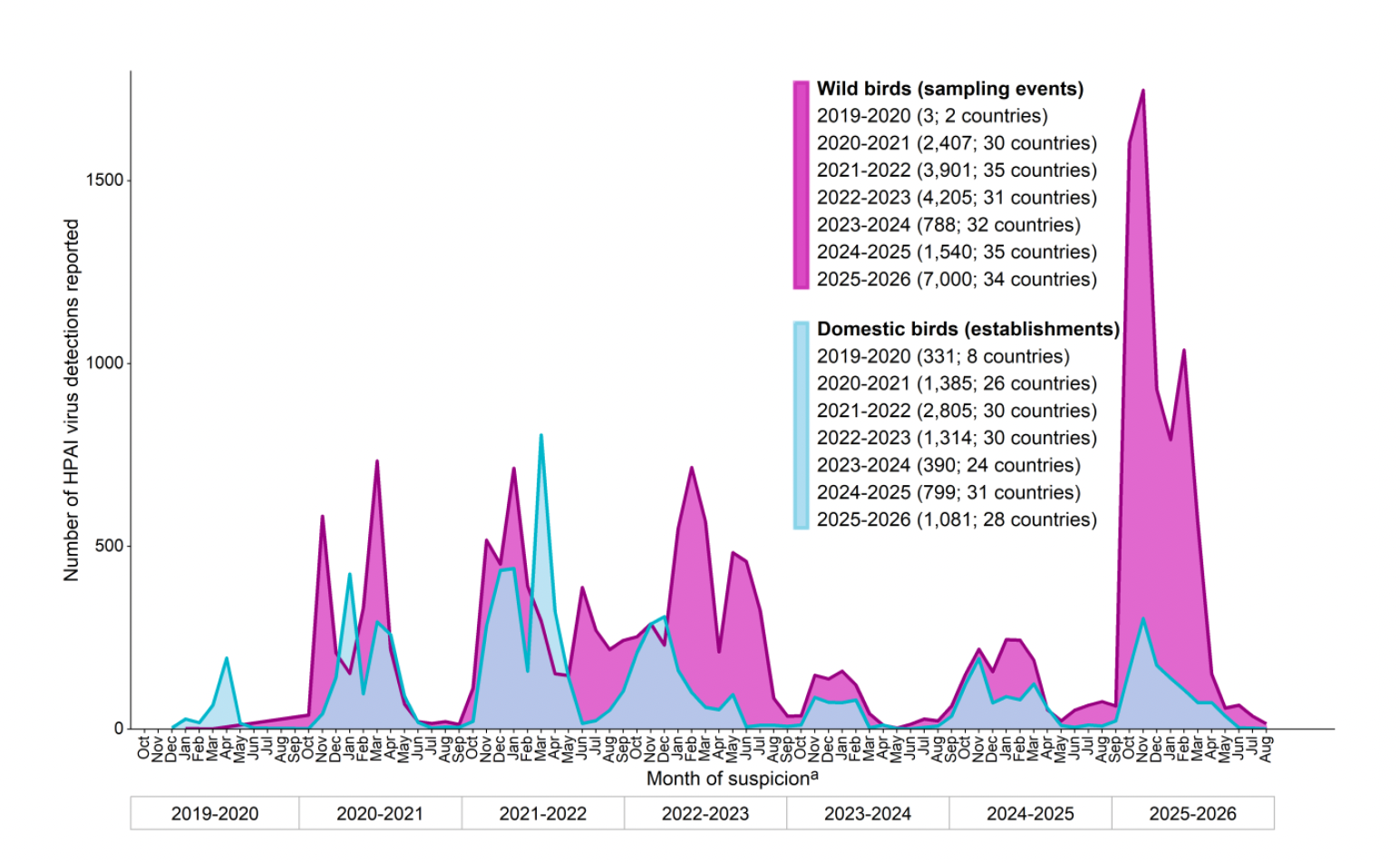
Note: United Kingdom data are from the Animal Disease Notification System (ADNS, former ADIS) up until 31 December 2020. From 1 January 2021 onwards, the data source was WOAH-WAHIS for the United Kingdom (excluding Northern Ireland) and ADNS/ADIS for the United Kingdom (Northern Ireland)5.
a If the date of suspicion was not available, the date of confirmation was used to assign the week of suspicion.
Source: ADNS/ADIS and WOAH-WAHIS (data extraction carried out on 28 August 2026).
Preparing poultry farms for the higher-risk season
Given the seasonal increase in HPAI A(H5) risk observed in previous years, the report calls for heightened preparedness over the coming months.
Biosecurity should be kept at a high level throughout the production cycle and during culling operations, including in vaccinated flocks. Particular attention is recommended for establishments under the same ownership, those belonging to integrated production chains and farms located in densely populated poultry areas.
Surveillance must also remain capable of identifying infected establishments promptly.
The report draws attention to developments in the French duck sector during the 2025–2026 epidemiological year. Outbreaks in domestic ducks decreased markedly despite sustained HPAI infection in wild birds. The authors consider it likely that mandatory preventive vaccination, combined with strict biosecurity, helped to reduce both spillover from wild birds and transmission between farms.
This experience also reinforces a central point: vaccination does not replace biosecurity.
Continued circulation outside Europe
Outside Europe, HPAI A(H5N1) continued to circulate in Central and South America. Outbreaks in domestic birds were frequently reported in non-commercial and backyard establishments.
Mexico officially reported three HPAI A(H7N3) detections in wild plain chachalacas during the monitoring period. Separately, media sources cited in the report described outbreaks of the same subtype in Mexican poultry establishments between January and July 2026.
Nepal continued to report a substantial number of HPAI outbreaks in poultry.
Australia also faced a changing situation following the first introduction of HPAI A(H5N1) to the mainland. The virus spread among resident wild bird species and was associated with unusual mortality in greater crested terns.
For European poultry producers, the low summer figures are encouraging, but they do not signal the end of the risk period. With autumn migration under way, early detection and consistently applied biosecurity will remain central safeguards against the introduction of HPAI into poultry establishments.
Source: EFSA, ECDC and EURL, “Avian influenza overview June–August 2026”, published on 22 September 2026.
Apa Reaksi Anda?
 Suka
0
Suka
0
 Kurang Suka
0
Kurang Suka
0
 Setuju
0
Setuju
0
 Tidak Setuju
0
Tidak Setuju
0
 Bagus
0
Bagus
0
 Berguna
0
Berguna
0
 Hebat
0
Hebat
0