























Changing IBDV landscape warrants vaccine programming reset

By Kalen Cookson, DVM, MAM, DAPVC
Director of clinical research
Zoetis
Infectious bursal disease virus (IBDV) has evolved to include multiple phylogenetic clusters, including variants with different antigenic looks.
When variant strains, such as AL2, or emerging variants, such as the Del-E subtypes similar to China variant SHG19 (A2dB1), break through expected protection, not only can an IBD challenge hit early, but it may also affect how well birds respond to other health challenges.
As veterinarians consider vaccination strategies against these emerging IBDV variant strains, it’s important to keep a clear goal in mind: provide every chick the strongest possible immune start while keeping pace with a changing virus.
Complex and changing IBDV landscape
In cooperation with Zoetis Diagnostics Services, technical service colleagues regularly conduct bursal surveillance programs with customers to determine IBDV strains present in flocks, in order to help inform vaccination programming decisions. Consolidated results from these surveillance efforts also provide insight into the complex IBDV landscape in the field.
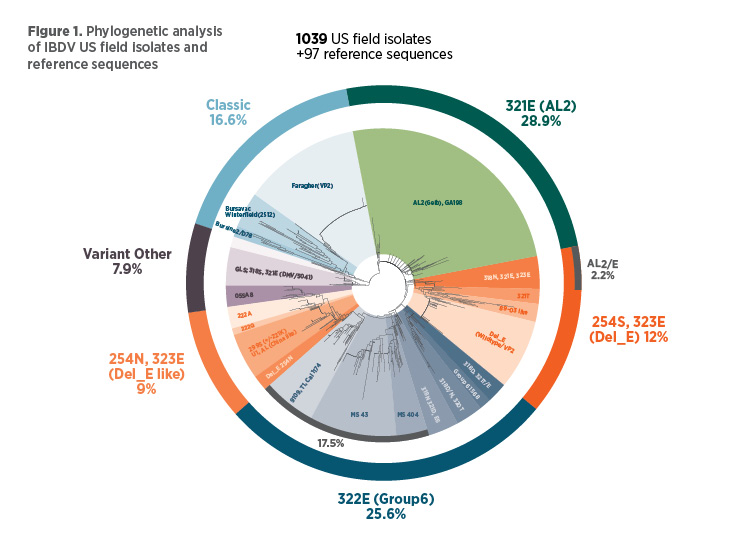
Figure 1.
Phylogenetic analyses conducted by Zoetis categorized IBDV into six general clusters (Figure 1). The Classic cluster is made up mostly of the Faragher insert contained in most rHVT-IBD vaccines but also contains live vaccine strains and Winterfield-2512.1
The Group-6 cluster, named after the many IBDVs sharing the same restriction enzyme pattern, contains the most extensive branching.1
There are two Del-E clusters: The prototype cluster and another cluster containing the 254S→N mutation. Over half of the Del-E 254N cluster also contains 299S, making them 98% identical to the SHG19 China variant that has spread to much of Southeast Asia, Western Canada (BC/Del-E) and, more recently, the Middle East.1
The Del-E prototype cluster represents about 10% of all sequences mapped in the US.2
The Variant Other cluster notably includes viruses from Pennsylvania that are also most prevalent in Eastern Canada and closely related to South Africa variant 05SA8.1
Del-E and AL2 viruses are identical everywhere except in Peak B, where they differ in three positions. These differences in the immune-dominant hydrophilic Peak B region most likely allowed AL2 to become the predominant variant since the turn of the century. Group-6 IBDVs differ from Del-E in one to four positions in Peak B.1
Matching vaccine type, timing to IBDV variant
Live IBD vaccines can help protect chicks by stimulating immunity against IBDV as maternal antibodies decline. They can also serve as strategic boosters and help block early field infections. Recombinant vaccines can help provide a consistent “cushion” of active immunity, delay field infections and reduce the bursal atrophy that occurs when field viruses do infect.
A study tested three vaccination strategies given by subcutaneous administration at hatch:3
- Recombinant vaccine (Poulvac® Procerta® HVT-IBD)
- Live vaccine
- Combination of both vaccines
Specific-pathogen-free (SPF) chickens were vaccinated and then exposed to AL2 or a Novel SHG-19-like variant IBDV.3
After challenge, all three vaccination methods provided strong protection, with 90% to 97% protection against AL2 and 87% to 100% protection against the SHG-19-like variant. Birds that were not vaccinated showed severe bursal damage from the virus.3
Although the live vaccine alone may not work as well in chicks with high levels of maternal antibodies, the study demonstrates how valuable live IBD vaccine administration can be for protecting chicks starting with marginal antibody levels. Live vaccination is thus useful to fill the protection gap before significant immunity from recombinant vaccine is attained.3
Live vaccine can protect susceptible birds (low maternal antibodies) quickly and reduce early variant IBDV replication, while recombinant HVT-IBD immunity is not affected by maternal antibodies but takes longer to kick in. Live vaccine plus recombinant IBD is a complementary hatchery strategy to help control both early and late IBDV infections.3
Additionally, a series of leghorn challenge studies showed the cushioning effect of Procerta HVT-IBD when birds were challenged with AL2 or the SHG-19-like Del-E subtype at either 3 or 4 weeks of age. Vaccination with the recombinant vaccine provided a cushioning effect against AL2 through 35 days and against the SHG-19-like Del-E subtype through 29 days.4 (Figure 2)
When vaccination programs for IBDV are developed and timed based on active surveillance programs, they can support the chick’s immune foundation, care for flock health from day one and be adjusted appropriately as the field challenge changes.
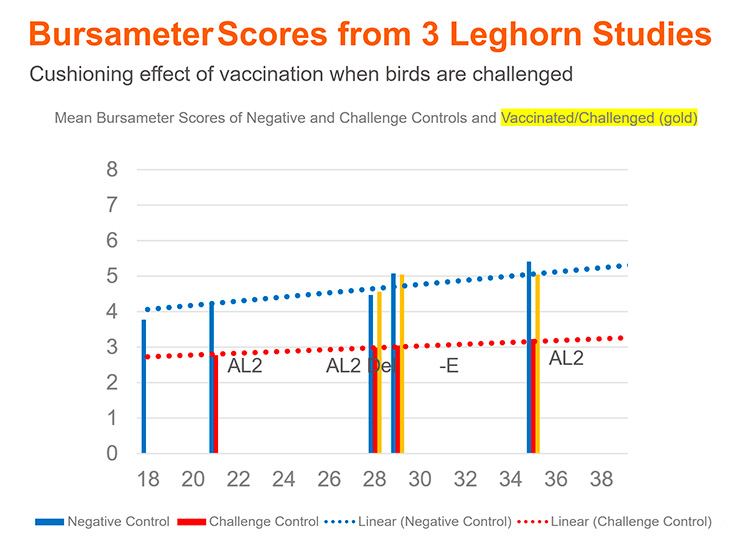
Figure 2.
IBDV programming best practices
- Know local field pressure through diagnostics and surveillance programs and stay alert to emerging variant types. With multiple types of IBDV in the field, it is important to choose a vaccine that provides protection against the most dominant variants in your area. Taking a “set it and forget it” approach may miss the mark on the level of protection needed over successive flocks in an operation.
- Choose a vaccine program strategically. Distinct vaccine options — recombinant vaccines, immune complex vaccines and live vaccines — may complement each other to achieve IBDV management goals.
- Monitor protection levels and adjust breeder, hatchery or field vaccination programs to close gaps. With information from active bursal surveillance programs, an IBDV vaccination strategy can be developed using all the available tools to help minimize the severity of an IBDV challenge and limit immune suppression.
References
- Yu P-H, Cookson K, Schaeffer J. Phylogenetic analysis of over 1,000 IBDV sequences of VP2 from commercial chicken flocks since 2009 and a comparison of key mutations shared with reference strains. International Poultry Science Forum 2025.
- Cookson K, Alig B, Jordan B, Schlenker J, Yu P-H. Phylogenetic analysis of over 1,000 IBDVs from North American chicken flocks since 2009 and how today’s commercial killed vaccines protect against IBDVs in each major cluster. World Poultry Congress 2026.
- Data on file, Study No. RM-OQO-KC8330, Zoetis Inc.
- Cookson K, Alig B, Yu P-H, Jordan B. A comparison of uninfected vs. IBDV challenged bursa sizes at several different ages from broilers and leghorns from at least 8 challenge studies. AAAP 2026.
All trademarks are the property of Zoetis Services LLC or a related company or a licensor unless otherwise noted.
The post Changing IBDV landscape warrants vaccine programming reset appeared first on Modern Poultry.
Apa Reaksi Anda?
 Suka
0
Suka
0
 Kurang Suka
0
Kurang Suka
0
 Setuju
0
Setuju
0
 Tidak Setuju
0
Tidak Setuju
0
 Bagus
0
Bagus
0
 Berguna
0
Berguna
0
 Hebat
0
Hebat
0