





























Six hours: Why the feed deprivation clock impacts feed conversion, yield, food safety and profit

By Douglas L. Fulnechek, DVM
Public Health Veterinarian
GTS Health
Of all the levers a broiler operation can pull in the final hours before a flock is harvested, few pay back as quickly — or cost as much — as the feed deprivation program. Get the timing right and you ship cleaner birds, hit your microbiological performance standards and protect every ounce of yield.
Get it wrong and you make your feed conversion worse, lose saleable meat weight and increase the Salmonella load at the processing plant. Optimizing the period from the flock’s last meal to the kill blade makes money you can bank.
Timing the deprivation
The bird’s body experiences two stages during feed deprivation: emptying of digestive tract contents and depletion of water and muscle mass. The first stage happens during the first 6 hours and cannot be changed. The second stage is where you can make a difference.
A comfortable broiler under full or near-full light eats about every 4 hours and drinks several times in between. This is steady-state consumption. The instant that feed is pulled, that eat-drink-rest rhythm becomes a clock. The crop is empty and the bird is hungry roughly 4 hours after the last meal. Feed leaving the gizzard clears the lower intestine in about 2 more hours.
But even the best-run 6-hour deprivation program cannot overcome the reality of a flock’s eating pattern. The flock should be eating continuously. When the feed pans are raised, some birds will have just filled their crops, and some birds’ crops will be empty. Under the best circumstances, the time off feed for individual birds will range from 5 to 11 hours at slaughter.
That time span comes from the plant. If you have a 33,600-head house, the plant runs 16,800 head per hour. Feed-up time is calculated from the midpoint of processing, and you get a 5-to-11-hour deprivation range for individual birds, as shown in the graphic (Figure 1).
If your operation has mega-houses with over 45,000 broilers, feed deprivation becomes even more difficult! For houses of that size, the plant needs to run about 21,000 birds per hour to keep the slaughter window as small as possible. The logistics then become really complicated when trying to catch and deliver four, five or even six truckloads per hour to the plant.
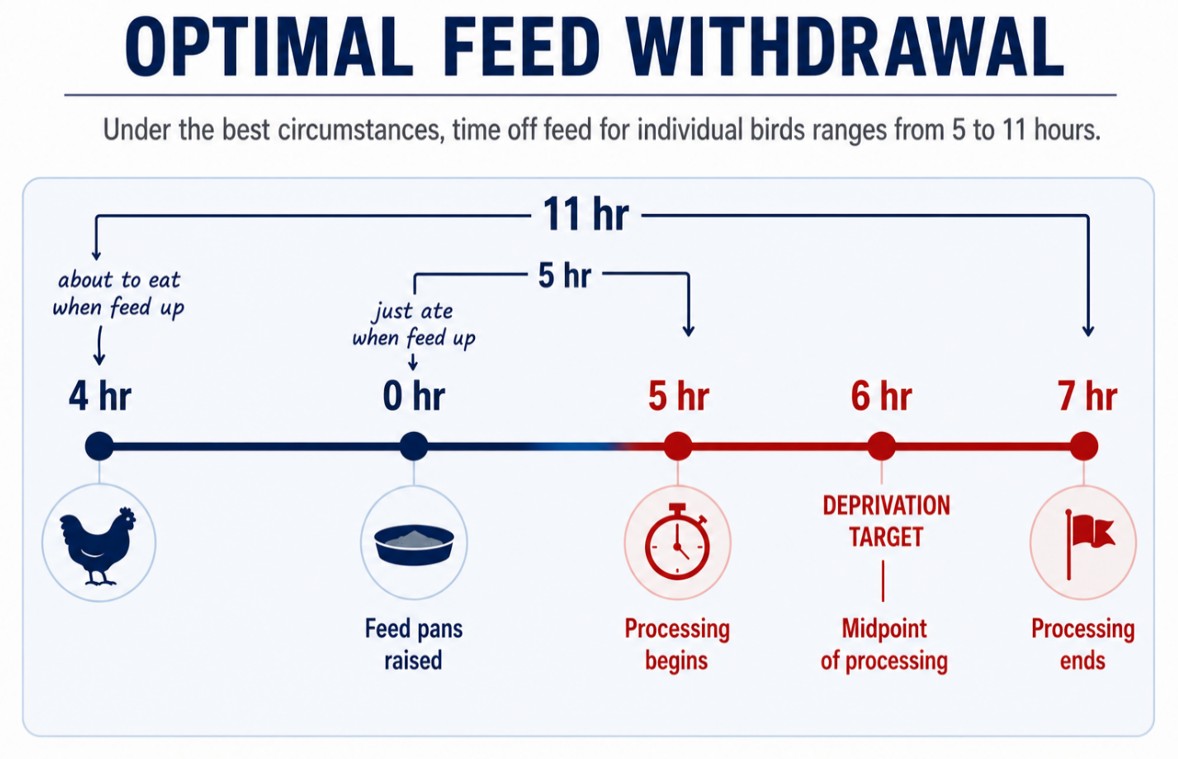
Figure 1.
Unforgiving numbers
There is extensive scientific research about this subject, and the arithmetic is unforgiving. Researchers have observed that live shrink, which is pre-processing weight loss, ranges from 0.18% to 0.43% of bodyweight per hour.
In the following scenario, the dollar math is painful.
- Plant processes 1.2 million broilers per week.
- Average live weight at catch is 6.7 pounds (3 kg).
- Average live shrink is conservative — about 0.25% per hour.
- Feed-conversion ratio (FCR) increases by about 0.005 per hour.
- FCR is about 1.67.
- Feed costs about $270 per ton (907 kg).
- Plant sells whole carcasses for about $1.20 per pound.
- Optimal feed deprivation period is 6 hours.
- Actual feed deprivation period is 10 hours.
This same 4-hour over-deprivation loss shows up in two ledgers — farm feed cost and plant revenue — and the two don’t add together. The 10-hour program is costing roughly $1 million per year in feed value tied up in weight lost to shrink and approximately $4 million-per-year loss in saleable product.
It is important to remember that you cannot value live shrink at whole-bird prices — it’s the dressed broiler that gets sold.
In my career, I have evaluated more than 1,000 feed deprivations, and I have never found a program where the period was too short. Plant personnel will tell you they would rather deal with feed in the crop than feces in the colon.
With the parameters above, a 10-hour target puts some birds at 15 hours off feed. That’s a problem. At 15 hours the lining is sloughing, bile is backing up into the gizzard, the ceca are about to empty and the intestine breaks easily.
Final points
Here are important takeaways regarding feed deprivation:
- Avoid feed outages, light interruptions and temperature extremes that trigger binge eating.
- Count deprivation from the flock’s last meal to the kill blade. Catching, loading, transportation and lairage are logistics that occur within the deprivation window. They do not impact the clock.
- Calculate feed-up time backward from the midpoint of the processing window.
- Target empty but strong intestines — shorter beats longer.
- Leave water available until the catch crew arrives.
- Regularly evaluate intestinal tracts at the plant.
Six hours isn’t a stretch goal. Hitting it doesn’t take new equipment or a bigger budget. It takes a calculation and a habit: Figure feed-up time backward from the kill, and open intestinal tracts at the plant. By doing that, you protect feed conversion and yield, the plant gets cleaner birds and the money stops leaking from both ledgers at once.
Editor’s note: The views expressed in this article are solely those of the author.
The post Six hours: Why the feed deprivation clock impacts feed conversion, yield, food safety and profit appeared first on Modern Poultry.
Apa Reaksi Anda?
 Suka
0
Suka
0
 Kurang Suka
0
Kurang Suka
0
 Setuju
0
Setuju
0
 Tidak Setuju
0
Tidak Setuju
0
 Bagus
0
Bagus
0
 Berguna
0
Berguna
0
 Hebat
0
Hebat
0