
























































What Does ‘Clinically Proven’ actually Prove?


A run of Advertising Standards Authority rulings has put skincare efficacy claims back under scrutiny. We discuss with Consultant dermatologist Dr Clare Kiely why one phrase has come to describe very different levels of evidence, and what a credible standard of proof looks like from the cell to the mirror.
The Advertising Standards Authority had a busy spring. In the space of a few weeks it worked through a run of familiar names. A Eucerin poster on the London Underground assured women that a serum was clinically proven to make them look up to five years younger. An advertisement for 111SKIN's Exosome Face Lift claimed the product was clinically proven to lift the skin by twenty per cent in four weeks. A Beauty Pie campaign for an LED mask promised wrinkles clinically reduced over the same period. Each claim carried an air of authority. In each case the regulator found the wording misleading and told the brand it could not appear again in that form.
Eucerin submitted four studies and a peer-reviewed paper, and the ASA judged none of it sufficient, noting absent control groups, unclear blinding and a reliance on how volunteers felt rather than on anything an instrument had recorded. The 111SKIN study ran for twenty-eight days on thirty subjects, with no placebo or control arm, and rested on a subjective grading score rather than an objective measurement of lift. Beauty Pie's product-specific studies were unpublished, and one recorded a reduction in wrinkles that fell short of statistical significance.
So, if clinically proven can carry a national campaign and still fail at the ASA, what is the phrase actually worth, and how is anyone outside a testing lab meant to tell one version from another?
A phrase that can mean almost anything
Few people have spent longer on that question than Dr Clare Kiely. A consultant dermatologist and laser surgeon who trained at St John's Institute of Dermatology, she is an honorary senior lecturer in skin ageing and aesthetics at the University of Manchester and chairs the Cosmetic Practice Standards Authority. She is also the founder of The Skin Diary, the dermatologist-led brand behind a testing framework it calls Cell-to-Surface, which she established with Professor Chris Griffiths OBE, Dr Tamara Griffiths and Dr Richard Barlow.
Her reason for formalising is "because skincare has a credibility problem, and we wanted to raise the bar for transparency in how skincare products are tested and the evidence behind the claims made about them," she says. The difficulty, as she sees it, is that two words are made to carry an enormous load. "It might refer to a molecule tested in isolation in a petri dish. It might mean a consumer survey where people simply say their skin feels better. Or, more rarely, it might refer to a randomised, blinded, controlled trial with objective biological endpoints. The phrase is identical each time. The evidence behind it is not."
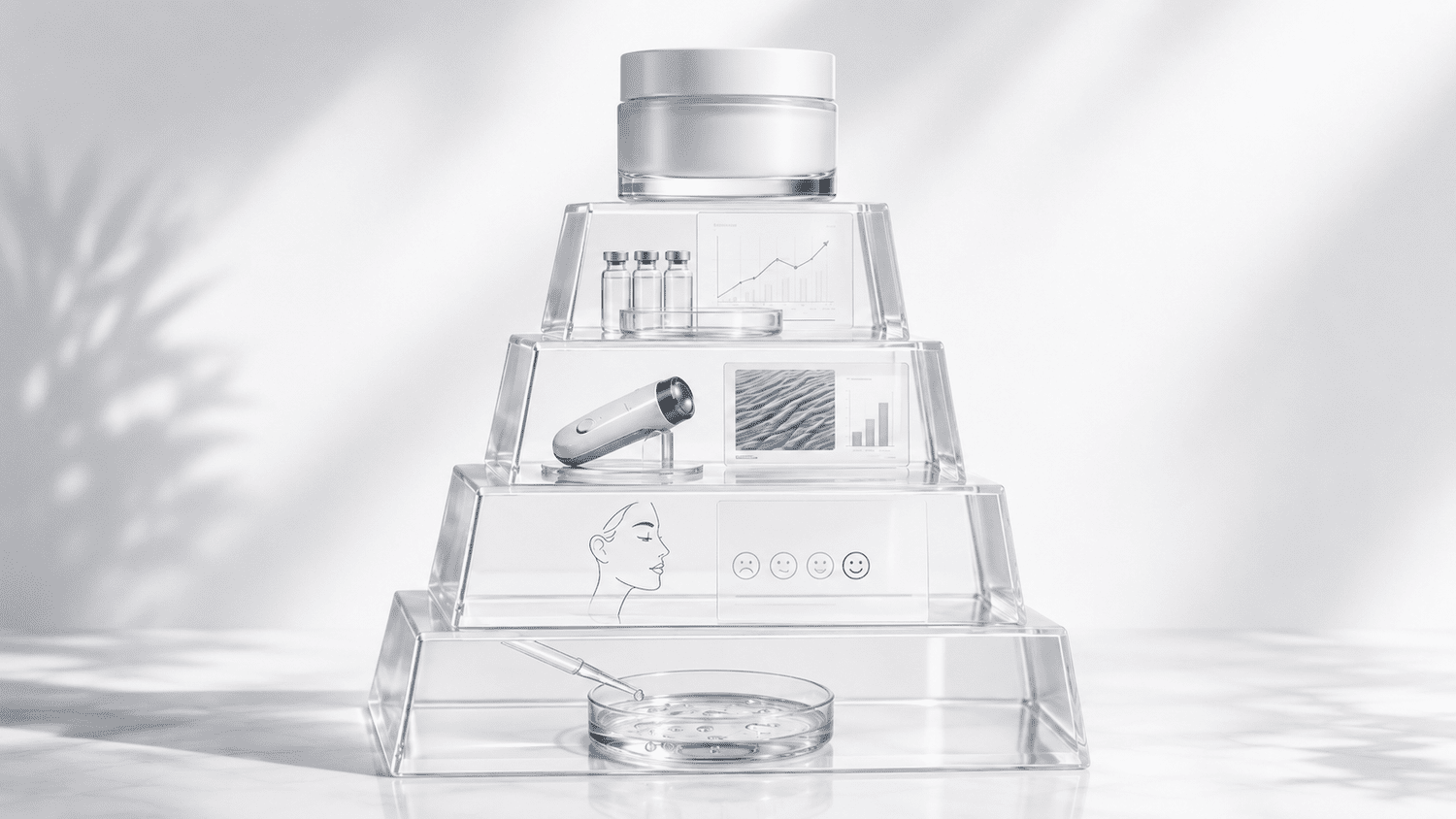
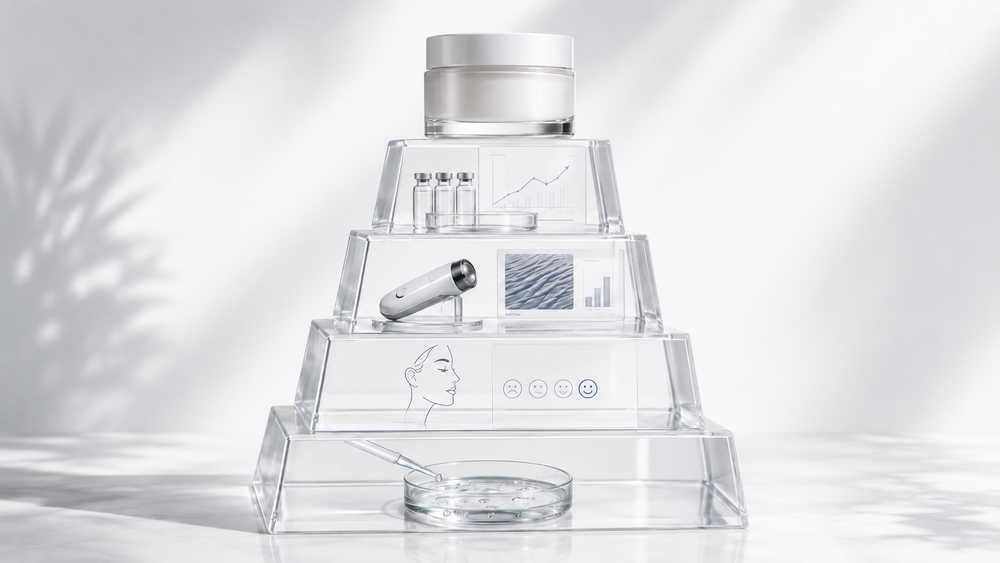
The phrase can conceal four quite different things; the first is an ingredient study, in which a molecule is assessed on its own rather than as the finished product. The second is a consumer study, in which a panel is asked whether their skin feels better. The third is a clinical trial, in which instruments record a change at the surface but nothing is measured beneath it. The fourth, and rarest, is a trial of the finished formula against a control on real skin, with a biological endpoint. Very few shoppers, and not many of the practitioners or journalists assessing a product, carry a ready framework for working out which of the four sits behind the words on the jar.
Some of the pressure, Kiely suggests, comes from the supply side rather than the science. Novel actives are far easier to obtain than they once were, which she regards as broadly a good thing but the complication arrives afterwards. A promising active is now simple to source, and so it "can show a promising signal in a cell culture, have a compelling story built around it, and end up on the front of a jar as a 'breakthrough' before the finished formula has been tested to determine whether, at the concentration people actually use, it produces the same effect", she says. "Drug development teaches us that promising laboratory findings often do not translate into real-world performance."
The regulator appears to be drawing much the same line, under the UK Cosmetics Regulation and the Common Criteria retained in Regulation 655/2013, every cosmetic claim must meet six tests, evidential support among them, and the weight of proof is expected to match the weight of the claim. The underlying regulation is enforced by the Office for Product Safety and Standards and by Trading Standards, while the ASA polices advertising through the CAP Code. A brand need not publish its evidence in advance but it must hold enough to justify the impression a reasonable consumer would take away, and it’s this reason the brands did not hold up in their rulings.
Kiely is clear not to dismiss consumer perception work, which remains a fixture of the trade. "They matter, but they sit at the experiential end of the evidence pyramid rather than the top, and it is worth being honest about why," she says.
"Consumer studies ask people whether they noticed a difference: smoother skin, more glow, less redness. That is real information, how a product feels and performs in someone's daily life is part of the evidence a brand should be gathering. However, perception studies are inherently more susceptible to expectation, reporting and placebo/context effects than objective measurements. Almost any moisturiser, for example, can transiently soften the appearance of fine lines through hydration alone. That is not the same as demonstrating that the product has produced a measurable biological change within the skin."
In her model perception keeps its place, provided it does not stand alone. "Used alongside biomarker evidence at the cellular level and objective clinical measurements at the skin surface, it demonstrates that the reported improvements are accompanied by measurable biological and clinical changes. That combination, not the consumer study in isolation, is what gives me confidence to recommend a product."
What makes a study worth trusting
For anyone attempting to read a supplier's data pack, Kiely begins with a single question. "The first thing I ask is what question is the study trying to answer?" Cellular work, instrumental clinical work and consumer work all have their uses, she notes, but they answer different questions, and the honest course is "to be transparent about which type of evidence you have, rather than presenting them as though they are all equivalent".
After that, a handful of features raise confidence; whether the finished product has been tested rather than the ingredient alone, since "formulation matters enormously". Kiely wants a proper control. "Ideally, I want to see the active formulation compared with the same formulation without the active ingredient," she says, which distinguishes the work of the active from the comfort of the moisturising base. She looks for blinding, so that "neither the participant nor the person assessing the results should know which product is being used". And she weighs what has actually been measured, allowing that subjective feedback has value while insisting that "the strongest clinical studies combine that with objective measurements, such as imaging, wrinkle analysis, skin hydration measurements or other validated instrumental assessments".
The last of her tests is the one the industry finds least comfortable, "Is the brand willing to publish the results even if they are less impressive than expected? That openness tells me the goal is to generate evidence, not simply support a marketing claim." The core of her argument is the distance between an ingredient and a product. "Because a cell culture is not skin, and a molecule is not a product," she says of the decision to test final formulations. "When an ingredient is tested in isolation, it is usually in direct contact with cells in a dish. There is no skin barrier to get through, no competing ingredients, no formulation to remain stable in, and no real person with their own biology and lifestyle."
A good illustration of this in action is with retinoids, a 2021 paper in the Journal of Cosmetic Dermatology by Temova Rakuša and colleagues examined retinoid stability across a dozen commercial products and found losses running from the negligible to about 80 per cent within six months, with several products containing less active than the label declared. "some products retaining almost all of their active ingredient while others lose up to around 80% within six months of storage under the same conditions", as Kiely puts it. "The same ingredient does not necessarily behave the same way in every formulation." Hence, she argues, the case for testing at three points. "At the cell, to determine whether the finished formula produces measurable biological changes in the skin; at the surface, to determine whether those biological changes are reflected in objective measurements of the skin; and in the mirror, to establish whether those changes are meaningful to the person using the product."
Cell-to-Surface is Skin Diary’s attempt to hold itself to that sequence. At the cell, it draws on independent biomarker work, including the Manchester Patch Test Assay at the University of Manchester and gene-expression analysis through Skin Life Analytics. At the surface, it commissions randomised, intra-subject controlled trials at an ISO-accredited laboratory, using instruments such as SELS wrinkle imaging and corneometry. At the mirror, independent consumer panels test whether any of it registers in ordinary use. Both of the brand's flagship products, the Night Repair Therapy night cream and the Age Defence day cream, have been through all three tiers. Professor Chris Griffiths OBE, Emeritus Professor of Dermatology at Manchester, was among the researchers who first showed that topical retinoids could repair photoaged skin. That history sits behind the brand's bolder marketing, which includes a claim to have outperformed prescription tretinoin and a consumer-facing figure describing one product as up to twenty times more effective than retinol - and the Skin Diary can prove it.
What good practice would look like
Asked what she would like to see become normal over the next five years, Kiely starts with transparency. "When brands use terms such as 'clinically proven', they should make it clear what that actually means," she says, so that clinicians, journalists and consumers can tell ingredient data, a perception study and a finished-formula trial apart.
She is candid about expense. "Not every company has the resources to undertake university-based biomarker studies, and that is completely understandable. High-quality clinical studies with objective instrumental measurements are still very valuable evidence. Brands should be transparent about the level of evidence they have generated and avoid implying they have demonstrated more than they actually have."
Her final hope is for the science itself to keep moving. "The next generation of technologies, from transcriptomics and epigenetics to multi-omic approaches will increasingly help us understand how products work," she says. The standard she has built is not, she insists, the end of the matter. "The Cell-to-Surface standard was never intended to be the finish line; it is simply one step towards generating stronger evidence, asking better scientific questions and continually raising the standard of evidence that underpins skincare."
Practitioners are part of. the system, a method of control to ensure that suppliers are held accountible for the claims that they make on their products, and they can support raising questions to any supplier before a product reaches the shelf or the treatment room. Was the finished formula tested, or only the ingredient. Was there a control. Was the study blinded. What did it measure. And was any of it ever published. After the spring the ASA has just had, those five questions carry a commercial weight they lacked a year ago.
Sign up with your email address to receive news and updates.
Subscribe
We respect your privacy. Thank you!
What's Your Reaction?
 Like
0
Like
0
 Dislike
0
Dislike
0
 Agree
0
Agree
0
 Disagree
0
Disagree
0
 Excellent
0
Excellent
0
 Useful
0
Useful
0
 Great
0
Great
0