











































.png?format=1500w#)


 Large.jpeg?format=1500w#)







10 Kettlebell Chest Exercises to Try Today + Sample Workout


10. Kettlebell Floor Chest Press
Use a pair of kettlebells for the floor press.
The floor press limits your range compared with a bench, which changes how the rep feels. Keep tension through your chest and use the triceps in this movement to finish the press.
-
Lie faceup with your knees bent, feet flat, and hips slightly raised.
-
Set the bells at chest level with your elbows bent. Stack each handle over your forearm so your wrists stay straight.
-
Press both bells toward the ceiling with your palms facing each other.
-
Lower with control until your upper arms touch the floor, then press again.
Keep each bell balanced over your forearm and maintain a neutral wrist throughout the kettlebell chest press.
9. Kettlebell Seesaw Press
Use a pair of kettlebells and alternate presses from the floor.
Alternating the presses challenges your pecs as well as your shoulders. Your trunk works to keep you steady as the bells move.
-
Lie faceup with your knees bent, feet flat, and hips slightly raised.
-
Set the bells at chest level with your elbows bent. Stack each handle over your forearm so your wrists stay straight.
-
Press one bell toward the ceiling. As you lower it toward your chest, press the other bell up.
-
Continue alternating for your chosen number of reps.
For a harder variation, let one shoulder blade lift slightly as you press. Rotate through your upper back without losing control of the bell or your trunk.
8. Decline Floor Fly
Use a light paiThe decline floor fly uses a pair of kettlebells in a wide arc. Use a light pair and move slowly so you can control both bells throughout the movement.ly so you can control both bells throughout the arc.
-
Lie faceup with your knees bent, feet flat, and hips slightly raised.
-
Bring both bells over your chest with your elbows slightly bent and your wrists neutral.
-
Turn your palms toward each other and center the bells over your chest.
-
Keep a soft bend in your elbows as you lower your arms out from your shoulders.
-
Stop at a range you can control, then bring the bells back over your chest.
Choose a load you can control. Slow down or reduce the range if the bells wobble or the position feels uncomfortable.
7. Kettlebell Pullover
Use one kettlebell and a bench for the overhead arc.
For kettlebell upper-chest work, the pullover adds a long overhead arc. ACE classifies lying pullovers as a chest exercise. Move the bell over your upper chest as well as your upper back, then keep the range smooth and controlled.
-
Lie faceup on a bench with your feet planted. Hold one kettlebell by the horns over your chest, and keep your hips supported on the bench.
-
Keep a soft bend in your elbows as you lower the bell behind your head only as far as you can control.
-
Pull the bell back over your chest without changing your elbow angle.
Keep your ribs steady and move slowly. The goal is a smooth arc, not the deepest possible range.
6. Crush Grip Floor Press
Use one kettlebell and press it with both hands.
The crush-grip floor press uses one heavy kettlebell, so it works well when equipment is limited. Pressing inward on the bell gives you a clear tension cue without adding another weight.
-
Lie faceup with your knees bent and feet flat on the floor.

-
Hold the bell with both hands, press your palms inward, and extend the kettlebell toward the ceiling.
-
Keep pressing inward as you lower the bell toward your chest, then drive it back up.
Choose a bell you can lower without losing wrist position or inward pressure.
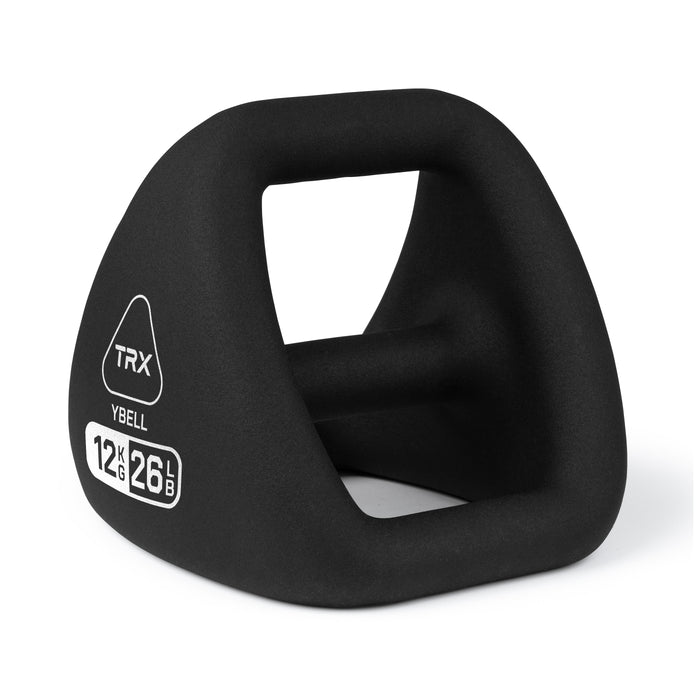
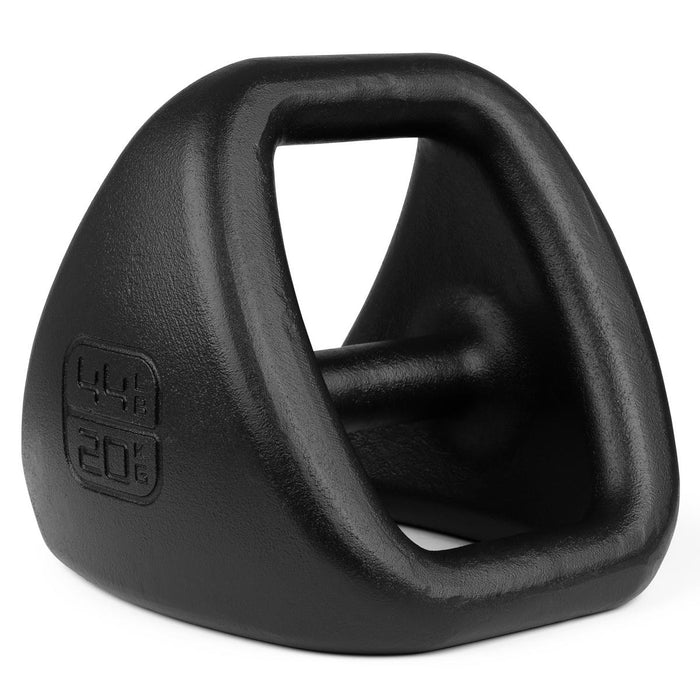
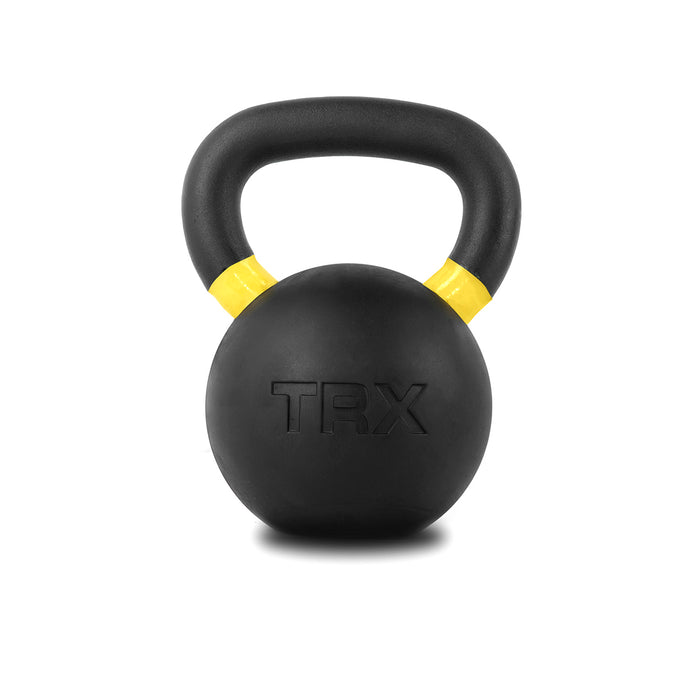
Here's the gear you'll need:
5. Kettlebell Push-Up
Use two stable kettlebells as push-up handles.
Two stable kettlebells can serve as neutral-grip push-up handles. ACE’s kettlebell push-up instructions call for neutral wrists and a controlled lowering phase. Check that both bells sit flat and stay steady before you start.
-
Place two kettlebells on the floor about shoulder-width apart with the handles parallel.
-
Grip the handles and step back into a high plank, or lower your knees for a scaled option.
-
Brace your trunk, bend your elbows, and lower your chest between the bells with control.
-
Press through both handles until your arms are straight, keeping your body in one line.
What Kettlebell Shape Works Best for Push-Ups?
A kettlebell with a flat, steady base is the better choice for push-ups.
TRX® Rubber Coated Kettlebells use a machined flat base, which gives you a predictable setup before you put weight through the handles.
Place two bells shoulder-width apart, press down on both handles, and check for rocking. If either bell shifts, use floor push-ups or a purpose-built stand instead.
4. Half Get-Up Kettlebell Press
Use one kettlebell for this roll-up and press sequence.
The half get-up press combines a supported roll-up with a one-arm press. It challenges your shoulders, hips, and core all together.
Lie faceup with the bell at your right shoulder. Bend your right knee, plant your right foot, and extend your left arm and leg about 45 degrees from your body.
-
Roll onto your left forearm, then press up to your hand.
-
Press the kettlebell toward the ceiling once your hand is planted.
-
Lower the kettlebell to your shoulder, then return to your forearm and back with control.
Start light enough to control the roll-up and press. Add load only after the full sequence feels steady.
3. Close-Grip Kettlebell Push-Up
Use one stable kettlebell and place both hands on it.
The close-grip kettlebell push-up puts both hands on one bell and demands steady trunk control. Use a stable bell that rests flat on its side.
-
Set the kettlebell flat on its side.
-
Place both hands on the bell and step your feet wide for a stable base.
-
Brace your trunk, bend your elbows, and lower your chest toward the bell.
-
Press through both hands until your elbows are straight.
A wide stance gives you a steadier base. Switch to the offset push-up if the single-bell setup feels unstable.
2. Offset Push-Up
Use one stable kettlebell to elevate one hand.
The offset push-up raises one hand on the kettlebell and keeps the other on the floor. This uneven setup challenges you to stay square as you press.
-
Set one kettlebell flat on its side.
-
Center one hand on the bell and place the other on the floor.
-
Brace your trunk and bend both elbows to lower with control.
-
Press evenly through both hands until your elbows are straight.
Set the bell flat and center your palm on it before each set. Widen your feet if you need more stability.
1. Incline Press-Out
Use one kettlebell and press it forward on a slight upward angle.
Press the bell up and away from your chest on a diagonal path past your upper inner chest! Use one bell you can control without leaning back.
This standing, single-bell move works well when floor space is limited. Keep the path diagonal instead of turning it into an overhead press.
-
Hold the bell with both hands at chest height and press your palms inward.
-
Extend your arms forward and slightly upward without arching your back.
-
Keep inward pressure on the bell as you draw it back to your chest.
Choose a load that challenges you without changing the diagonal path or shortening the range.
Sample Kettlebell Chest Workout
Use the kettlebell chest routine below as a starting point for your next kettlebell chest workout. Your goal should guide the load and volume, so adjust the reps, sets, and range of motion to match your experience.
Warm-Up and Progression
Warm up with one or two easy rounds of push-ups, light floor presses, and controlled pullovers. Keep the load light enough to rehearse each position without building fatigue.
Progress one variable at a time. Add a rep, a set, range of motion, or load once every rep stays controlled.
Heavier loads can support strength, and more weekly volume can support muscle growth. Keep the plan aligned with your goal and recovery.
Five-Move Kettlebell Chest Workout
This five-move kettlebell chest workout combines floor-based and standing options.
-
Offset Push-Up: 10-12 reps x 3 sets
-
Decline Floor Fly: 10-12 reps x 3 sets
-
Kettlebell Pullover: 10-12 reps x 3 sets
-
Incline Press-Out: 10-12 reps x 3 sets
-
Kettlebell Seesaw Press: 10-12 reps x 3 sets
Single-Kettlebell Chest Workout
Run this single-kettlebell chest workout as a compact option. Complete all reps on one side before switching when the movement is unilateral, and scale the ranges to your current level.
-
Crush-Grip Floor Press: 8-12 reps x 3 sets
-
Kettlebell Pullover: 8-12 reps x 3 sets
-
Half Get Up Kettlebell Press: 6-8 reps per side x 3 sets
-
Incline Press-Out: 10-12 reps x 3 sets
Standing Kettlebell Chest Options
For standing kettlebell chest work, use the Incline Press Out as your base. Try these options only when you can keep the bell controlled without turning the movement into an overhead press.
-
Incline Press-Out: 8-12 reps x 3 sets
-
Standing Crush-Grip Press Out: 8-12 reps x 3 sets
-
Split-Stance Incline Press Out: 8-10 reps per side x 2-3 sets
Want another way to combine your tools? Try this TRX kettlebell fusion workout.
Do Kettlebell Swings Work Your Chest?
Kettlebell swings are driven by the hips, not the chest. Use presses, push-ups, fly variations, or pullovers when direct chest work is the goal.
Build Your Kettlebell Chest Workout
Choose the movements you can control, then build load or volume as your goals change.
Ten movements give you plenty of ways to train with one bell or a pair. Start with the exercises that fit your space and skill level, then build your kettlebell chest workout over time. For a full-body kettlebell day, pair this session with our kettlebell leg exercises.
Good chest training starts with a load and setup you can control. TRX® YBell weights and Rubber Coated Kettlebells give you single-weight, paired-weight, and push-up options for the same session. TRX has spent more than 20 years building functional training tools for elite athletes and everyday exercisers. Use the cues above to choose your movements, then turn them into a session you will repeat.
Keep moving with the TRX Training Club or add a pair of kettlebells to your home setup. Pick your next workout and get to work.

References
American College of Sports Medicine. “ACSM Unveils Landmark 2026 Resistance Training Guidelines: First Update in 17 Years.” ACSM, 17 Mar. 2026.
Schnettler, Chad, et al. “Kettlebells: Twice the Results in Half the Time?” ACE FitnessMatters, Jan.-Feb. 2010, pp. 6-10.
What's Your Reaction?
 Like
0
 Dislike
0
 Agree
0
 Disagree
0
 Excellent
0
 Useful
0
 Great
0