






























Beneficial Insects in Regenerative Agriculture: Nature’s Partners in a Healthy Farm
A healthy farm depends on much more than crops, soil, water, and sunlight. It also depends on the countless organisms living within the agricultural ecosystem.
Among the most important are beneficial insects.
Beneficial insects in regenerative agriculture can perform several valuable ecological functions. Some prey on crop pests, others pollinate flowers, and many contribute to the biodiversity and biological balance of the farm.
Rather than viewing every insect as a potential problem, regenerative agriculture encourages farmers to understand which insects are present, what roles they perform, and how farming practices can create conditions that support useful species.
By creating diverse habitats, maintaining flowering plants, reducing unnecessary pesticide applications, and increasing crop diversity, farmers can encourage beneficial insects to become part of a more resilient agricultural system.
Predatory Insects Help Control Crop Pests
Some beneficial insects survive by feeding on insects that can damage crops.
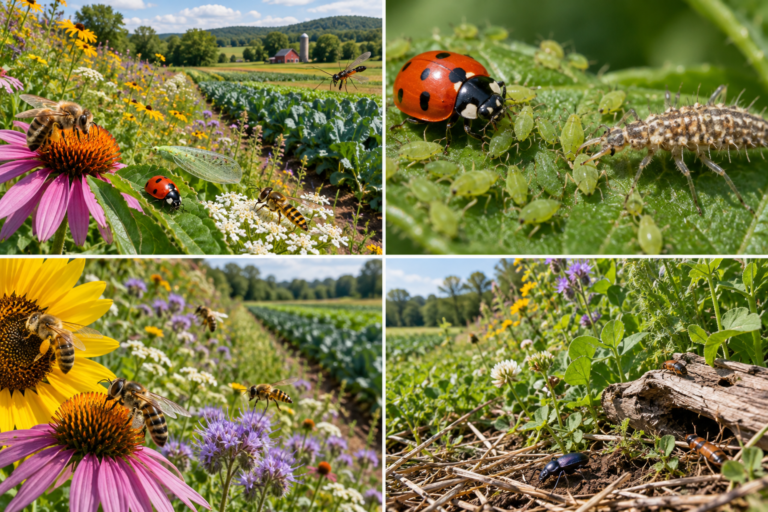
Lady beetles, lacewing larvae, hoverfly larvae, ground beetles, minute pirate bugs, and other predators may consume aphids, mites, insect eggs, caterpillars, and other agricultural pests.
A healthy population of predators will not necessarily eliminate every pest. Nor should that be the goal.
Instead, natural enemies can help keep some pest populations below levels that cause significant crop or economic damage.
This process is an important part of biological pest control.
When farmers provide suitable habitat for predatory insects, these species may become valuable partners in an integrated pest-management strategy.
Parasitoid Insects Can Reduce Pest Populations
Predators are not the only insects that help control pests.
Another important group consists of parasitoids.
Parasitoid insects lay their eggs on or inside another insect. Their developing offspring use the host for food and eventually kill it.
Many parasitoid wasps are extremely small and may go unnoticed even when they are actively working within a farm ecosystem.
Different parasitoid species attack pests such as aphids, caterpillars, flies, and other crop-damaging insects.
Because parasitoids often specialize in particular hosts, a diverse population of natural enemies can contribute to more balanced pest management.
Bees Support Crop Pollination
Not all beneficial insects control pests.
Some provide another essential agricultural service: pollination.
Bees are among the best-known agricultural pollinators. As they move between flowers collecting pollen and nectar, they transfer pollen from one flower to another.
This process supports reproduction in many flowering plants and contributes to the production of numerous fruits, vegetables, seeds, nuts, and other agricultural products.
Honey bees are important pollinators, but they are not the only ones.
Many native bee species, as well as some flies, beetles, butterflies, and other insects, also contribute to pollination.
Supporting a diversity of pollinators can therefore be an important part of building a healthy agricultural ecosystem.
Flowering Plants Provide Food for Beneficial Insects
Beneficial insects need reliable food sources.
For bees, flowering plants provide the pollen and nectar they need. Other beneficial insects may depend on flowers during certain stages of their lives even if they are predators or parasitoids at other stages.
For example, some adult parasitoid wasps and flies feed on nectar while their offspring attack agricultural pests.
Providing different flowering species can help extend the period during which nectar and pollen are available.
Ideally, farmers can select plants that bloom at different times so that flowers are present throughout much of the growing season.
Flowering plants can be incorporated into:
- Field borders
- Hedgerows
- Cover crop mixtures
- Insectary strips
- Windbreaks
- Buffer areas
- Areas around farm buildings
These spaces can provide food while also increasing habitat diversity across the farm.
Regenerative Practices Create Insect Habitat
Beneficial insects need more than food.
They also need shelter, nesting areas, overwintering locations, and protection from unnecessary disturbance.
Several practices commonly associated with regenerative and conservation agriculture can help provide these conditions.
Cover crops create vegetation and flowering resources between cash crops.
Reduced soil disturbance may help protect some insects and other organisms that live or overwinter near the soil surface.
Crop diversity creates a wider variety of potential food sources and habitats.
Hedgerows, native vegetation, field margins, brush piles, and other semi-natural areas may provide additional shelter and overwintering locations.
Instead of keeping every part of a farm bare or intensively managed, leaving carefully selected areas for habitat can support a wider range of organisms.
Pesticide Use Can Affect Beneficial Insects
Pesticides can be valuable agricultural tools when pest populations threaten crops, but their use needs to be carefully managed.
Some broad-spectrum insecticides can affect beneficial insects in addition to their intended targets.
Repeated or poorly timed applications may reduce populations of predators, parasitoids, and pollinators that otherwise contribute useful ecological services.
This is one reason Integrated Pest Management (IPM) is important.
IPM encourages farmers to monitor pest populations, understand economic thresholds, use preventive management practices, and select appropriate interventions when they are genuinely needed.
When pesticide treatments are necessary, farmers can consider factors such as product selection, application timing, placement, and potential effects on non-target organisms.
The goal is not necessarily to eliminate pesticide use completely. Instead, the objective is to manage pests effectively while minimizing unnecessary disruption to the agricultural ecosystem.
Crop Diversity Supports More Insect Species
A farm with many types of plants can provide a greater variety of food and habitat than a farm dominated by a single plant species.
Different crops flower at different times.
They develop different canopy structures and root systems.
They may also attract different insects and other organisms.
Crop rotations, cover crop mixtures, intercropping, agroforestry, flowering borders, and preserved natural areas can all increase diversity within the agricultural landscape.
Greater plant diversity can support insects performing several ecological roles, including:
- Pollinators
- Predators
- Parasitoids
- Decomposers
- Soil-associated organisms
The result can be a more complex agricultural ecosystem in which multiple biological processes operate at the same time.
Beneficial Insects Strengthen Natural Pest Control
A regenerative farm does not need to be completely free of pest insects.
In fact, predators and parasitoids require prey or hosts in order to survive.
The objective of natural pest management is therefore not necessarily complete eradication.
Instead, beneficial insects can help keep pest populations at levels where crop damage remains manageable.
This concept is known as conservation biological control.
Rather than simply introducing beneficial organisms, conservation biological control focuses on creating and protecting the habitats needed by the predators and parasitoids already present in agricultural landscapes.
Flowering strips, hedgerows, cover crops, field margins, and reduced pesticide exposure can all be part of this strategy.
Beneficial Insects and Farm Biodiversity
The importance of beneficial insects extends beyond pest control and pollination.
Insects are part of larger food webs.
They provide food for birds and other wildlife, interact with plants and microorganisms, contribute to decomposition, and participate in nutrient cycling.
This means that protecting insect diversity can have effects throughout the agricultural ecosystem.
A farm containing crops, cover crops, flowering plants, hedgerows, natural vegetation, and other habitat types may support a wider range of organisms than a simplified landscape.
Regenerative agriculture seeks to work with these biological relationships rather than relying exclusively on external inputs.
Beneficial insects are one important part of that approach.
How Farmers Can Encourage Beneficial Insects
Farmers interested in supporting beneficial insect populations can begin by observing what is already living on their land.
Identify existing flowering plants, field margins, natural vegetation, and areas where insects are especially active.
From there, opportunities may include planting flowering field borders, using diverse cover crops, maintaining hedgerows, providing undisturbed habitat, reducing unnecessary pesticide use, and monitoring both pest and beneficial insect populations.
The most appropriate approach will depend on the farm’s crops, climate, pest pressures, existing habitat, and management goals.
Beneficial insects should therefore be viewed as one component of a broader regenerative and integrated pest-management strategy rather than as a complete replacement for every other pest-control method.
Conclusion
Beneficial insects can make important contributions to regenerative agriculture.
Predatory insects and parasitoids help regulate crop pests.
Bees and other pollinators support plant reproduction.
Flowering plants provide food, while cover crops, field margins, hedgerows, and natural vegetation create habitat.
Crop diversity can support a wider range of beneficial species, and careful pesticide management can help protect those populations.
The goal is not simply to introduce more insects onto a farm.
It is to create an agricultural ecosystem in which beneficial organisms have the food, habitat, and protection they need to perform their natural roles.
When farmers work with these biological relationships, beneficial insects can become valuable partners in creating more resilient, diverse, and sustainable agricultural systems.
Interested in Regenerative Agriculture?
Would you like to learn more about working with natural ecological processes rather than against them?
The Ecolonomics Action Team (EAT Community) brings together farmers, environmental professionals, entrepreneurs, and others interested in regenerative agriculture, sustainable business, and practical environmental solutions.
Explore ideas, learn from experienced professionals, and discover approaches that can help create agricultural systems that are both environmentally responsible and economically sustainable.
Visit the EAT Community to learn more:
https://www.eatcommunity.com/
Sources & Further Reading
The Xerces Society — Habitat Planning for Beneficial Insects
A comprehensive resource covering beneficial predators, parasitoids, conservation biological control, habitat development, cover crops, field borders, hedgerows, and pesticide-risk reduction.
https://xerces.org/publications/guidelines/habitat-planning-for-beneficial-insects
The Xerces Society — Conservation Biological Control
Explains how farms can conserve predators and parasitoids and integrate beneficial insects into ecological pest-management systems.
https://xerces.org/pesticides/ecological-pest-management/conservation-biological-control
The Xerces Society — Supporting Pollinators on Farmland
Guidance on providing flowering resources, nesting sites, overwintering habitat, and protection from pesticides for agricultural pollinators.
https://xerces.org/pollinator-conservation/farmland
The Xerces Society — Beneficial Insect Scouting Guide
A practical resource for identifying and monitoring beneficial insects in cropped areas, cover crops, hedgerows, and other farm habitats.
https://xerces.org/publications/scouting-guides/beneficial-insect-scouting-guide
The Xerces Society — Beneficial Insects: Farms and Agricultural Landscapes
A farm-focused habitat assessment resource for evaluating conditions that support beneficial insects.
https://xerces.org/publications/habitat-assessment-guides/beneficial-insects-farms-and-agricultural-landscapes

The post Beneficial Insects in Regenerative Agriculture: Nature’s Partners in a Healthy Farm first appeared on WorldWide Aquaculture.
Apa Reaksi Anda?
 Suka
0
Suka
0
 Kurang Suka
0
Kurang Suka
0
 Setuju
0
Setuju
0
 Tidak Setuju
0
Tidak Setuju
0
 Bagus
0
Bagus
0
 Berguna
0
Berguna
0
 Hebat
0
Hebat
0