





































The role of the G20 group in global meat production and trade. Part 2: global meat exports
A previous article analysed the role of the G191 countries in the global meat industry (Windhorst, 2026). This revealed the significant role of this group of countries, as they accounted for approximately 70% of the production volume of the four most important types of meat. Within the group, the most populous countries dominated, with China, the USA, Brazil, India, and Russia holding the leading positions. Two subsequent articles will explore whether a similar situation existed in the trade of the meat types analyzed here. This article focuses on the role of the G19 in global meat exports.
Exports increased faster than production
A comparison of the long-term development of global meat production and meat exports reveals that trade volume increased faster than the production volume. Between 2010 and 2024, global production increased by 28.4%, while meat trade grew by 36.5%. The development was even more dynamic among the G19 countries. Here, production rose by 34.3%, but trade increased by 61.3%. This had a significant impact on the G19’s share in global production and exports. The G19’s share of production grew from 72.3% to 75.7% during the period under review, and its share in trade increased from 51.4% to 60.7%. Figure 1 shows that meat exports increased particularly sharply after 2010, especially poultry meat. The increase in pig meat production was interrupted from 2020 onwards due to the massive outbreaks of African swine fever in Asia and Eastern Europe.
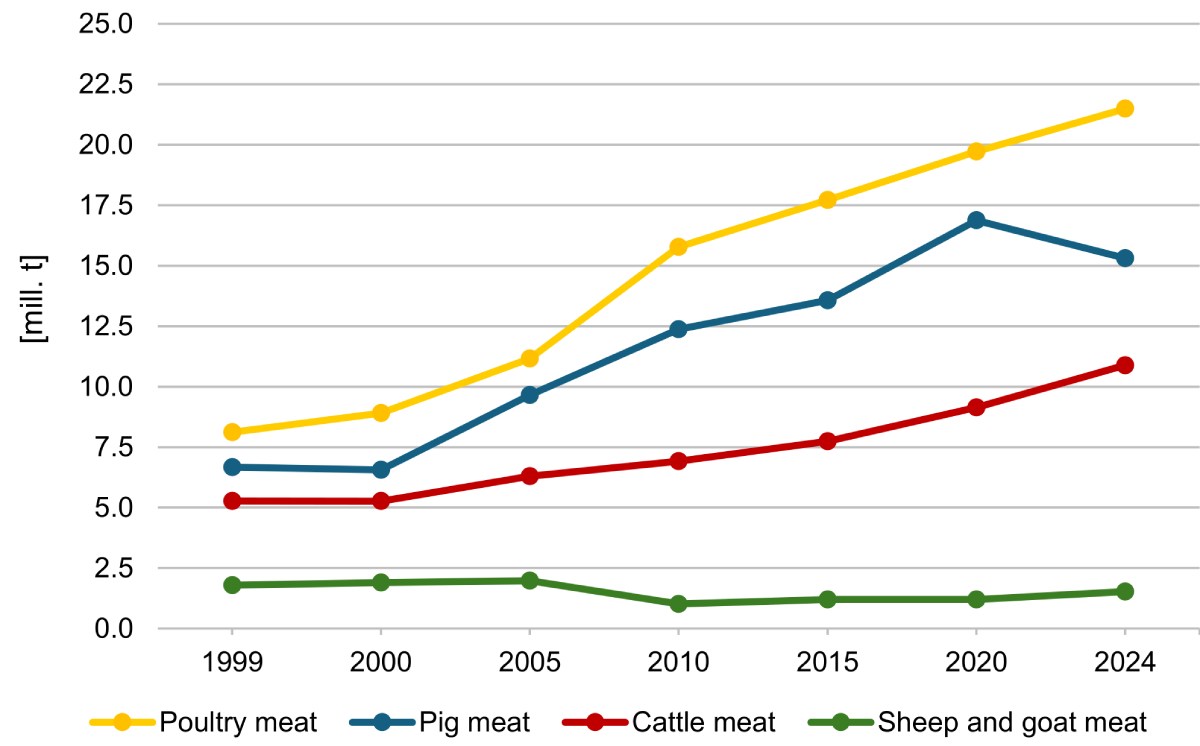
Design: A. S. Kauer based on FAO data.
A comparative analysis of the dynamics, broken down by meat type, from 2010 onwards is interesting (Table 1). Globally, poultry meat showed the highest absolute increase in both production and exports, but the relative increase was higher for beef, sheep, and goat meat exports. However, the significantly lower starting values must be taken into account. This pattern is repeated in the G19 group. Here, too, the production volume of poultry meat increased much faster than that of the other three meat types. The high export volume of pig meat is surprising at first glance. The production slump in China following the massive outbreaks of African swine fever and the resulting imports caused pork trade to rise sharply for several years. This will be discussed in detail in the following article on import development. The shortage of pig meat in the countries affected by African swine fever also impacted beef trade and explains the high absolute and relative increases observed there.
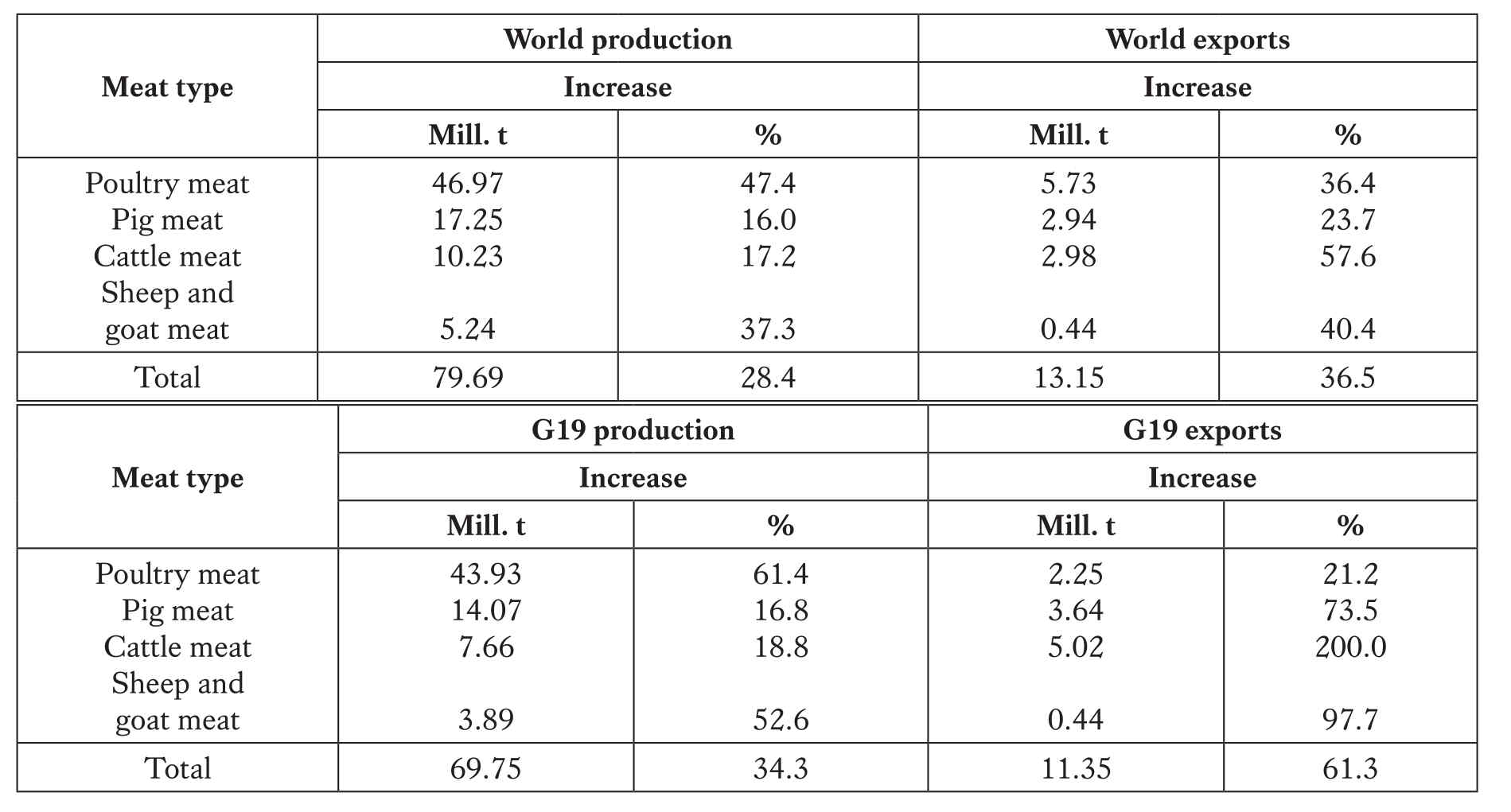
Source: own calculation based on FAO data.
It is noteworthy that despite the high absolute increase in poultry meat production among the G19 countries, which accounted for almost 94% of the global increase, the relative rise in exports was significantly lower than both the absolute and relative global figures. It must be considered that the strong production increase occurred primarily in some Asian countries where demand rose sharply due to higher disposable incomes and production was therefore mainly for domestic consumption. Exports, dominated by Brazil and the USA, which accounted for over 40% of global poultry meat trade in 2024, did not increase as sharply in their respective markets as in some emerging and developing countries outside the G19.
Significant differences between production and exports at country level
A comparison of countries rankings in meat production and meat exports reveals similarities but also significant differences depending on the meat type. For poultry meat (Figure 2), regional concentration in exports was much higher than in production. Brazil and the USA together accounted for over two-thirds of the group’s total exports, but contributed only 31.5% to production. China, which accounted for almost a quarter of global production in 2024, lagged significantly behind the other two countries with a share of less than 10%. Production primarily focused on supplying its own population. The sharp decrease in pig meat production due to African swine fever resulted in consumers increasingly favoring the cheaper broiler meat over beef. Germany, which was not among the top ten G19 producers, ranked fourth.
A detailed look at the development of poultry meat exports from the four leading countries between 2010 and 2024 reveals some notable differences. Overall, exports from the G19 countries increased by 2.25 million tons. Of this, Brazil accounted for 1.22 million tons, or 54.2%, and China for 568,000 tons, or t.2%. In contrast, the US export share declined by 200,000 tons, or 5.4%, despite a significant increase in production. The rising per capita consumption of broiler meat and the recurring outbreaks of the avian influenza virus since 2015, which resulted in high losses (Windhorst, 2025), were the decisive steering factors.
The export volume of pig meat from the G19 countries increased by 3.64 million tons between 2010 and 2024 (Figure 2). The USA saw the highest absolute increase at 1.1 million tons, representing a rise of 62.0%. However, the highest relative increase was in Brazil at 143.7%, resulting from an expansion of exports by 900,000 tons. Canada also recorded a significant growth in exports of 297,000 tons, or 28.9%. These three countries together shared 63.6% in the G19’s total export growth. In Germany, which still ranked third among the leading exporting countries in 2024, exports have declined by 528,000 tons, or 25.0%, since 2020. The reasons for this decline were, firstly, a decrease in the per capita consumption, with pork losing significantly to broiler meat, and secondly, outbreaks of African swine fever in wild boar populations. These outbreaks led some major importing countries to either drastically reduce or even completely stop their imports. Furthermore, declining profits caused numerous pig farmers to abandon pig fattening. The unresolved situation regarding eligible housing systems for financial support by the government also deterred many pig farmers from investing. In France, pork exports fell by 88,000 tons during the period under review, resulting in a drop to seventh place among the leading G19 exporting countries. Export growth was particularly dynamic in the four leading cattle meat exporting countries, as can be seen from the graphs in Figure 2. Exports from the G19 countries increased by 5.02 million tons between 2010 and 2024, thus tripling. Brazil recorded the largest absolute increase at 2.15 million tons, representing a relative increase of 144.5%. Argentina followed with 717,000 tons. With an increase of 217.6%, Argentina had the highest relative growth rate of the four countries. Australia expanded its beef exports by 635,000 tons, or 45.8%, while the USA only showed an increase of 274,000 tons. The USA also recorded the lowest relative growth rate at 22.5%.
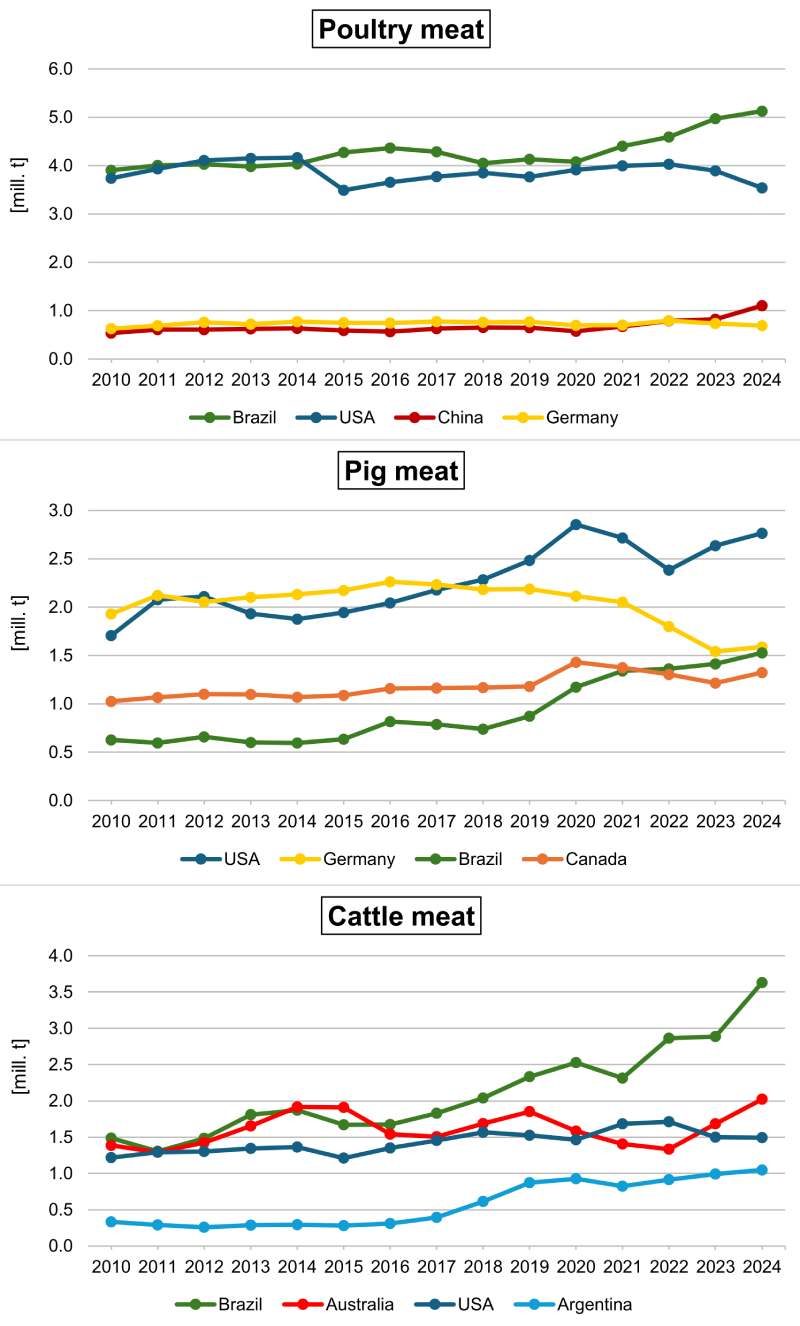
Design: A. S. Kauer based on FAO data.
A comparison of the four countries’ shares in the overall increase in cattle meat exports for the G19 shows that Brazil contributed the largest share at 42.7%, followed by Australia at 18.6% and Argentina at 14.3%. The USA, at 4.9%, lagged significantly behind the other three countries. In total, the four countries accounted for 74.5%. Looking at the overall dynamics across the three meat types, it becomes obvious that Brazil, Australia, and Argentina were the big winners in meat exports for the G19. The USA lost market shares in poultry, pig meat, and cattle meat, while Germany lost ground primarily in pig meat. China began to expand its position in poultry meat exports. Brazil is positioned to become the dominant power in the meat trade, not only within the G19 but also globally (see Windhorst, 2025a).
Summary: higher concentration in exports than in production
The preceding analysis of the G19’s role in global meat trade focused on the question of whether the countries dominating production also played a leading role in exports.
Figure 3 shows the share of the top 10 exporting countries in the total exports of each of the four meat types considered here. It is apparent that there was a strong concentration in a few countries for all meat types, but significant differences existed nonetheless. This concentration was very high for sheep and goat meat as well as poultry meat, and lower for pig meat and cattle meat. To answer the initial question, Table 2 compares the top five countries in production with those in exports.
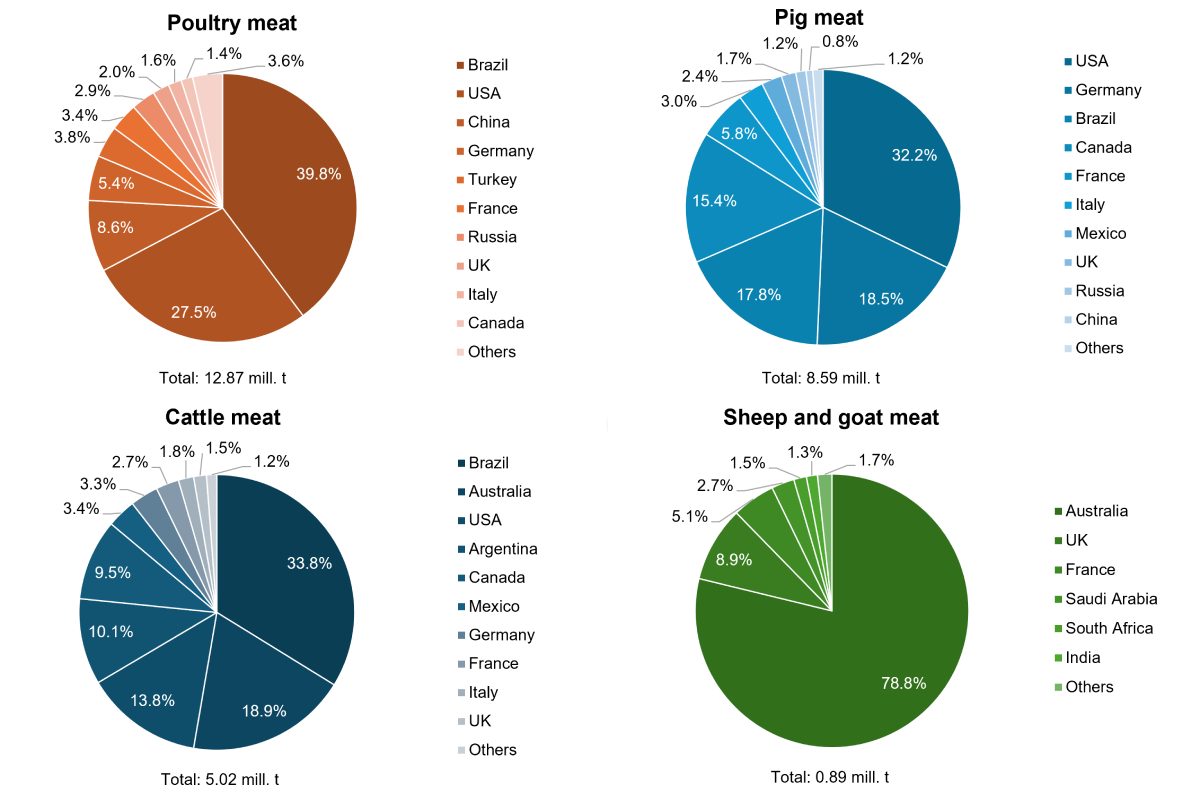
Design: A. S. Kauer based on FAO data.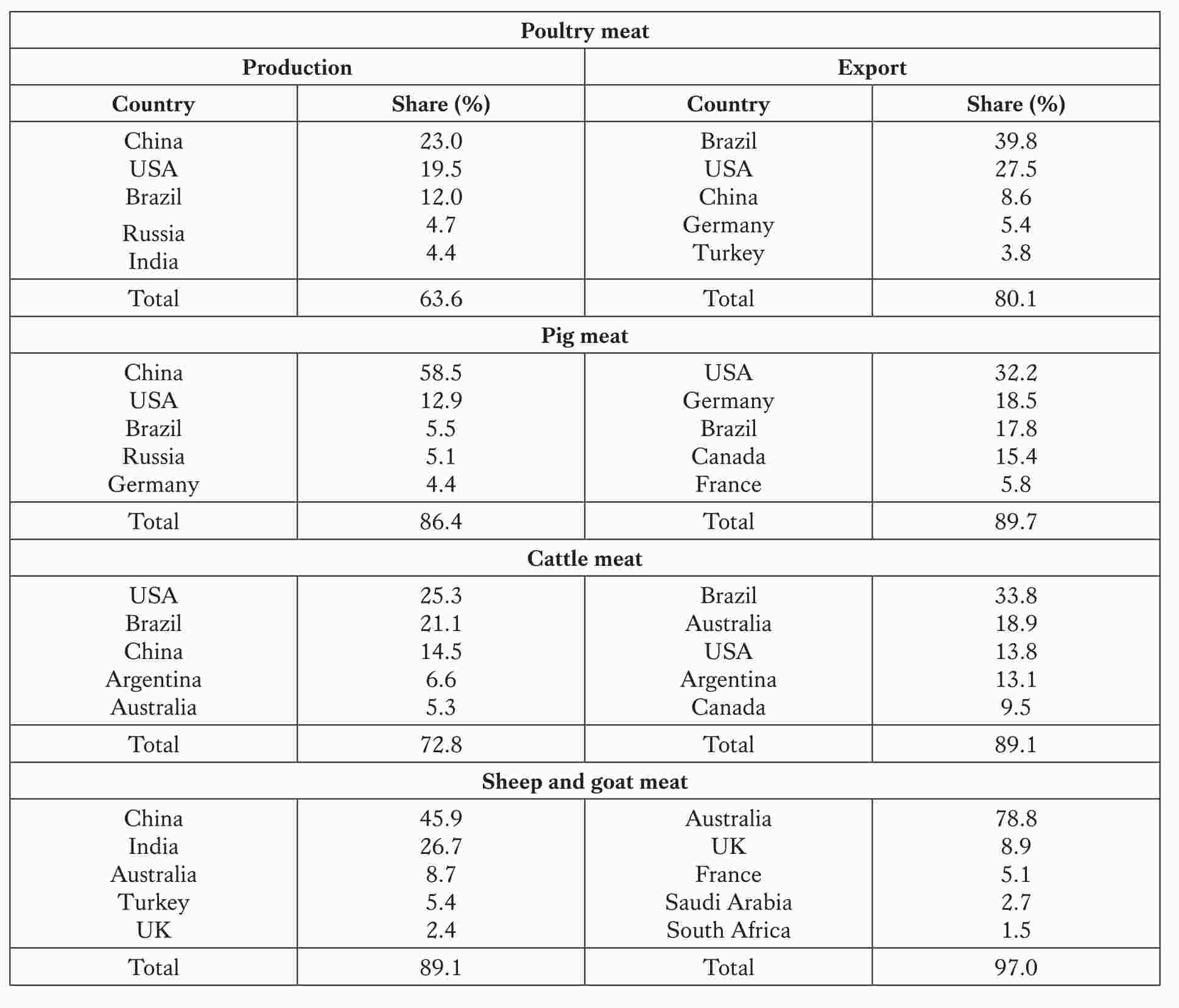
Source: own calculation based on FAO data.
Even a cursory glance at the data reveals that for all four meat types, the five countries’ share in exports was significantly higher than their share in production. With the exception of poultry meat, shares of nearly 90% or even more were achieved. However, a more detailed analysis of the composition and ranking of the countries reveals remarkable differences. For poultry meat, Brazil accounted for only 12.9% of production but 39.8% of exports. The opposite was true for China. It is evident that Brazil was heavily focused on the global market, while China primarily on its domestic demand. This was also the case for Russia and India.
In pork production, China held a dominant position but played no role in exports; Russia also produced almost exclusively for its own population. The USA, Canada, and Germany were more strongly oriented towards the global market, although, as already mentioned, Germany has lost considerable market share in recent years. It is worth noting that Brazil accounted for over a third of cattle meat exports but only for 21.1% of production. Here, too, the focus on the global market was evident, as it was in Argentina and Australia. The ratio between production and exports in the USA requires explanation. The analysis of imports, which follows in the third section, will show that despite its high production volume, the USA imported a considerable amount of high-quality beef but exported lower-value cuts.
China and India, which together produced nearly three-quarters of the G19’s sheep and goat meat, played no significant role in exports because both meat types were almost exclusively used by their own populations. Overall, it should be noted that while populous countries also played an important role in meat exports, they were not as dominant, and countries with smaller populations, such as Canada, Australia, Saudi Arabia, and South Africa, were also able to break into the top group. The importance of the top five countries in each meat type, not only within the G19 group but also in global meat trade as a whole, is evident in the fact that they accounted for over 50% of the meat reaching the world market.
Data source and supplementary literature
Food and Agriculture Organization of the United Nations. (n.d.). FAOSTAT. https://www.fao.org/faostat
Windhorst, H.-W. (2025a). Der Seuchenzug im Winter 2024/2025. Vierte AI-Epidemie in den USA innerhalb des zurückliegenden Jahrzehnts. Fleischwirtschaft, 105(9), 33-36.
Windhorst, H.-W. (2025b). Fourth AI epidemic in the USA in the past decade – The epidemic in winter 2024/25. Zootecnica Poultry magazine, 1(7/8), 22-27.
Windhorst, H.-W. (2025c). The dynamics of global meat trade. Part 1: Exports. Meatingpoint, (63), 34-37.
Windhorst, H.-W. (2026). Die Rolle der Gruppe der G20 in der Weltfleischerzeugung und im Weltfleischhandel. Teil 1: Weltfleischerzeugung. Fleischwirtschaft, 106.
Windhorst, H.-W. (2026). The role of the G20 group in global meat production and trade – Part 1: meat production. Zootecnica Poultry magazine, 2 (4), 28-33.
1The following analysis considers only the 19 member countries. The population and economic output of the EU (27) and the African Union are not included.
See also
The role of the G20 in global meat production and trade. Part 1: meat production
Apa Reaksi Anda?
 Suka
0
Suka
0
 Kurang Suka
0
Kurang Suka
0
 Setuju
0
Setuju
0
 Tidak Setuju
0
Tidak Setuju
0
 Bagus
0
Bagus
0
 Berguna
0
Berguna
0
 Hebat
0
Hebat
0