























Vaccine options to optimize chicks’ early immune response
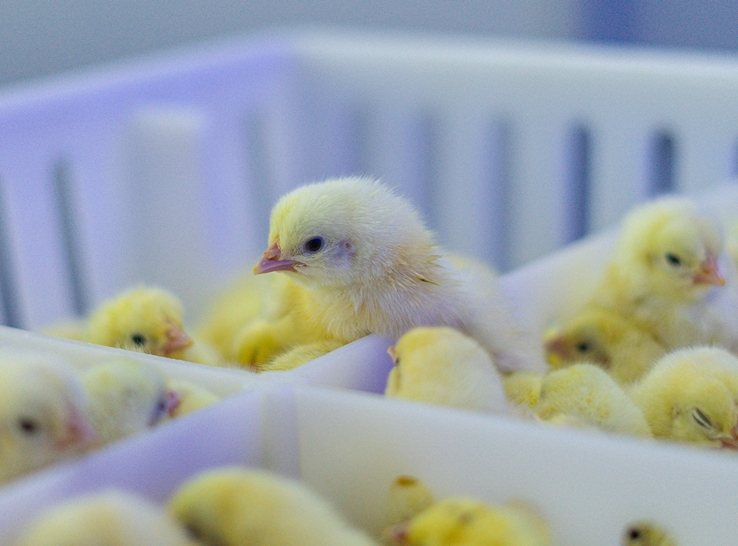
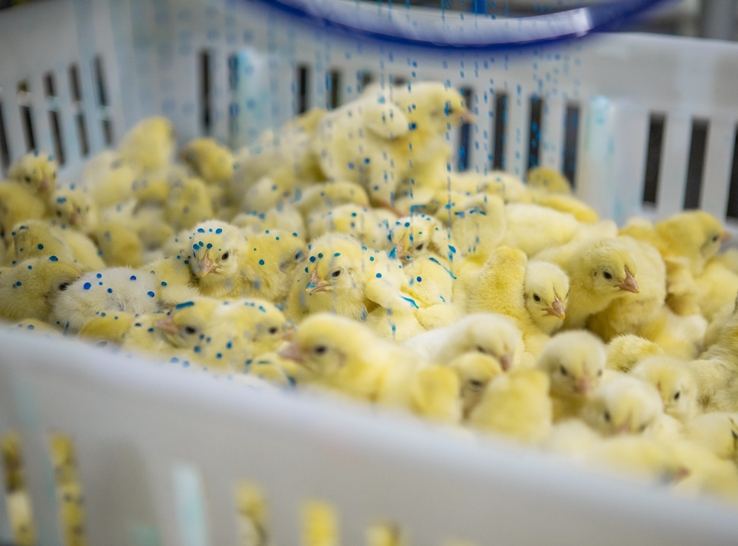
The newly hatched chick’s immune system is immature, but it develops with time. However, the developmental characteristics are incomplete and skew toward innate response versus active response, which challenges the commonly practiced day-of-age vaccination protocol.
“We don’t really know what goes on at day of age regarding immune responses,” said Rodrigo Gallardo, DVM, PhD, DACPV, professor in poultry medicine at the University of California–Davis School of Veterinary Medicine.
“Several experiments suggest that we should vaccinate chicks later, but the industry won’t abandon day-of-age vaccination because it’s simply too convenient,” he added.
The main immune deficiencies in young chicks are found within heterophils and natural killer cells, reducing the phagocytic and oxidative capabilities. Additionally, the number of T, B and MHC class II-positive cells is reduced, gradually increasing until 8 to 9 weeks of age.
“Immature, ’non-conventional’ T cells though, are abundant after vaccination; these cells might be the key to protective immune responses,” Gallardo said.
He presented the findings of his study evaluating the immune responses of early chick vaccination with two respiratory virus strains at the 2026 International Poultry Scientific Forum.
Focus on immune response
The first objective was to determine the cellular and humoral responses after day-of-age vaccination with an infectious bronchitis virus (IBV) Massachusetts-strain vaccine and a Newcastle disease virus (NDV) enteric strain.
The second objective was to assess immune responses to the challenge of a heterologous IBV strain.
Gallardo used specific-pathogen-free chickens, with the chicks divided in four groups: unvaccinated controls, NDV vaccinated, IBV mass vaccinated and a group vaccinated with both vaccines.
Five days post-vaccination, Gallardo necropsied a group of birds and collected Harderian glands and tracheas for flow cytometry (to characterize immune cells). He also collected blood to determine specific antibodies and recorded respiratory signs.
Twelve days post-vaccination, researchers collected tears and blood from birds to evaluate Immunoglobulin A (IgA), an antibody associated with the immune system, and antiviral responses. On day 15, Gallardo’s team challenged the birds with a heterologous IBV-DMV1639 strain to evaluate a potential boost in cross protection. At this time, researchers divided each of the four groups in two (challenged and unchallenged) for a total of eight groups.
Five days after the challenge, the team again collected Harderian glands and tracheas to evaluate cellular immunity. They also collected blood and information about respiratory signs.
The study concluded on day 35, with a final blood sample.
Key findings
- Five days post-vaccination, “the birds’ mucosal respiratory system was conditioned, vaccines multiplied activating macrophages, while we saw mild respiratory signs. The results also showed a normal increase in IgA in tears and IgY in serum for each of the viruses, indicating a good mucosal and systemic priming,” Gallardo said.
- In tracheas and Harderian glands, undifferentiated T cell and B cells expanded, while conventional T cells remained stable. “Although poorly defined in chickens, these undifferentiated T cells seem to be important, covering functions that regular T cells would perform,” he noted.
- The study found an increase in IgY responses after IBV vaccination. “When we vaccinate day-of-age chicks with IBV, there’s a poor antibody response. Surprisingly, in the dual-vaccinated chickens, we saw a statistically significant increase in these antibodies. So, there’s something interesting occurring when you combine these two vaccines.”
- “After challenge, we noticed IBV vaccine protection ameliorating respiratory signs and viral shedding” Gallardo said. “Interestingly, vaccinated non-challenged birds still had IBV virus almost 20 days after vaccination; this virus might be stimulating the immune system, inducing memory.”
- “The persistence of the virus and maybe the presence of another virus (in the case of double-vaccinated birds) increased the retention of macrophages and T cells, improving immune responses after a heterologous challenge,” he said.
Maximizing the early immune response
Gallardo offered these take-home points from the study to further understand and optimize the early immune response in chicks.
Dual-vaccinated chickens demonstrated the largest macrophage and T-cell accumulation, suggesting strong local responses when challenge occurs.
Viral shedding persisted in vaccinated birds without challenge, potentially increasing the recruitment and retention of macrophages and T cells to the infected site. This improves the responses after challenge even though a vaccine overload might cause rolling reactions, underscoring the importance of proper vaccination in the hatchery, Gallardo concluded.
The post Vaccine options to optimize chicks’ early immune response appeared first on Modern Poultry.
Apa Reaksi Anda?
 Suka
0
Suka
0
 Kurang Suka
0
Kurang Suka
0
 Setuju
0
Setuju
0
 Tidak Setuju
0
Tidak Setuju
0
 Bagus
0
Bagus
0
 Berguna
0
Berguna
0
 Hebat
0
Hebat
0