






















































Meet the Expert: Bridging Research, Technology, and Real-World Care



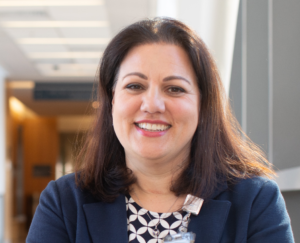
Jennifer Sherr, MD, PhD, is a pediatric endocrinologist at Yale Medicine and a Professor of Pediatrics in the Division of Endocrinology at Yale School of Medicine in New Haven, Connecticut.
Dr. Sherr also serves as the Medical Director of the pediatric diabetes program at Yale Medicine and as a Medical Advisor for T1D Exchange.
Interview with Jennifer Sherr, MD, PhD
In this interview, Dr. Sherr shares her approach to care delivery and how her clinical interactions inspire research projects and her deep commitment to quality improvement. The T1D Exchange Quality Improvement Collaborative (T1DX-QI) was established in 2016 with the support of The Leona M. and Harry B. Helmsley Charitable Trust to refine best practices and improve daily life for people with type 1 diabetes (T1D). Growth has been tremendous, with over 60 endocrine clinics from across the U.S. participating in the Collaborative.
Fueled by top leaders in diabetes care, the T1DX-QI has become an engine of innovation and inspiration. By engaging with the T1DX-QI’s shared, data-driven, and systematic QI methods, clinics are achieving measurable success in diabetes management.
With members working closely together to identify gaps in care, discover and refine best practices, and share research learnings, the process has become knowledge-sharing at its very best. While collated data gives clinics a clear sense of where they are, it also demonstrates where they can be by applying evidence-based methods to improve care.
What led you to medicine?
“When I was a child, my grandmother developed lung cancer, and I watched my mom — who was a nurse — tend to her,” said Sherr. “I remember saying, ‘I want to do what you do.’ But my grandmother said, ‘No, Jennifer, you’re going to be a doctor.’”
Less than a year later, in 1987, Sherr was diagnosed with type 1 diabetes.
“Thanks to my parents’ modeling, I learned type 1 diabetes is very manageable,” she said, “And I just knew I would become a pediatric endocrinologist from that point on.”
“I went back to school for 4th grade, and kids would ask, ‘Do you want to play?’ And I’d say, ‘I’m working on a scholarship to become a pediatric endocrinologist,’” Sherr said with a laugh. “I was always on a mission.”
She went on to complete a BA/MD program through Rutgers University and the University of Medicine and Dentistry of New Jersey-Robert Wood Johsncon Medical School, where she started medical school while completing her junior year of college. She first came to Yale as a pediatric resident and remained for her pediatric endocrinology fellowship.
During her training, she met Bill Tamborlane, MD, “a giant in the field of pediatric diabetes,” who encouraged her to think bigger. “He told me I should do research — and probably get a PhD,” she said. ‘Why take care of a few people if we can change the world?’” he asked.
“So,” she added, “I got a PhD, too.”
How has living with T1D yourself influenced your role in clinical research and as an endocrinologist?
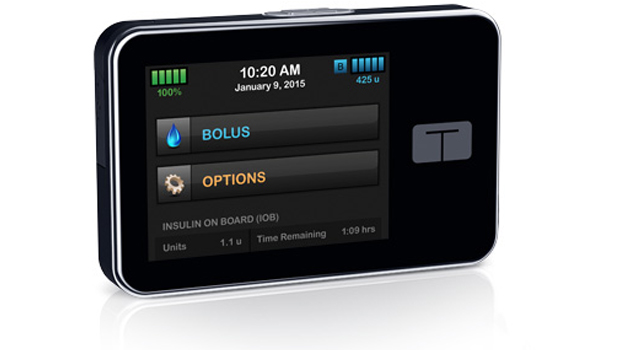
“I’ve always been deeply interested in how we can harness technology for diabetes management,” said Sherr. “In 1996, I was the first person my pediatric endocrinologist put on an insulin pump.”
“I made him wait until the day after my senior prom, because I didn’t know where I’d put that thing in my dress,” she said with a smile. “But as soon as I put it on, it was life-changing.”
Sherr’s early experience with technology naturally extended into her career as a physician-scientist. At Yale, she played a key role in CGM and automated insulin delivery system (AID) trials — sometimes staying overnight to monitor participants.
Looking back, the pace of development has been astounding to her. “We went from bedside trials to commercially available devices within about 10 years — it just went so quickly,” said Sherr, whose first-hand experience bridges back to simplistic tools of the 80’s.
“There’s an Einstein quote that says something like insanity is doing the same thing over and over again expecting a different result,” she said. “But in diabetes, it’s almost the opposite. You can do the same thing — eat the same foods, take the same amounts of insulin, have the same activity — and still get completely different results.”
“What we’ve learned is that without automated insulin delivery, that consistency just wasn’t possible. Automated insulin delivery has allowed us to hand over variability in glucose levels to the insulin received. So in that sense, these advances are just phenomenal.”
Her lived experience also shapes her clinical approach. “Parents will say, ‘I’m worried about my child’s future and what their lifespan will look like,” she said. “While I can’t promise a cure, I can promise that life will continue to get better — we’ve already seen that happen.”
At the same time, she remains focused on what’s next. “Look, we’re not done here,” Sherr said. Technology has helped to offset some of the burden, but gaps still exist.
“There are so many amazing individuals who are pushing the limits and getting things done — and I’m grateful to be part of that community.”
What do you love most about what you do?
“There have been so many opportunities over the course of my career to make a meaningful impact,” said Sherr. “Let’s just say — It’s never boring.”
For Sherr, that impact spans research to real-world outcomes.
“I’ve been a part of the work that led to approval of nasal glucagon,” she said. “And now, with continuous ketone monitoring, someday I’ll be able to say I helped move that forward, too.”
At the same time, her work remains grounded in the needs of those she cares for. “My patients show me what matters most to them,” she explained. “That allows me to focus my time on work that’s relevant.”
“I feel passionate and driven every single day, because I’m so excited about how this work will impact people in the end.”
How do you integrate your MD and PhD as a physician-scientist?
“It’s like sitting in the center of a Venn diagram,” she said. “Clinical care informs research, and research comes back to impact patients. By sitting right in the middle, you can influence both ends of the spectrum because one has to inform the other.”
Sherr explained that asking clinically important, real-world questions is central to her work. ”When I’m seeing kids in clinic, I often think, ‘This is something we should explore — or, I wish a company was looking into this.’”
That mindset anchors her work. “If clinical research isn’t going to make a difference for the people we care about, there’s no reason to do it,” she said.
“They tried to get me to do lab-based research with mice models in the beginning, but I said, ‘No — I’d get too attached. I’d name them and set them free,’” joked Sherr. “I knew I was better off in patient-centered research.”
Let’s talk about the T1DX-QI
Prior to the T1DX-QI, the Type 1 Diabetes Exchange Clinic Registry and Network was founded in 2010 and led by the JAEB Center for Health Research. Dr. Sherr was selected to serve as the first junior pediatric faculty member to that organizations Steering Committee in 2016.
“That was a pivotal experience,” she said. “I had the opportunity to learn from experts in the field, contribute ideas, and help shape the direction of the work.”
In 2026, she was appointed as a Medical Advisor for the T1DX-QI.
For Sherr, quality improvement work is rooted in real-world impact. “Sharing what’s happening in clinical practice, benchmarking across centers, and understanding outcomes is how we figure out what’s working, what’s not, and where we go next,” she explained.
“What led me to this role is wanting to make sure all of the amazing treatments and advances are actually reaching the people who need them,” she explained.
“I’m very excited to be working as a Medical Advisor to the T1DX-QI team,” she said. “It’s a privilege to help shape what comes next for a group that’s already doing such impactful work.”
While Yale isn’t formally part of the T1DX-QI, she hopes that may soon change.
“As an institution, we’ve been diligently working toward getting involved,” she said. “It’s become evident that if you’re not a part of the Collaborative, you’re missing out. Benchmarking with peers and asking questions together helps define the best path forward.”
What research do you have underway?
Sherr’s current consortium work includes TrialNet, where she serves as a lead investigator at Yale. In that group, her work focuses on preventing progression to Stage 3 T1D and preserving beta cell function in those newly diagnosed.
She also works with the NIH-funded Epidemiology of Diabetes Interventions and Complications (EDIC), a long-term follow-up of the landmark Diabetes and Complications Trial (DCCT).
Now, decades later, the same cohort is being followed into older adulthood, and it’s fascinating. “We’re learning about aging with diabetes in ways we never could before,” she said. “We’re studying cognitive functioning, cardiovascular health, and other conditions not traditionally assessed with type 1.”
Beyond these efforts, Sherr co-leads a Yale site in the GO MOMs Study, which is exploring the use of continuous glucose monitoring as an alternative to oral glucose tolerance testing for diagnosing gestational diabetes.
Outside of these projects, Sherr is assisting with Wave T1D, which is focused on evaluating immune therapies to preserve insulin production in those newly diagnosed.
In terms of new technologies, Sherr is working on continuous ketone monitoring. “I’ve been a huge proponent, and I think ketone monitoring is underutilized and a missed opportunity to prevent DKA,” said Sherr, who continues to do studies with industry partners looking at their next-generation systems.
Another bucket of work for Sherr is in new treatments. “We have a study that’s going to start exploring inhaled insulin in youth with new onset diabetes — in place of using rapid-acting analogs.”
Across all of these efforts, the goal is consistent: “We want to have a smoother course, utilizing technology and therapies that better match physiology.”
What’s next? What’s your hope for the future?
“I’m most excited about getting the therapies we already have into the hands of everyone who needs them,” said Sherr. “The guidelines are clear — everyone deserves access.”
Sherr points to the T1DX-QI as part of the solution. The Collaborative can demonstrate what’s possible and help to push adoption forward.
“I’m also very excited about immunotherapies, disease-modifying therapies, and stem cell therapies,” she said. “It sometimes feels like science fiction — I really can’t believe we’re talking about people getting islet cells and coming off insulin therapy.”
“I’m in awe of the work that’s being done.”
What do you enjoy outside of work?
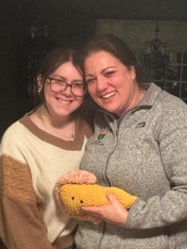
Outside of work, she enjoys spending time with her family. While two kids have left the nest, her youngest, who is 12, keeps her busy in the carpool to activities. She also enjoys cooking, gardening, and traveling.
The post Meet the Expert: Bridging Research, Technology, and Real-World Care appeared first on T1D Exchange.
What's Your Reaction?
 Like
0
Like
0
 Dislike
0
Dislike
0
 Agree
0
Agree
0
 Disagree
0
Disagree
0
 Excellent
0
Excellent
0
 Useful
0
Useful
0
 Great
0
Great
0