
































How Termites Support Nutrient Cycling in Forest Soils
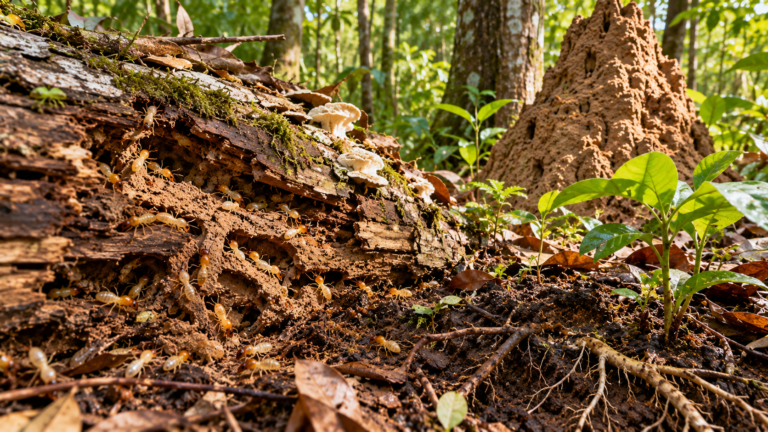
Termites are often associated with structural damage to buildings, but in natural forests they perform a very different role. Many species feed on dead wood, roots, leaves, and other cellulose-rich material, helping break down plant matter that would otherwise remain on the forest floor much longer. Their feeding, tunneling, and nest-building activities move organic material through the soil and influence how carbon and nutrients are redistributed through forest ecosystems.
Scientists often describe termites as ecosystem engineers because they physically change the environment around them. A global analysis published in Nature in 2025 examined 12,975 observations from 1,047 studies across six continents and found that termites, ants, and earthworms generally increased soil macronutrients, microbial biomass, plant biomass, and soil respiration compared with nearby reference soils. Termites are therefore part of a much larger group of soil organisms that actively shape how ecosystems function.
Termites Accelerate Deadwood Decomposition
Dead wood stores a significant amount of carbon and nutrients, and its decomposition is an important part of forest nutrient cycling. Termites are particularly effective because their digestive systems and symbiotic microorganisms allow them to process cellulose-rich plant material that many animals cannot use. As dead wood is consumed, some of its nutrients are incorporated into termite bodies, while other material returns to the environment through waste, construction material, and decomposed residues.
A U.S. Forest Service-supported experiment in a subtropical forest found that termites were responsible for an estimated 55.7% of wood loss when wood blocks contacted soil and 48.9% when they did not during a two-year study. The researchers concluded that termites could have a greater effect on wood decomposition than microbes under the conditions they studied. This shows how strongly termite activity can influence the rate at which dead trees return material to the forest system.
Termites also influence where carbon from deadwood ends up. Another Forest Service study found that subterranean termites released about 42% of consumed wood carbon as gas, returned 40% as organic deposits, and retained 18% in their tissues. Those organic deposits include frass and construction material that become part of the surrounding soil environment.
Tunnels and Mounds Change Soil Conditions
Termites do not simply consume material at the surface. Their colonies excavate extensive networks of underground galleries, moving soil particles and organic matter between different depths. These tunnels can alter porosity, aggregation, water movement, and aeration, although the exact effect depends on termite species, soil type, climate, and colony activity.
A 2023 review of soil-termite interactions reported that termite activity can enhance soil aggregation and influence hydraulic properties. By reorganizing soil particles and creating biogenic structures, termites modify the physical environment through which water, air, microorganisms, and roots move.
Termite mounds can also become chemically different from surrounding soils. A 2025 study in Forest Ecology and Management found that termite mounds acted as nutrient hotspots and increased soil macronutrient heterogeneity in natural forest. Mounds are built from soil, saliva, plant material, and other resources collected by colonies, so nutrients may become concentrated in these structures rather than being evenly distributed across the forest floor.
Termite Activity Supports Broader Ecosystem Diversity
The influence of termite mounds extends beyond soil chemistry. Vegetation growing on and around mounds can differ from the surrounding landscape because of changes in nutrients, moisture, soil texture, and disturbance. These patches may then provide feeding, nesting, and shelter opportunities for other organisms.
Recent research in Mozambique found that termite mounds supported higher bird species richness and abundance than surrounding vegetation across savanna, saline grassland, and agricultural landscapes. The researchers found that mound vegetation had denser woody growth and different plant characteristics, illustrating how termite engineering can influence animal communities indirectly through vegetation.
Earlier work from African savannas reached a similar conclusion. One study reported that birds used termite mounds almost exclusively in the landscape examined, with only 3.5% of bird observations occurring in the treeless areas between mounds. Although these examples come from savannas rather than closed forest, they demonstrate how termite-created structures can influence habitat far beyond the termite colony itself.
Climate and Moisture Influence Termite Activity
Termite effects are not constant throughout every ecosystem or season. Temperature, rainfall, soil moisture, wood availability, and flooding all influence where termites can forage and how quickly they decompose plant material. Forest type also matters because some termite species tolerate dry conditions, while others are restricted by saturated soils or extended flooding.
A five-year U.S. Forest Service study of forested wetlands found that termite wood decomposition changed with seasonally varying water tables and the amount of time soils remained flooded. The researchers compared wetlands where water reached the soil surface for different lengths of time with a nearby drier upland forest, demonstrating that moisture conditions can strongly shape termite access to deadwood.
Newer research also suggests that termite-influenced soil can remain biologically active under difficult climatic conditions. A 2026 study in Brazil’s semi-arid Caatinga found that soil connected to termite galleries had carbon-dioxide efflux as much as 4.7 times higher than nearby reference soils, and the effect persisted across different rainfall conditions. This does not mean climate change will benefit termites everywhere; rather, it shows that termite responses depend heavily on species, ecosystem, and moisture regime.
Termites are easy to overlook because much of their activity happens inside deadwood, beneath the soil surface, or within nests. Yet their work helps break down plant material, move carbon and nutrients, alter soil structure, and create patches of habitat used by other organisms. Maintaining deadwood, natural soil processes, and diverse forest structure allows these ecological relationships to continue contributing to healthy forest soils.
Join the EAT Community at https://www.eatcommunity.com/ to learn from environmental professionals and explore practical strategies for forest ecology, conservation, and sustainable land management.

The post How Termites Support Nutrient Cycling in Forest Soils first appeared on WorldWide Aquaculture.
Apa Reaksi Anda?
 Suka
0
 Kurang Suka
0
 Setuju
0
 Tidak Setuju
0
 Bagus
0
 Berguna
0
 Hebat
0